
Key Takeaways on Forex Analysis Techniques
- There are three primary types of forex analysis used to anticipate price movements and evaluate market trends.
- Traders typically rely on one method or a combination of approaches, depending on their trading style and personality.
- Practicing these methods in a forex demo account is an effective way to validate strategies before committing real capital.
There are multiple approaches to analyzing the forex market, but effective traders prioritize clarity over complexity. Keeping analysis structured and focused allows for better identification of high-probability trading opportunities.
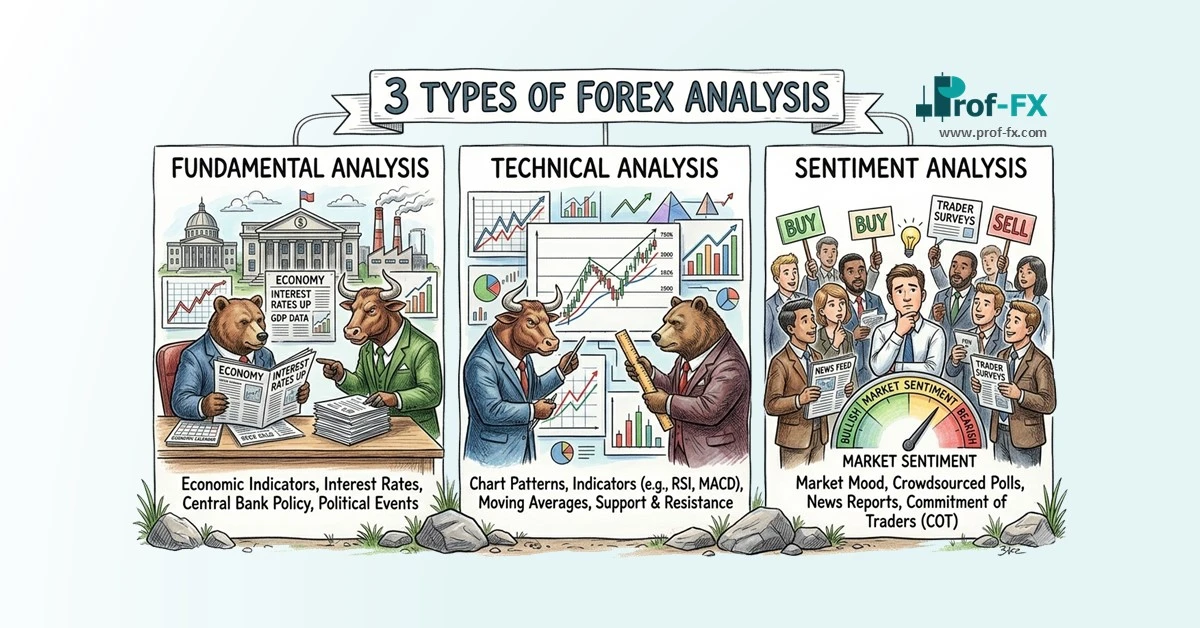
This article examines the three core analytical frameworks, fundamental analysis, technical analysis, and sentiment analysis, and explains how each contributes to building a robust trading strategy. Ultimately, selecting the right approach depends on aligning the method with your individual trading style.
The 3 Most Common Types of Forex Market Analysis
1) Fundamental Analysis
Fundamental analysis in forex primarily revolves around interest rates, as they are one of the most influential drivers of currency valuation. Changes in interest rates directly impact capital flows, making them central to currency strength or weakness.
In addition to interest rates, traders also monitor key macroeconomic indicators such as:
- Gross Domestic Product (GDP)
- Inflation rates
- Manufacturing data
- Overall economic growth
However, the critical factor is not whether economic data is positive or negative in isolation, but how that data influences future interest rate expectations.
When market participants adopt a risk-on (risk-seeking) approach, capital tends to flow toward currencies offering higher yields. Conversely, during risk-off (risk-averse) conditions, investors shift capital into safe-haven currencies, reducing exposure to higher-risk assets.
From a professional perspective, understanding how macroeconomic data shapes monetary policy expectations is essential. Traders who fail to interpret this relationship correctly risk misjudging long-term currency trends.
2) Technical Analysis
Technical analysis focuses on evaluating historical price action to identify patterns and determine optimal entry and exit points. It is one of the most widely adopted methods in forex trading due to the market’s high liquidity and responsiveness to price behavior.
Price charts reveal underlying dynamics of supply and demand, allowing traders to identify:
- Trends (bullish or bearish)
- Support and resistance levels
- Breakouts and retracements
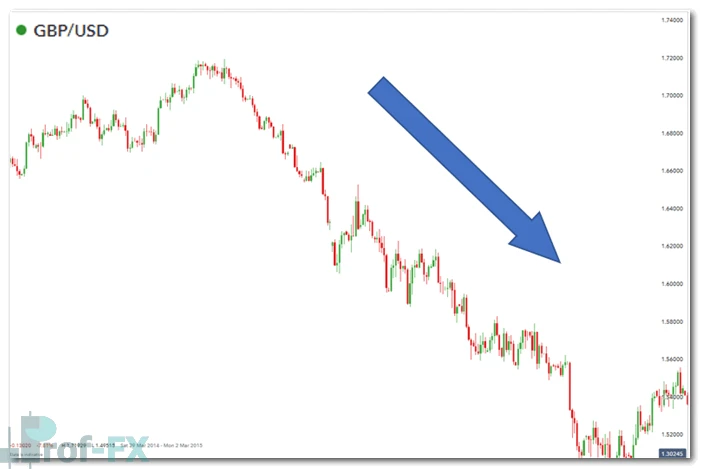
For example, analyzing a GBP/USD chart may reveal sustained USD strength against the British Pound, indicating a prevailing trend that traders can align with.
In addition to raw price action, traders often incorporate technical indicators such as:
These tools provide structured signals that simplify decision-making and improve timing accuracy.
The debate between technical vs. fundamental analysis remains ongoing, but there is no definitive “best” approach. In practice, many professional traders integrate both methods to achieve a more comprehensive market view.
3) Sentiment Analysis
Sentiment analysis evaluates the positioning of market participants, offering insight into how traders collectively view a currency pair.
When sentiment becomes heavily skewed in one direction, it indicates that a large proportion of traders are already committed to that position.
For example, if the majority of traders are bullish on EUR/USD, this implies that many have already entered buy positions. These traders will eventually need to close those positions, effectively becoming future sellers.
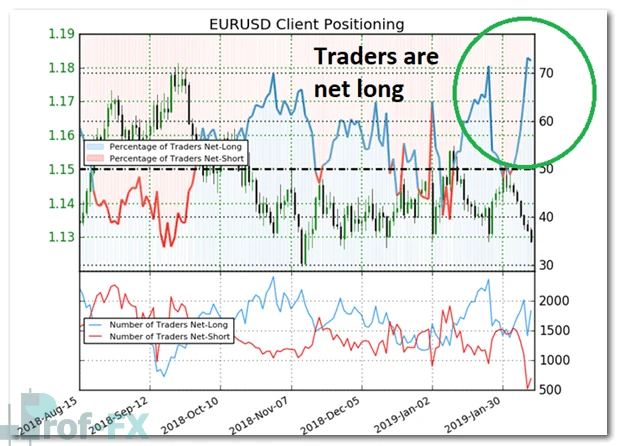
This dynamic introduces a critical concept: sentiment often acts as a contrarian indicator. When the market becomes overcrowded on one side, the probability of a reversal or pullback increases.
Advanced traders extend sentiment analysis beyond retail positioning by incorporating institutional data, such as the Commitment of Traders (CoT) report, to assess how large market participants are positioned.
From an institutional standpoint, combining retail and institutional sentiment provides a more complete understanding of market dynamics and potential turning points.
How to Apply Forex Analysis Techniques in Trading
Professional traders rarely rely on a single method. Instead, they integrate all three types of analysis to create a structured and high-probability trading process.
This can be achieved through the following framework:
- Use fundamental analysis to identify long-term trends
- Apply technical analysis to refine entry and exit points
- Incorporate sentiment analysis as a confirmation tool before executing trades
1) Use Fundamentals to Identify Long-Term Trends
Analyzing macroeconomic indicators such as GDP, inflation, and interest rates provides insight into the overall strength of a country’s economy and currency.
For instance, if the United States enters a cycle of interest rate hikes, the US dollar (USD) typically becomes more attractive to investors. Increased demand for USD can drive sustained upward momentum.
The key conclusion is that long-term currency trends are largely driven by monetary policy expectations and capital flows.
2) Apply Technical Analysis for Trade Entries
Technical analysis enables traders to identify precise entry opportunities by analyzing price structure and indicators.
Using tools such as:
- Multi-timeframe analysis
- MACD
- RSI
traders can align entries with the prevailing trend and improve timing accuracy.
From a professional standpoint, technical analysis transforms broad market bias into actionable trade setups.
3) Incorporate Sentiment as a Confirmation Tool
Sentiment data provides an additional layer of validation by revealing how other market participants are positioned.
Traders can evaluate:
- The ratio of long vs. short positions
- Changes in net positioning over time
Retail sentiment, in particular, is often used as a contrarian signal, as retail traders tend to position themselves against dominant market trends.
The key takeaway is that sentiment analysis helps traders avoid overcrowded trades and identify potential reversal points.
Final Perspective: Integrating the Three Approaches
Each type of forex analysis offers a unique perspective:
- Fundamental analysis explains why the market moves
- Technical analysis identifies when to enter or exit
- Sentiment analysis reveals how traders are positioned
Individually, each method has limitations. However, when combined, they provide a comprehensive framework for analyzing and trading the forex market with greater precision.
In professional trading environments, the integration of these three approaches is widely regarded as best practice for achieving consistency and managing risk effectively.
Further Learning to Advance Your Trading Skills
To deepen your understanding and improve your trading performance, consider exploring:
- Foundational forex trading courses for beginners
- Advanced trading guides for strategy development
A structured learning approach, combined with disciplined execution, remains the most reliable path toward long-term success in forex trading.
Prof FX delivers forex news and technical analysis, focusing on the key drivers shaping global currency markets.