
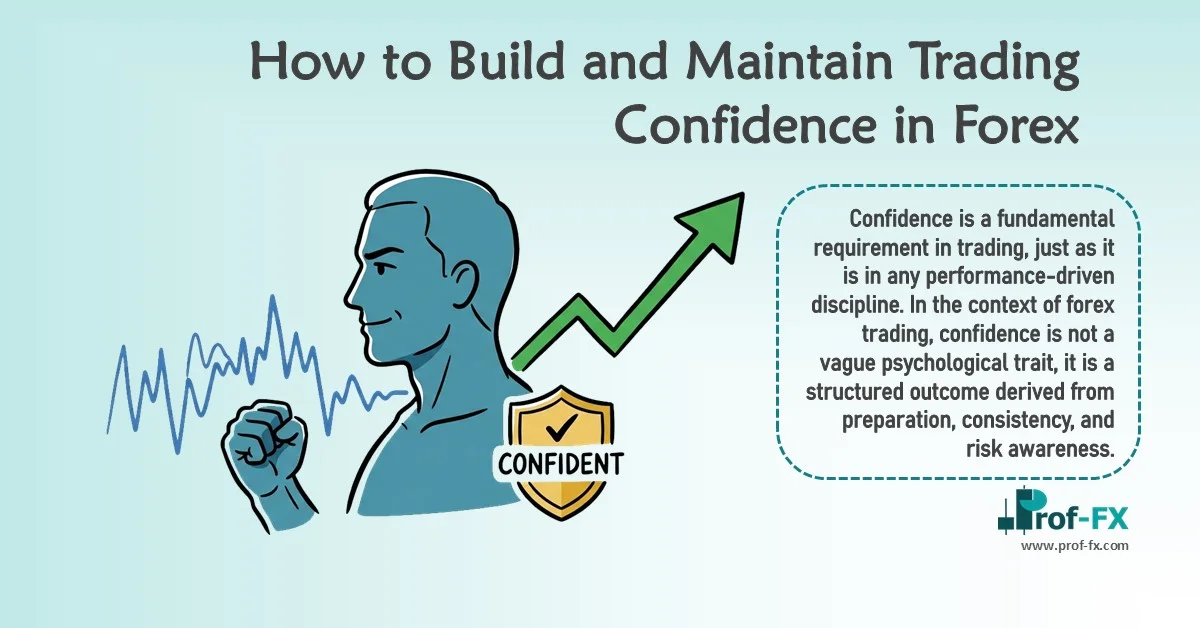
Confidence is a fundamental requirement in trading, just as it is in any performance-driven discipline. In the context of forex trading, confidence is not a vague psychological trait, it is a structured outcome derived from preparation, consistency, and risk awareness. Without it, decision-making becomes inconsistent, emotional, and ultimately unprofitable.
A Clearly Defined Trading Plan Is Non-Negotiable
A significant number of traders enter the market without a structured game plan. This typically means they lack clarity in identifying trade setups, defining entry and exit rules, and selecting appropriate strategies to capitalize on market opportunities.
A well-defined trading plan functions as a roadmap. It provides direction before entering live market conditions and reduces uncertainty during execution. From a professional standpoint, operating without a plan is equivalent to trading without a measurable edge, an approach that is statistically unsustainable.
Master Your Trading Methodology and Tools
There is no single “correct” way to analyze financial markets. Both technical analysis and fundamental analysis, individually or combined, can be effective when applied consistently.
However, the critical factor is simplicity and clarity. Overly complex systems often lead to “analysis paralysis,” which directly undermines confidence and execution speed.
A trader must:
- Define a clear methodology
- Identify specific trade setups (e.g., breakout, retracement, trend continuation)
- Ensure these setups provide a measurable edge over time
A structured and repeatable approach reinforces confidence because decisions are based on predefined criteria rather than impulse.
Choose a Time Frame That Matches Your Psychology
Time frame selection plays a critical role in trading performance. Higher time frames such as the daily and 4-hour charts typically provide more stable price action, clearer trends, and reduced noise.
In contrast, lower time frames especially in day trading, require rapid decision-making under pressure due to high market volatility. This can lead to mental fatigue and inconsistent execution.
Consistency is essential:
- Do not convert day trades into swing trades
- Do not alter trade intentions mid-execution
Maintaining alignment between your strategy and time horizon eliminates indecision, which is a key factor in preserving confidence.
Focus on a Select Group of Markets
Not all currency pairs or financial instruments behave the same way. Each market has its own volatility profile, liquidity characteristics, and behavioral patterns.
Limiting your focus to a smaller group of instruments allows you to:
- Develop familiarity with price behavior
- Improve pattern recognition
- Execute trades with greater confidence
From a professional perspective, specialization consistently outperforms over-diversification in discretionary trading.
Define and Control Your Risk Exposure
One of the most common and costly mistakes among traders is excessive risk-taking. Trading with position sizes beyond your tolerance level leads to emotional instability, impaired judgment, and ultimately poor decision-making.
Key considerations include:
- Define risk per trade (e.g., 0.5%, 1%, or 2% of account equity)
- Align risk with your strategy and time frame
- Understand the relationship between win rate and risk/reward ratio
For example:
- Breakout strategies often have lower win rates but higher risk/reward ratios, resulting in potential streaks of consecutive losses
- Mean reversion strategies typically have higher win rates but lower reward relative to risk
It is essential to analyze your trade history to estimate potential losing streaks. By calculating the maximum expected drawdown (e.g., 10 consecutive losses × risk per trade), you can determine whether your current risk level is sustainable.
If the projected drawdown exceeds your comfort level, position sizing must be reduced. This is not optional, it is a core principle of capital preservation.
Prioritize Process Over Short-Term Results
Focusing solely on profit and loss leads to inconsistent behavior. Professional traders instead prioritize execution quality.
Implementing a checklist whether written or mental, ensures that every trade meets predefined criteria:
- Valid trade setup
- Clear entry and exit (stop loss and take profit)
- Acceptable risk parameters
This structured approach reinforces discipline and prevents participation in low-quality trades, which are a major source of confidence erosion.
A key principle to understand:
- A losing trade executed correctly is a good trade
- A winning trade executed outside the plan is a bad trade
Over time, only process-driven execution leads to consistent profitability.
Maintaining Confidence Through Review and Feedback
Confidence must be continuously reinforced through data-driven evaluation. This is achieved by maintaining a detailed trading journal and conducting regular performance reviews.
Through journaling, traders can:
- Identify strengths to reinforce
- Detect recurring mistakes
- Adjust strategies before losses escalate
This feedback loop ensures continuous improvement and prevents deviation from the trading plan.
Rebuilding Confidence After a Drawdown
During periods of significant drawdown, the priority is risk containment – not recovery.
The correct approach is:
- Temporarily stop trading to prevent further losses
- Analyze past trades to identify errors
- Resume trading with reduced position size
- Focus on executing high-quality trades rather than generating profit
Confidence is rebuilt through consistency, not aggression. Attempting to recover losses quickly typically leads to deeper drawdowns.
Managing Overconfidence After Winning Streaks
While confidence is essential, overconfidence is equally dangerous. After a series of profitable trades, traders may deviate from their plan, increase position size excessively, or ignore risk controls.
This behavior inevitably leads to losses.
Professional discipline requires:
- Maintaining strict adherence to the trading plan
- Avoiding emotional escalation after wins
- Recognizing that the market is always uncertain
A critical insight:
- Profitability does not validate poor decision-making
- Consistency in execution is the only reliable benchmark of success
Final Perspective
Confidence in trading is not an inherent trait, it is a byproduct of preparation, discipline, and structured risk management.
A trader who operates with a clear plan, controlled risk, consistent methodology, and continuous review will naturally develop confidence over time. Conversely, a lack of structure inevitably leads to doubt, inconsistency, and long-term failure.
In professional trading, confidence is earned through process not assumed through outcomes.