
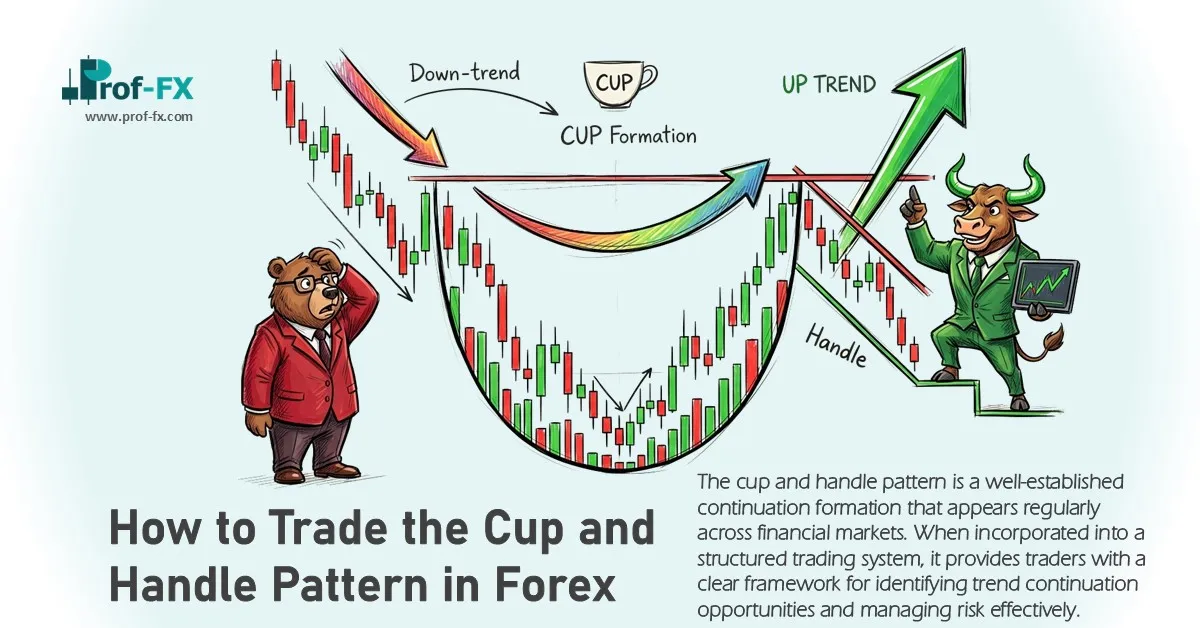
The cup and handle pattern is a well-established continuation formation that appears regularly across financial markets. When incorporated into a structured trading system, it provides traders with a clear framework for identifying trend continuation opportunities and managing risk effectively.
What Is the Cup and Handle Pattern?
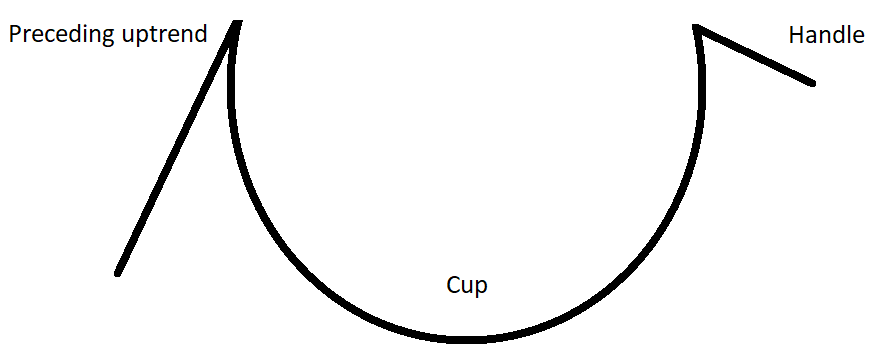
The cup and handle pattern is a continuation pattern that typically forms after an established trend, most commonly a bullish trend. It consists of two main components:
- The Cup: A rounded “U-shaped” formation that reflects a gradual transition from selling pressure to buying interest
- The Handle: A short-term consolidation phase, usually sloping downward, representing a pause before a potential breakout
This structure indicates that the market is absorbing supply before continuing in the direction of the prevailing trend.
How to Identify a Cup and Handle Pattern
Compared to simpler chart patterns, the cup and handle requires more precision in identification. The following criteria are essential:
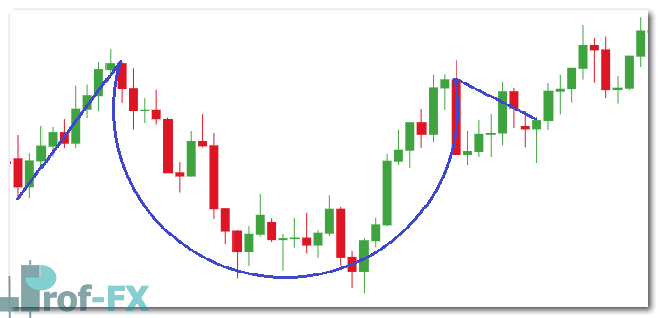
- Prior Trend: The pattern is most reliable when it forms after a clear uptrend. This can be identified using price action (higher highs and higher lows) or indicators such as moving averages
- Cup Formation: The cup should resemble a smooth “U” shape rather than a sharp “V,” indicating gradual accumulation
- Symmetry: The highs on both sides of the cup should be relatively equal, forming a resistance level
- Handle Structure: The handle appears as a consolidation phase, often resembling a flag, pennant, or slight downward channel
- Breakout Point: Entry signals occur when price breaks above resistance (cup highs) or above the handle trendline
How to Trade the Cup and Handle Pattern
Although the core principles remain consistent, execution may vary slightly between forex and equities.
1) Trading the Cup and Handle in Stocks
In equity markets, volume plays a key role in confirming breakouts.
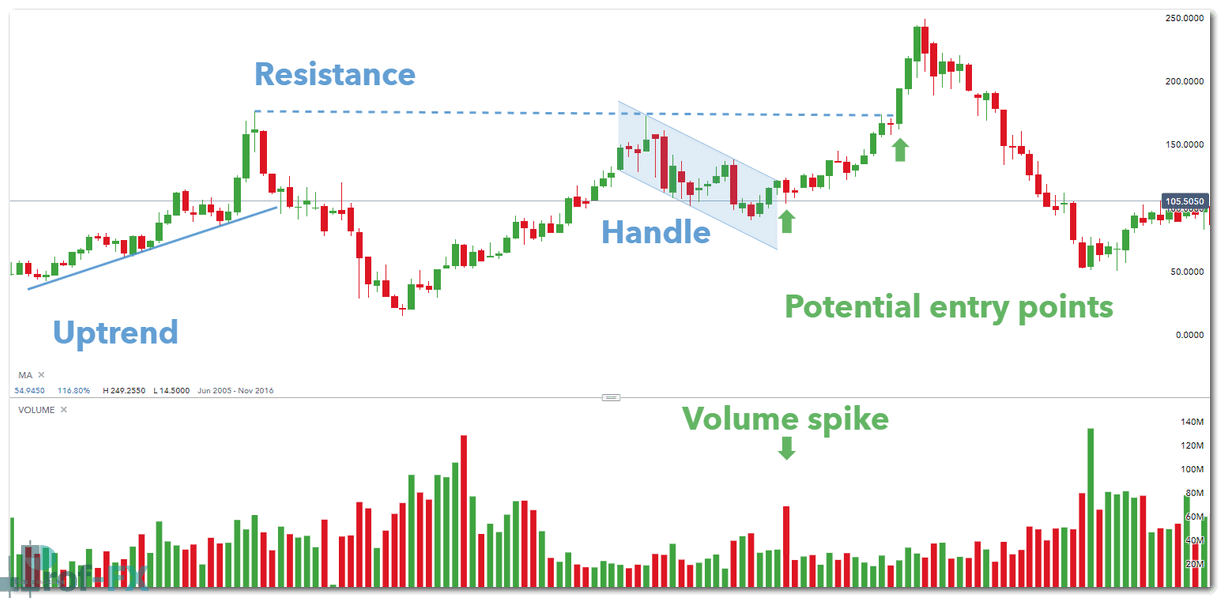
Using the example of Wynn Resorts Ltd:
- The chart shows a clear prior uptrend supported by higher highs and higher lows
- The cup and handle formation develops over time
- Two primary entry methods are identified:
- Aggressive Entry: Breakout above the handle channel with a surge in volume
- Conservative Entry: Break above the resistance level formed by the cup highs
Volume expansion during the breakout strengthens the validity of the move and reduces the likelihood of a false breakout.
Risk Management:
- Stop Loss: Placed below the low of the handle
- Take Profit: Typically set at a multiple of the stop distance (e.g., 1:2 risk/reward ratio)
- Alternative Targets: Fibonacci extensions may be used to project profit levels
2) Trading the Cup and Handle in Forex
In forex markets, volume data is less reliable or often unavailable. As a result, traders rely more heavily on price action and breakout confirmation.
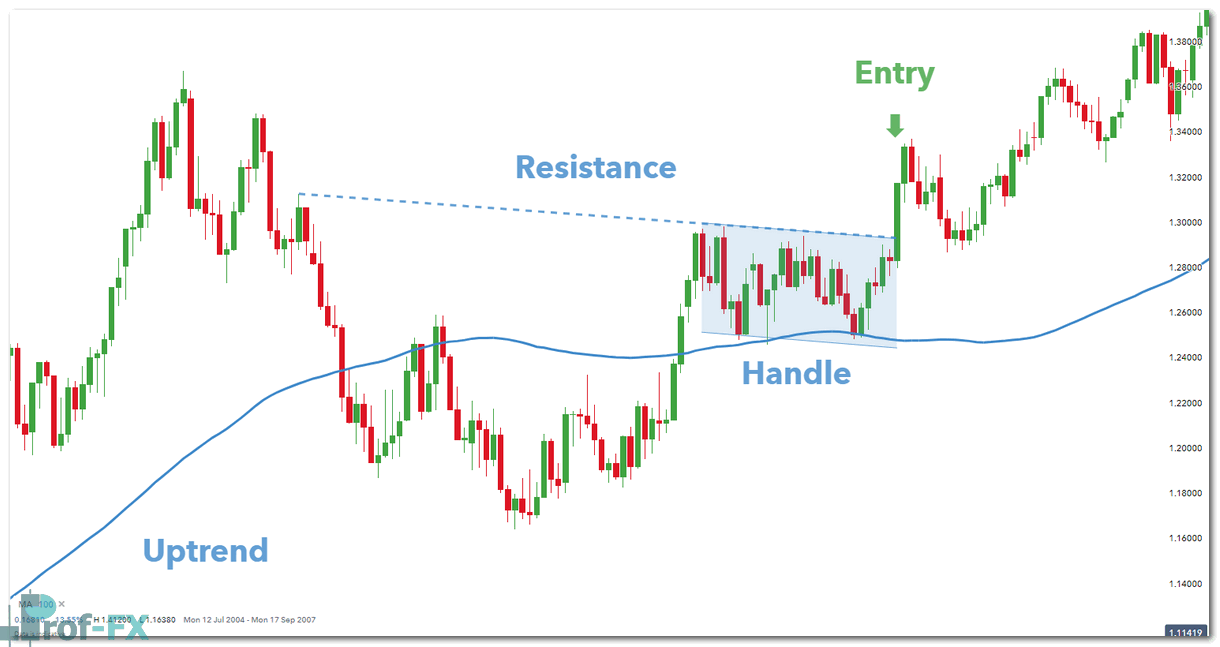
In the EUR/USD example:
- The prior uptrend is confirmed using a moving average (price trading above the 100-period MA)
- The resistance level from the cup aligns with the handle’s upper boundary
- This creates a single, high-probability breakout level
Once price breaks above this resistance:
- Traders can enter long positions
- Stop loss and take profit levels are determined similarly to the stock example
The absence of volume is compensated by stronger emphasis on structure, momentum, and confirmation through price behavior.
Key Trade Management Principles
Regardless of the market, effective execution involves:
- Entering on confirmed breakouts
- Avoiding premature entries within the handle
- Placing stop loss below the handle structure
- Targeting a favorable risk/reward ratio (minimum 1:2)
This disciplined approach ensures consistency and capital protection.
Advantages and Limitations of the Cup and Handle Pattern
Advantages
- Provides clear entry, stop loss, and take profit levels
- Applicable across multiple markets, including forex and equities
- Offers strong risk/reward opportunities when properly identified
Limitations
- Can be difficult for beginners to recognize accurately
- Often requires confirmation from additional indicators
- May take extended periods to fully develop
From a professional standpoint, patience is essential when trading this pattern. Premature interpretation often leads to invalid setups.
Strategic Cup and Handle Pattern
The cup and handle pattern reflects a natural market cycle:
- Accumulation (cup formation)
- Consolidation (handle)
- Expansion (breakout)
Understanding this sequence allows traders to position themselves ahead of potential continuation moves.
However, relying solely on the pattern is insufficient. Combining it with:
- Support and resistance analysis
- Trend confirmation
- Risk management rules
significantly improves trade probability.
Conclusion
The cup and handle pattern is a high-quality continuation setup when aligned with a strong underlying trend. Its effectiveness lies in its ability to define structure, timing, and risk in a clear and measurable way.
Professional traders treat this pattern as part of a broader trading framework, not as a standalone signal. When combined with disciplined execution and confirmation techniques, it becomes a powerful tool for capturing sustained market moves with controlled risk.