

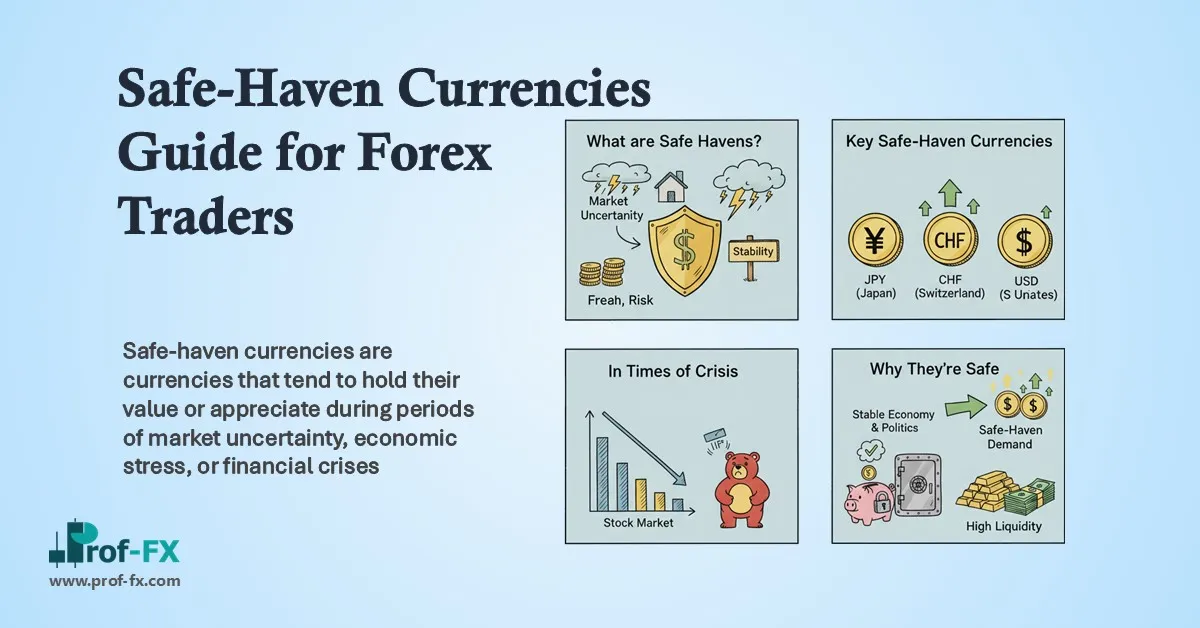
Safe-haven currencies are currencies that tend to hold their value or appreciate during periods of market uncertainty, economic stress, or financial crises. Unlike risk-sensitive currencies, safe havens typically show little correlation with equities and risk assets, making them particularly attractive to forex traders during market downturns.
In this guide, I will explain what qualifies a currency as a safe haven, highlight the major safe-haven currencies traded in the forex market, and show how traders can incorporate them into practical trading strategies during periods of heightened risk.
What Makes a Currency a Safe Haven?
A safe-haven currency is generally one that investors trust during periods of instability. Several characteristics tend to support a currency’s safe-haven status, including:
- High market liquidity
- A stable political and legal system
- Strong financial institutions
- Consistent economic performance
- Investor confidence in the issuing country’s central bank
However, these characteristics are not always definitive. A currency may still act as a safe haven even when a country faces fiscal or structural challenges.
A clear example is the Japanese Yen, which continues to function as a safe haven despite Japan having one of the highest government debt-to-GDP ratios globally. This demonstrates that safe-haven behavior is often driven more by market structure and investor behavior than by traditional fiscal metrics alone.
When Safe-Haven Status Can Be Undermined
Traders must also consider factors that can weaken a currency’s appeal as a safe haven. One major risk is government or central bank intervention.
For example, the Swiss National Bank (SNB) has repeatedly intervened in currency markets to prevent the Swiss Franc from becoming too strong, as excessive strength can harm Switzerland’s export-driven economy. These interventions can limit upside potential during risk-off periods.
The Japanese Yen faces a similar challenge. During global risk-off sentiment, the Yen often appreciates sharply. However, a stronger Yen reduces export competitiveness, negatively impacting Japanese corporate earnings and equity markets. In response, Japanese authorities have historically intervened by selling Yen, purchasing US Dollars, or—most notably—introducing negative interest rates in 2016 to suppress currency strength.
These dynamics highlight why traders must monitor policy risk when trading safe-haven currencies.
The Most Traded Safe-Haven Currencies
Among global forex markets, four currencies are most commonly associated with safe-haven behavior:
- US Dollar (USD)
- Euro (EUR)
- Japanese Yen (JPY)
- Swiss Franc (CHF)
These currencies dominate global trading volume due to their liquidity, institutional use, and economic importance.
Top Safe-Haven Currencies by Trading Activity
| Currency | Trading Volume Rank | Share of Global FX Trades | Most Traded Pair | Avg. Daily Volume* |
| USD | 1st | 88% | EUR/USD | $4.4 tn |
| EUR | 2nd | 31% | EUR/USD | $1.6 tn |
| JPY | 3rd | 22% | USD/JPY | $1.1 tn |
| CHF | 6th | 6.9% | USD/CHF | $0.24 tn |
Source: Bank for International Settlements (2016), net-net basis
Japanese Yen (JPY) as a Safe-Haven Currency
The Yen’s safe-haven status is closely linked to Japan’s large current account surplus, positioning the country as one of the world’s largest creditor nations. Additionally, the Yen plays a central role in carry trade strategies.
Because Japan maintains extremely low interest rates, traders often borrow Yen to invest in higher-yielding currencies. During periods of market stress, these positions are unwound, forcing traders to buy back Yen—driving the currency higher.
Historical examples of Yen appreciation include:
- The 2008 Global Financial Crisis
- The Brexit referendum uncertainty in 2015
- The near-collapse of Long-Term Capital Management (LTCM) in 1998
Since both the USD and JPY are considered safe havens, the USD/JPY pair may sometimes remain relatively stable during crises. In contrast, cross pairs such as GBP/JPY, AUD/JPY, and NZD/JPY often experience sharp moves as risk appetite shifts.
US Dollar (USD) as a Safe Haven
The US Dollar’s safe-haven role is largely supported by confidence in US Treasuries, which are widely viewed as one of the safest assets globally. During periods of financial turmoil, investors often rotate out of risky assets and into US government bonds and USD-denominated holdings.
That said, the Dollar’s safe-haven status is not absolute. In certain periods, capital has flowed preferentially into the Yen or Euro instead. Some analysts argue that USD demand during crises is often relative rather than dominant, depending on global monetary policy conditions and risk sentiment.
Euro (EUR) and Its Safe-Haven Debate
The Euro has occasionally displayed safe-haven characteristics, particularly when individual European economies show resilience or when interest rate differentials favor low-yield funding trades.
In 2015, for example, expectations of economic improvement in parts of the Eurozone and low interest rates supported bullish sentiment toward the Euro. However, its safe-haven role has weakened in recent years.
During periods of global equity selloffs—such as early 2018—the expected surge in Euro demand failed to materialize, while the Japanese Yen continued to attract strong inflows. This inconsistency has led many traders to view the Euro as a conditional safe haven rather than a reliable one.
Swiss Franc (CHF) as a Traditional Safe Haven
The Swiss Franc’s reputation as a safe haven is supported by:
- Political stability
- A strong banking system
- Low inflation
- High confidence in the Swiss National Bank
A notable example occurred in 2011, when investors flocked to CHF amid the US debt ceiling crisis and the European sovereign debt crisis. During that period:
- USD/CHF fell from 0.9400 to around 0.7900
- EUR/CHF dropped from near 1.3000 to close to parity
Like the Yen, the Franc is also widely used in carry trades, which amplifies demand during periods of risk aversion when positions are unwound.
How to Use Safe-Haven Currencies in Forex Trading
When trading safe-haven currencies, traders must recognize that not all safe havens react the same way to global events. Market consensus can also shift over time.
For example, some market participants consider the Norwegian Krone (NOK) a potential safe haven due to Norway’s fiscal surplus and lack of net debt. Others disagree, citing its lower liquidity and strong correlation with commodity prices.
Beyond currencies, gold is another popular safe-haven asset. Gold’s appeal lies in its historical role as a store of value, broad market acceptance, and limited sensitivity to central bank interest rate decisions.
For forex traders, safe-haven currencies are best used as tools for:
- Hedging risk during market downturns
- Trading risk-on vs risk-off sentiment
- Identifying relative strength between major economies