
THE COMMODITY CHANNEL INDEX (CCI) IN A TRADING STRATEGY
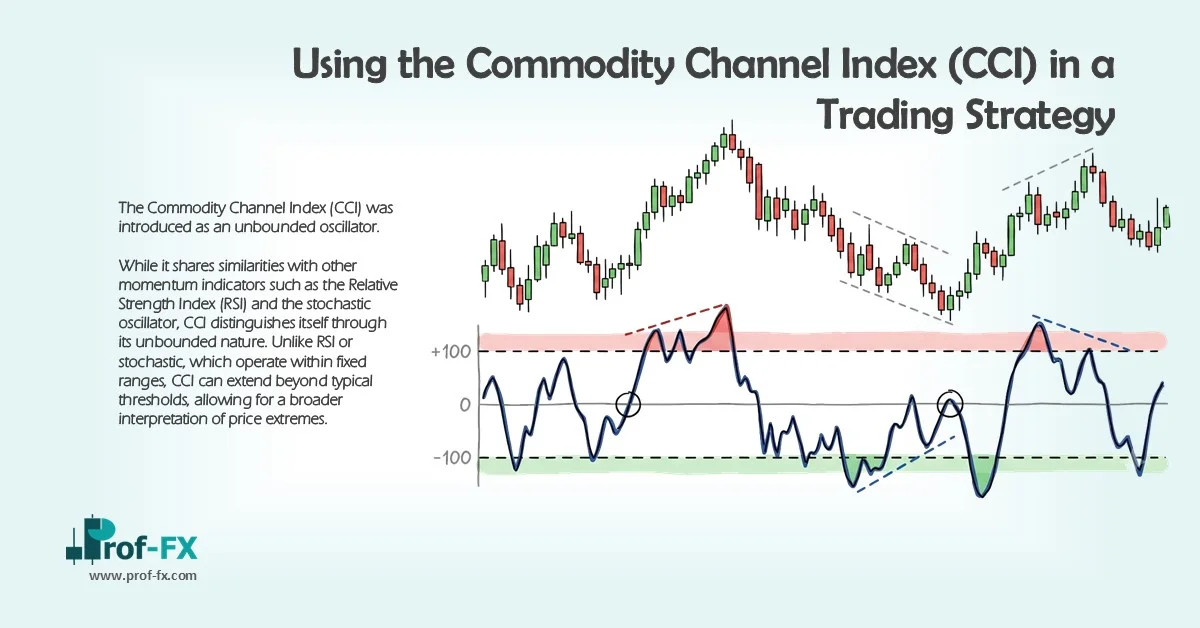
In the previous discussion, the Commodity Channel Index (CCI) was introduced as an unbounded oscillator. While it shares similarities with other momentum indicators such as the Relative Strength Index (RSI) and the stochastic oscillator, CCI distinguishes itself through its unbounded nature. Unlike RSI or stochastic, which operate within fixed ranges, CCI can extend beyond typical thresholds, allowing for a broader interpretation of price extremes.
Another defining feature of CCI is its inclusion of candlestick wicks in its calculation. This results in a more sensitive and often more volatile reading compared to bounded oscillators. Consequently, CCI tends to generate signals more frequently than indicators like RSI when evaluated under similar market conditions.
However, this increased signal frequency introduces a trade-off. While traders may benefit from more opportunities, the reliability of individual signals can be lower. This dynamic is well understood in technical analysis: higher signal frequency often correlates with reduced precision. To address this, traders can apply additional filters to improve consistency and overall effectiveness.
One of the most practical methods for refining CCI signals is the use of a trend filter, commonly implemented through moving averages. By aligning trades with the broader market direction, traders can reduce noise and focus on higher-probability setups.
APPLYING A TREND FILTER WITH CCI
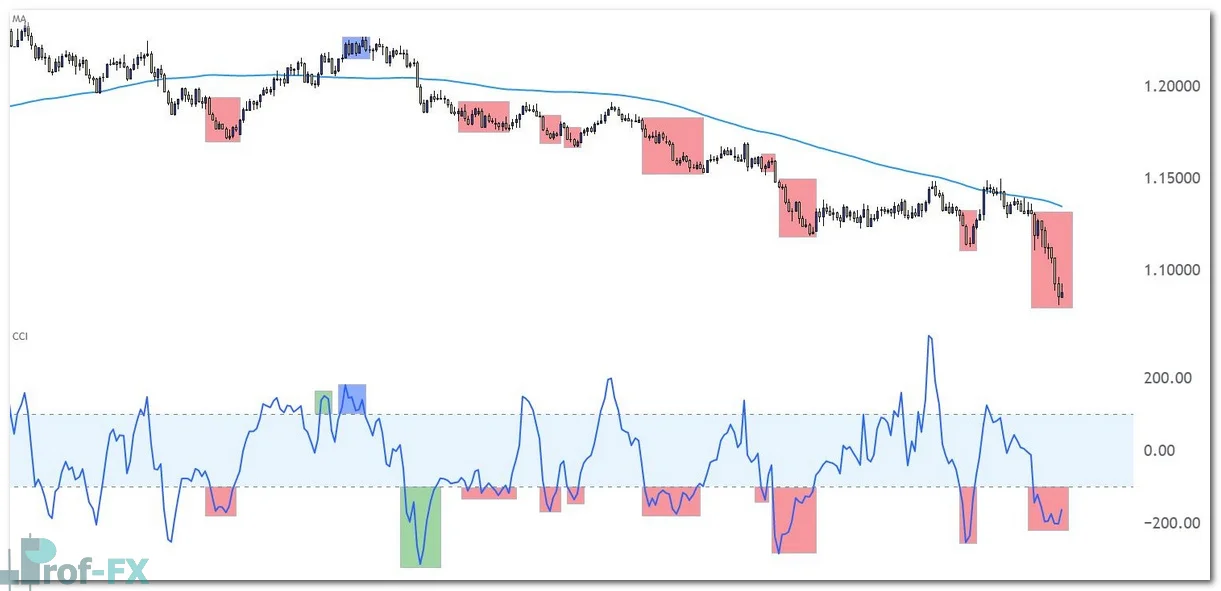
A structured approach involves combining CCI with a moving average to create a rule-based trading framework. In the example below, a 100-day moving average is applied to the daily chart of EUR/USD, while the CCI indicator is displayed in the lower panel.
The logic of this strategy is defined as follows:
- Bearish Setup:
- Price is below the 100-day moving average (indicating a downtrend)
- CCI crosses downward below -100
- Bullish Setup:
- Price is above the 100-day moving average (indicating an uptrend)
- CCI crosses upward above +100
In the chart, bullish signals are highlighted in blue, while bearish signals are marked in red. Additionally, two green boxes are included on the CCI indicator to emphasize specific signal scenarios, which will be analyzed further below.
EUR/USD Daily Price Chart
STRATEGY TAKEAWAYS
It is important to establish that this example represents a conceptual framework rather than a guaranteed system. Financial markets are inherently unpredictable, and no strategy can consistently produce identical results due to the wide range of influencing variables.
That said, several important observations can be drawn from this approach:
First, the strategy is inherently selective. By requiring alignment between the moving average and CCI signals, trades are primarily taken during strong trending conditions. This alignment increases the probability of capturing sustained directional moves, but it also limits participation during less defined market phases.
Second, the use of CCI as a trigger introduces relatively fast entry and exit signals. Because CCI reacts quickly to price changes, it can cross back above -100 or below +100 shortly after entry, potentially signaling an exit. This responsiveness can help reduce exposure but may also lead to shorter trade durations.
Third, the strategy demonstrates the concept of missed opportunities, as highlighted by the green boxes. In both cases, CCI generated valid signals ahead of significant price movements. However, these signals were filtered out because price was positioned on the opposite side of the moving average. This illustrates a key trade-off when using strict trend filters: improved consistency at the expense of potentially profitable setups.
From a strategic standpoint, these limitations are not flaws but variables that can be optimized. Traders may consider:
- Reducing the moving average period to increase responsiveness
- Replacing the moving average with a more flexible trend identification method, such as price action analysis
- Adjusting CCI thresholds to better match market conditions
STRATEGIC CONCLUSION
The Commodity Channel Index can serve as a highly effective entry trigger within a structured trading system. Its sensitivity to price movement allows traders to identify momentum shifts early, particularly when combined with a trend filter.
From a professional perspective, the strength of CCI lies not in its standalone signals, but in its integration within a broader strategy. By combining objective tools such as moving averages with momentum-based triggers, traders can create a balanced approach that emphasizes both precision and adaptability.
Ultimately, refining a CCI-based strategy requires continuous evaluation and alignment with individual trading goals, risk tolerance, and market conditions. When applied with discipline, CCI becomes a powerful component in building a consistent and methodical trading framework.