

The Reserve Bank of Australia (RBA) stands as one of the most influential central banks globally, with a direct and measurable impact on the trajectory of the Australian Dollar (AUD). Its policy decisions shape monetary conditions, regulate banking practices, and align closely with other international central banks. Understanding the RBA’s structure, mandate, and policy mechanisms is therefore essential for traders seeking to anticipate currency movements and market reactions.
Historically, the RBA evolved from the Commonwealth Bank of Australia, established in 1911. Over subsequent decades, it gradually assumed central banking responsibilities, which were formally defined after World War II through the Commonwealth Bank Act 1945 and the Banking Act 1945. As these functions expanded, the need for a distinct central authority became evident, leading to the enactment of the Reserve Bank Act 1959. The RBA officially commenced operations on 14 January 1960, marking the beginning of its independent role in managing Australia’s monetary system.
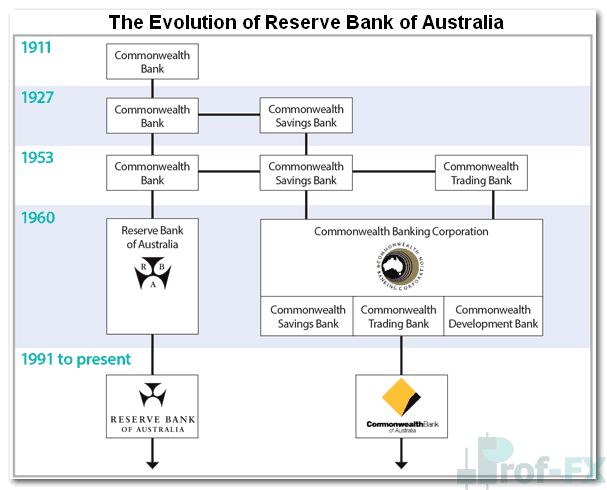
Source: RBA
Ownership Structure of the RBA
The Reserve Bank of Australia operates as a fully government-owned entity under the Commonwealth of Australia. This structure distinguishes it from several other central banks that retain elements of private ownership, such as the Bank of Japan, the South African Reserve Bank, and the Swiss National Bank. In contrast, the Federal Reserve System in the United States exhibits a hybrid structure, combining public oversight with private participation through member banks holding shares and receiving dividends.
This fully public ownership reinforces the RBA’s policy independence while ensuring alignment with national economic objectives.
Governance: Board Composition and Appointment Process
The RBA Board consists of nine members, including the Governor, Deputy Governor, and the Secretary to the Treasury. The remaining six members are non-executive appointees selected by the Treasurer, each serving terms of up to five years with eligibility for reappointment without term limits. The Governor and Deputy Governor are appointed for terms of up to seven years and may also be reappointed.
Legally, the Governor is required under the Reserve Bank Act 1959 to maintain close communication with the Treasury Secretary on matters affecting both institutions. Additionally, the Governor and senior RBA officials appear biannually before the House of Representatives Standing Committee on Economics. This process, initiated in 1996, ensures transparency and accountability regarding the conduct of monetary policy.
Core Roles and Responsibilities of the RBA
The RBA functions as Australia’s central monetary authority and sole issuer of banknotes. Its primary objective is to implement monetary and banking policies that support the broader economic well-being of the country.
Its key mandates are clearly defined:
- Maintaining the stability of the Australian currency
- Supporting full employment, generally interpreted as an unemployment rate between 5–6%
- Promoting the economic prosperity and welfare of the Australian population
While these objectives have remained consistent, the framework used to achieve them has evolved. Since the early 1990s, the RBA has adopted an inflation-targeting regime, aiming to maintain inflation within a 2–3% annual range on average. This target, introduced in 1993 and formalized in 1996, remains a cornerstone of its monetary policy strategy.
When inflation exceeds this range, the RBA typically responds by increasing interest rates. Higher interest rates tend to attract capital inflows due to improved yield differentials, which in turn supports an appreciation of the Australian Dollar.
Market Impact: Interest Rate Decisions and AUD Movement
AUD/USD 15 Min Chart Indicating the Immediate Impact of a 25bps Interest Rate Hike
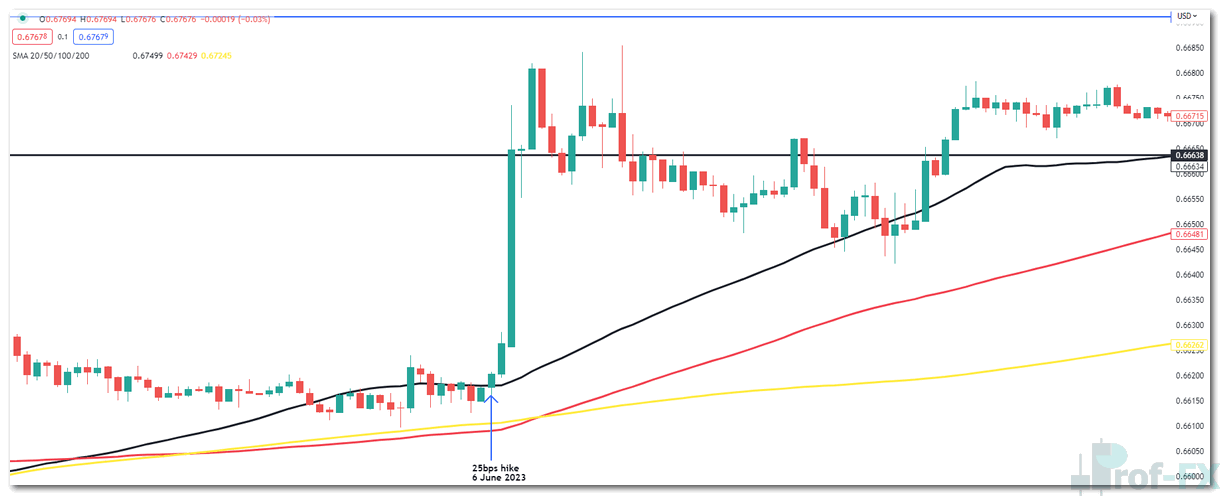
Note: The chart above illustrates the immediate market reaction to a 25 basis point rate hike on June 6, 2023, where the AUD/USD pair advanced more than 150 pips within one week following the announcement.
Monetary policy, particularly interest rate adjustments, remains the RBA’s primary tool for influencing currency valuation and controlling inflation. An increase in interest rates typically reduces liquidity in the financial system, strengthening the currency through increased demand. Conversely, a rate cut expands liquidity, encourages borrowing, and generally leads to currency depreciation due to increased supply.
From a trading perspective, it is critical to recognize that market expectations often carry as much weight as actual policy decisions. For example, even if the RBA holds rates steady, forward guidance signaling future rate hikes can drive bullish momentum in the Australian Dollar. This expectation-driven movement highlights the importance of interpreting central bank communication alongside economic data.
However, deviations from typical market behavior do occur. Unexpected macroeconomic developments, shifts in global risk sentiment, or conflicting data can result in atypical price action, reinforcing the need for disciplined risk management strategies such as stop loss and take profit placement.
The table below outlines potential scenarios based on changes in interest rate expectations, providing traders with a framework to anticipate whether the AUD may experience bullish or bearish pressure.
| Market Expectations | Actual Results | Resuting FX Impact |
| Rate Hike | Rate Hold | Depreciation of AUD |
| Rate Cut | Rate Hold | Appreciation of AUD |
| Rate Hold | Rate Hike | Appreciation of AUD |
| Rate Hold | Rate Cut | Depreciation of AUD |
Key Takeaways for Forex Traders
- The Reserve Bank of Australia officially began operations on 14 January 1960.
- It is entirely state-owned, with no private shareholders.
- Its primary mandates include currency stability, full employment (5–6% unemployment), and overall economic welfare.
- The RBA primarily uses interest rate adjustments, alongside quantitative easing and tightening, to achieve its policy objectives.
These elements collectively define the macroeconomic environment that drives AUD price action, making the RBA a central focus for forex traders.
Understanding Other Major Central Banks
While most central banks share similar objectives such as price stability and financial system resilience, each operates within a distinct institutional and economic framework. Key institutions to monitor include:
A comparative understanding of these institutions enables traders to evaluate relative monetary policy divergence, a critical factor in forex market trends and currency pair movements.