
The European Central Bank: A Forex Trader’s Guide
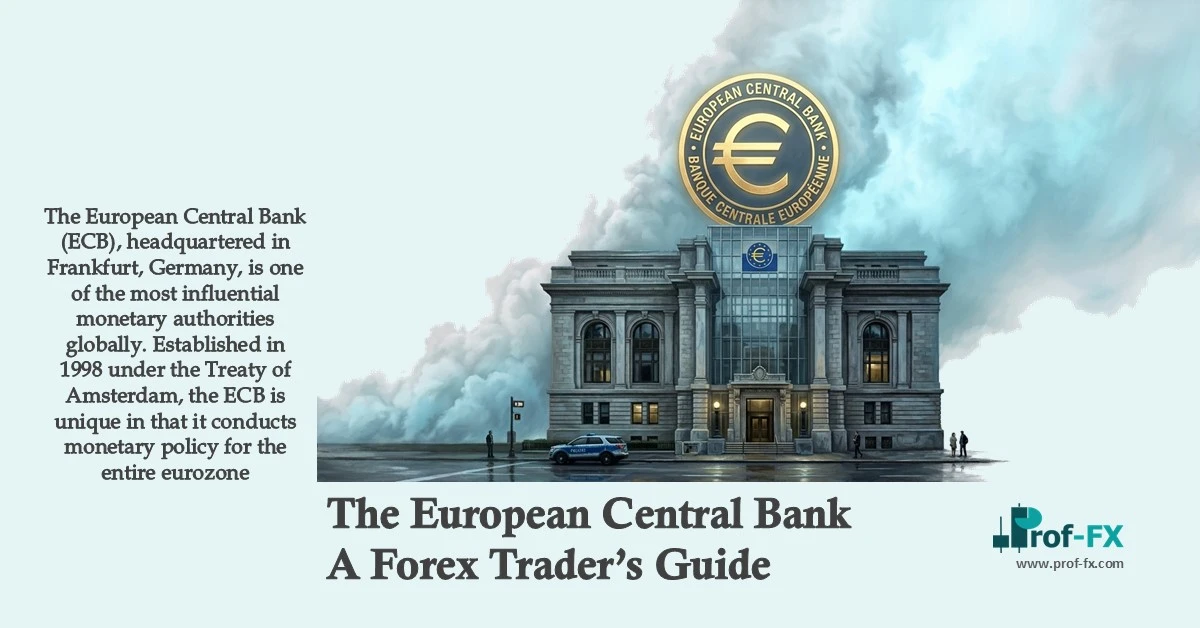
The European Central Bank (ECB), headquartered in Frankfurt, Germany, is one of the most influential monetary authorities globally. Established in 1998 under the Treaty of Amsterdam, the ECB is unique in that it conducts monetary policy for the entire eurozone rather than a single country. Its decisions directly influence the valuation of the Euro (EUR), making it a critical institution for forex traders to monitor.
The eurozone consists of 19 member countries, including Austria, Belgium, Cyprus, Estonia, Finland, France, Germany, Greece, Ireland, Italy, Latvia, Lithuania, Luxembourg, Malta, the Netherlands, Portugal, Slovakia, Slovenia, and Spain.
What is the ECB?
The ECB acts as the central bank for all eurozone member states, overseeing monetary policy across a unified economic region. It is governed by the Governing Council, which includes six Executive Board members one of whom serves as President, alongside the governors of national central banks. The Executive Board members are appointed by the European Council.
The ECB’s primary objective is to maintain price stability, ensuring controlled inflation while supporting sustainable economic growth and employment across the eurozone.
Key Economic Mandates of the ECB
The ECB’s policy framework is centered on two core pillars:
- Price Stability – Maintaining stable inflation levels, primarily measured by the Harmonised Index of Consumer Prices (HICP), while also considering the exchange rate of the Euro.
- Financial Stability – Ensuring the resilience of the eurozone financial system through policy interventions and liquidity management.
Price Stability
To achieve price stability, the ECB manages short-term interest rates across the eurozone. Its inflation target is defined as below, but close to, 2% over the medium term.
When inflation rises above this threshold, the ECB may signal or implement interest rate hikes to tighten monetary conditions and contain inflationary pressures. Conversely, during periods of economic slowdown or rising unemployment, the ECB may lower interest rates to stimulate growth, increase liquidity, and support job creation.
In complex macroeconomic environments such as when inflation rises alongside unemployment, policy decisions require a careful balance between controlling inflation and supporting economic expansion. This dual consideration reinforces the ECB’s data-dependent and forward-looking approach.
Financial Stability
Beyond inflation targeting, the ECB plays a central role in maintaining financial system stability. During periods of economic stress or financial crisis, the ECB can inject liquidity into the system through:
- Lowering interest rates to near-zero levels
- Purchasing financial assets such as government bonds (quantitative easing)
These measures are designed to stabilize markets, support credit flows, and prevent systemic collapse. Without such interventions, financial instability could escalate rapidly across the eurozone.
How ECB Interest Rates Affect the Euro
The ECB significantly influences the value of the Euro through both actual interest rate decisions and, critically, changes in interest rate expectations.
Currencies tend to appreciate when interest rate expectations rise, even if the nominal rate remains unchanged. For example, if the ECB holds rates steady but signals future tightening through forward guidance, the Euro may strengthen due to anticipated higher yields.
Conversely, expectations of rate cuts or prolonged low rates typically result in a depreciation of the Euro.
The Role of Quantitative Easing (QE)
Quantitative easing (QE) functions as an additional monetary policy tool with effects similar to interest rate adjustments. QE involves the large-scale purchase of financial assets to inject liquidity into the economy.
An expansion of QE increases the money supply, which generally leads to a depreciation of the Euro. Conversely, reducing or ending QE signals tighter monetary conditions, often resulting in currency appreciation.
Interest Rates and Economic Activity
The ECB adjusts interest rates in response to macroeconomic conditions:
- Lower interest rates stimulate economic activity by reducing borrowing costs, encouraging investment, and increasing liquidity in financial markets. This environment often supports bullish trends in equities and risk assets.
- Higher interest rates are used to contain inflation when the economy is overheating, reducing excess demand and stabilizing price levels.
Lower rates also contribute to a “wealth effect,” where rising asset prices encourage further spending and investment, reinforcing economic expansion.
Trading ECB Interest Rate Decisions
The relationship between market expectations and actual policy outcomes is a key driver of forex price action. The following scenarios illustrate how deviations between expectations and outcomes influence currency movements:
- Expected Rate Hike → Actual Rate Hold → Currency Depreciation
- Expected Rate Cut → Actual Rate Hold → Currency Appreciation
- Expected Rate Hold → Actual Rate Hike → Currency Appreciation
- Expected Rate Hold → Actual Rate Cut → Currency Depreciation
This framework highlights a fundamental principle: forex markets are driven more by expectations and surprises than by the policy decision itself.
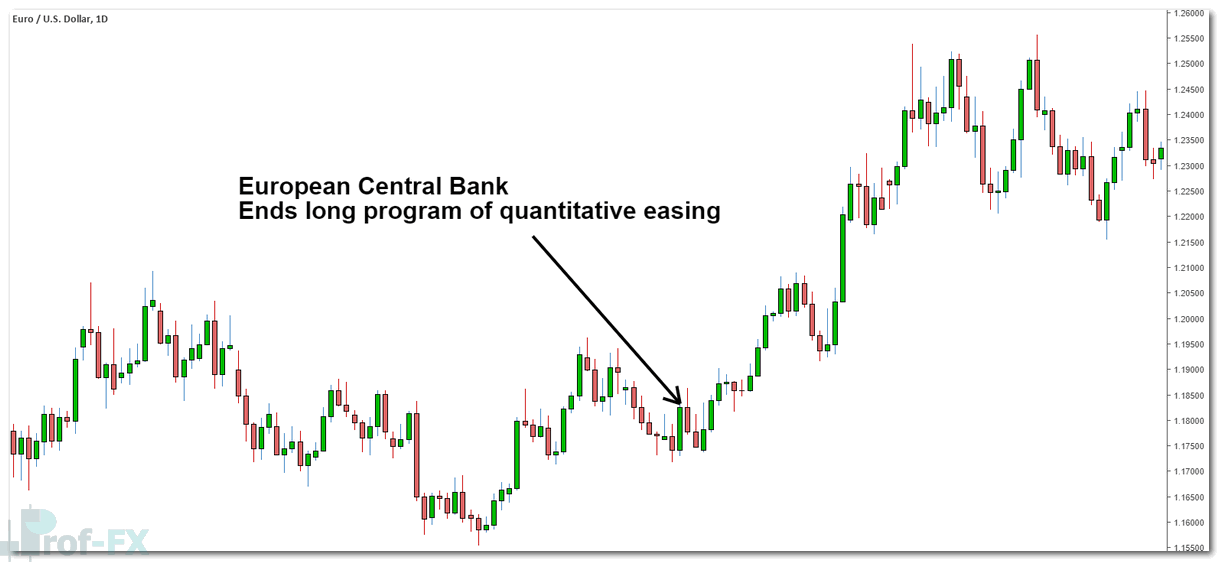
A practical example can be observed in EUR/USD when the ECB ended its long-standing quantitative easing program. On December 13, 2018, the ECB announced the conclusion of QE, signaling reduced liquidity in the system. This shift led to an appreciation of the Euro, as markets adjusted to tighter monetary conditions than previously anticipated.
Key Takeaways for Forex Traders
- The ECB is a primary driver of Euro valuation through its monetary policy decisions.
- Currency movements are heavily influenced by changes in interest rate expectations, not just actual rate changes.
- Quantitative easing and tightening have effects comparable to interest rate adjustments on the Euro.
- Rising inflation does not automatically result in rate hikes; decisions depend on the balance between inflation and economic growth.
- The ECB’s core mandate remains price stability, making inflation data a critical indicator for traders.
Expanding Your Understanding of Forex Fundamentals
Monitoring central bank activity is essential for informed trading decisions. Tools such as economic calendars, central bank statements, and interest rate announcements provide valuable insights into future market direction.
A structured understanding of how central banks operate—particularly their policy tools, forward guidance, and macroeconomic priorities—enables traders to anticipate bullish or bearish trends with greater precision.
Learn More About Other Central Banks
While central banks share common goals of maintaining price and financial stability, their frameworks and policy approaches differ. Key institutions to study include:
- The Bank of Japan
- The Bank of England
- The Swiss National Bank
- The Federal Reserve
Prof FX provides forex news and technical analysis focused on the macroeconomic trends and policy decisions that drive global currency markets.