

Copper remains one of the most actively traded commodities in the global financial markets. Due to its broad industrial application and close relationship with economic activity, copper attracts both institutional and retail traders seeking exposure to commodity price movements.
Copper is denominated in US Dollars, meaning fluctuations in the value of the Dollar often influence copper prices directly. In recent years, copper has also gained stronger recognition as an alternative investment asset alongside other commodities and inflation-sensitive instruments.
As discussed in our earlier copper market overview, copper prices generally perform well during periods of expanding emerging-market growth because demand is heavily tied to infrastructure development, industrial production, and construction activity. For this reason, copper trading strategies frequently combine both technical analysis and fundamental analysis to identify higher-probability opportunities.
Copper is considered a globally significant commodity because of its extensive use across multiple industries and its strong correlation with worldwide economic growth. Copper trading is widely utilized by hedgers seeking protection against future price volatility, as well as speculators aiming to capitalize on market fluctuations. Both individual traders and large institutions participate in the copper market, making it one of the most liquid and widely followed commodities available.
Why Trade Copper and How Does Copper Trading Work?
One of the major advantages of copper trading is accessibility. Traders can gain exposure to copper through several financial instruments, including futures contracts, options, equities, and CFDs. Investors may also access copper markets through copper-focused ETFs (Exchange Traded Funds), such as CPER (United States Copper Index Fund) and JJCB (iPath Series B Bloomberg Copper Subindex Total Return ETN).
Copper is classified as a soft and highly malleable metal with characteristics similar to gold and silver in terms of conductivity and industrial value. Demand for copper is primarily generated from sectors such as construction, transportation equipment, manufacturing, and electronics production. Because copper is an excellent conductor of electricity and heat, it remains essential in modern industrial infrastructure.
This broad industrial demand contributes to consistently high trading volume in copper markets. High liquidity is particularly beneficial for traders because it can contribute to tighter spreads, smoother market execution, and cleaner chart formations that may improve technical analysis accuracy.
Copper prices are heavily influenced by demand from emerging economies such as China and India. During periods of strong economic expansion, these countries require substantial quantities of copper to support infrastructure growth and industrial output. Rising demand typically contributes to higher copper prices. Conversely, during economic slowdowns or recessions, demand for copper often weakens, placing downward pressure on prices. Understanding this relationship is essential for anyone involved in copper trading.
Many professional copper traders incorporate technical analysis, fundamental analysis, or a combination of both to build structured trading strategies. These analytical approaches help traders forecast whether copper prices are more likely to rise or decline. Once a directional outlook is established, traders may buy or sell copper to potentially benefit from anticipated price movement.
A disciplined trading strategy also plays a critical role in risk management. It helps traders identify entry and exit opportunities, establish logical stop loss and take profit levels, and maintain favorable risk-to-reward ratios over time.
View current price movements of copper using our chart.
Copper Trading Hours
Copper is traded through CME Globex and CME ClearPort during the following hours:
Sunday – Friday: 6:00 p.m. – 5:00 p.m. ET
(5:00 p.m. – 4:00 p.m. Chicago Time/CT)
Trading includes a daily 60-minute break beginning at 5:00 p.m. ET (4:00 p.m. CT).
What Factors Affect the Price of Copper?
US Dollar
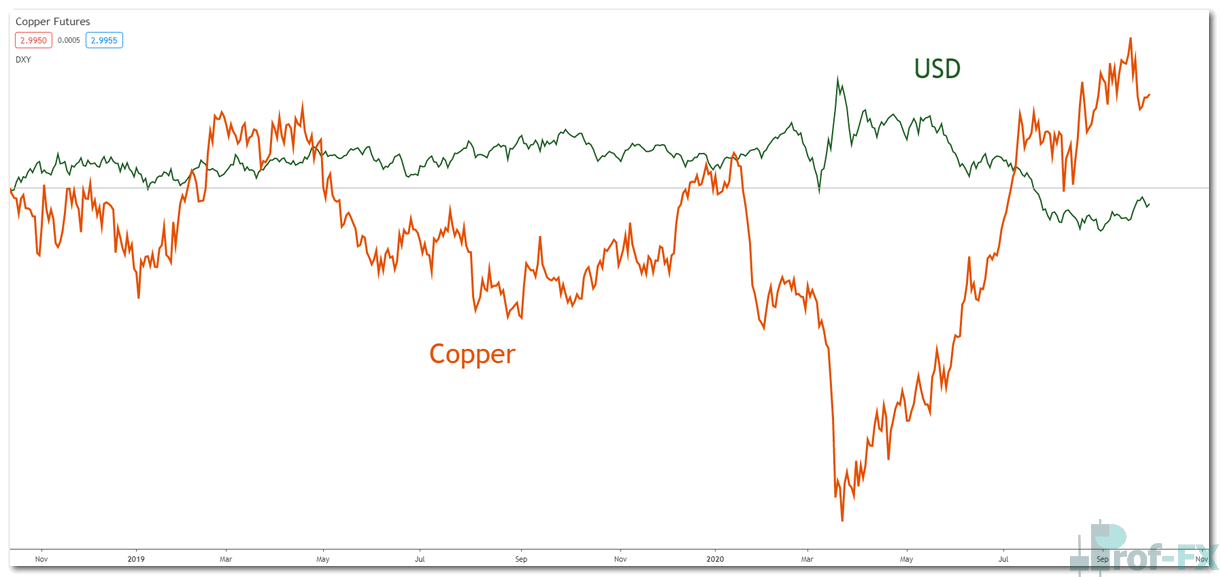
Like many commodities and industrial metals, copper generally maintains an inverse correlation with the US Dollar. In practical terms, when the US Dollar weakens, copper prices often rise, while a stronger Dollar may pressure copper prices lower. Although this relationship is not perfectly linear, the correlation remains historically significant.
The primary reason for this relationship is straightforward: copper is globally priced in USD. When the Dollar depreciates, foreign buyers can purchase copper using less of their domestic currency. This effectively reduces the relative cost of copper internationally, often stimulating additional demand and supporting higher prices.
Copper and USD inverse correlation representation
Oil
Copper refining requires substantial amounts of energy because the metal must undergo intensive processing to remove impurities. Energy expenses therefore represent a major component of copper production costs.
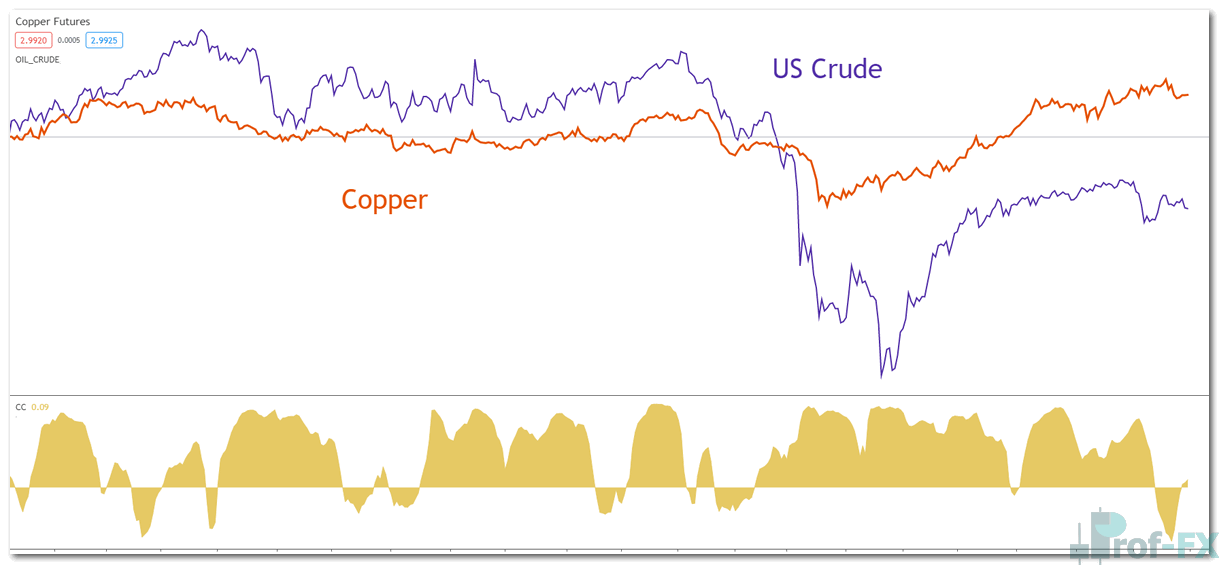
Historically, oil prices and copper prices have frequently moved in similar directions. Although both markets are influenced by different supply-and-demand variables, they often respond similarly to global economic conditions. Strong economic growth can increase demand for both industrial metals and energy products simultaneously.
For this reason, monitoring oil price trends may provide additional insight into potential copper market direction. However, traders should also recognize that expanding renewable energy adoption could gradually alter the traditional historical relationship between oil and copper prices over the long term.
Copper as a Barometer for Global Economic Growth
Copper is widely regarded as one of the most reliable indicators of industrial and economic expansion. Infrastructure development, manufacturing growth, and construction activity all depend heavily on copper consumption. As a result, rising copper demand often reflects improving economic conditions.
In most cases, increases in copper demand are followed by higher copper prices, while weakening demand tends to pressure prices lower. Among industrial metals, copper is commonly viewed as the benchmark metal because of its critical role in both developed and emerging economies.
Basic supply-and-demand principles remain highly relevant when analyzing copper markets:
- Increase in supply ↔ Lower demand pressure
- Decrease in supply ↔ Higher demand pressure
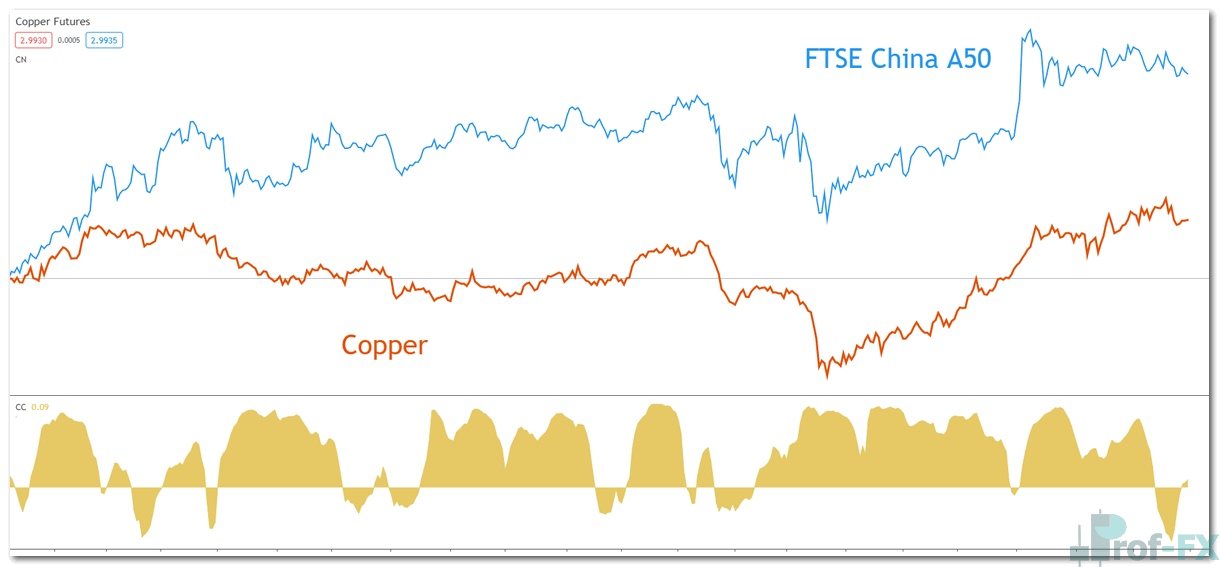
One of the most influential drivers of global copper demand is China. China remains the world’s largest copper consumer. Although China operates domestic copper mines, local production is insufficient to meet total national demand, forcing the country to import significant quantities from major producing nations.
This is precisely why Chinese economic performance is closely monitored by copper traders worldwide. If China continues to sustain long-term industrial and infrastructure growth, copper demand is likely to remain elevated. However, traders should also remain aware that China has increasingly emphasized long-term resource self-sufficiency, which may eventually alter global supply-and-demand dynamics.
Copper and FTSE China A50 positive correlation representation:
Copper Supply and Production Costs
Copper mining operations are heavily concentrated in South America, making the region extremely influential in determining global copper supply conditions. Supply shortages, ore quality, labor disputes, and changing production expenses can all significantly affect copper pricing.
Political instability and labor-related disruptions also represent major country-specific risks within the copper market.
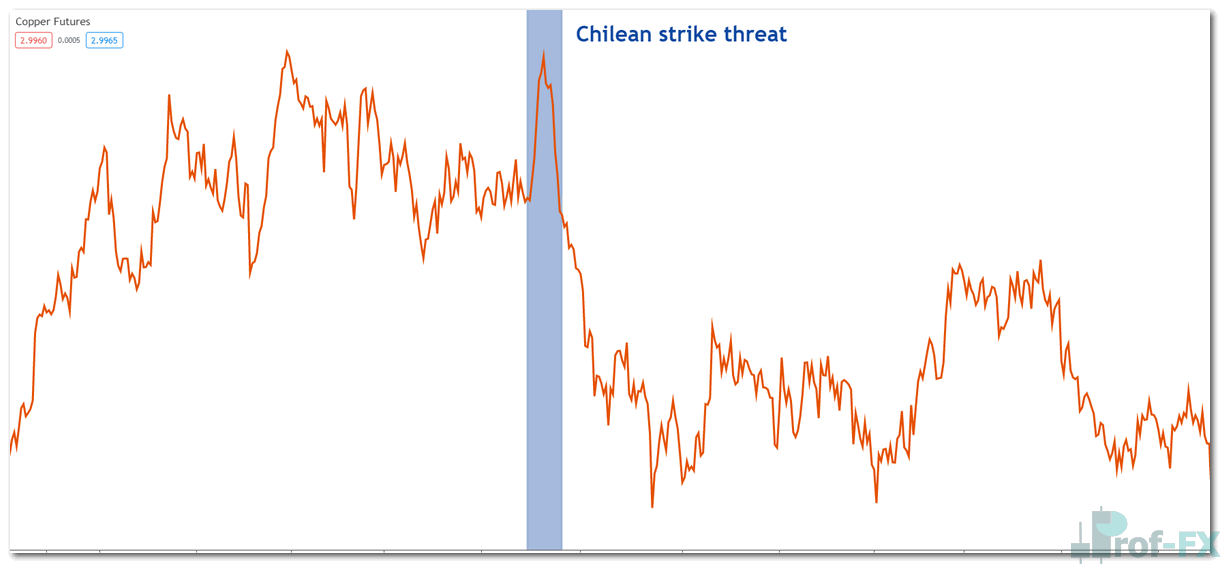
For example, during mid-2018, copper workers in Chile, the world’s largest copper producer, threatened strike action unless wage demands were satisfied. Concerns surrounding potential supply disruptions contributed to a sharp rally in copper prices, pushing the market toward multi-year highs during that period.
This event demonstrated how quickly supply-side uncertainty can reshape commodity pricing expectations.
Copper price reaction to Chilean copper strike:
Copper as an Investment Asset
Historically, copper was primarily used as a hedging instrument to reduce exposure to future price fluctuations. Producers and industrial consumers often relied on copper markets to lock in prices and stabilize operational costs.
Over recent decades, however, copper has increasingly evolved into a recognized investment asset. Speculative participation from hedge funds, institutions, and large asset managers has expanded considerably.
Because copper prices are strongly linked to economic activity, many investors view copper as a direct expression of global growth expectations. For example, portfolio managers with bullish expectations for worldwide economic expansion often maintain bullish exposure to copper markets as well.
Copper may also provide diversification benefits compared with more traditional financial assets, particularly during periods of inflationary pressure or cyclical economic recovery.
Trading Copper: Strategies
Copper’s broad industrial relevance and sensitivity to macroeconomic conditions create numerous strategic opportunities for traders. Trading strategies may be based entirely on technical analysis, entirely on fundamentals, or on a combination of both approaches.
Understanding how technical and fundamental drivers interact independently and collectively can significantly improve the effectiveness of a copper trading strategy.
Technical Strategy Example
The following example combines several technical analysis techniques to identify a possible trading opportunity in copper markets. It is important to recognize that this represents only one of many valid technical approaches available to traders.
To explore additional trading methods and analytical techniques, visit our Prof FX education center.
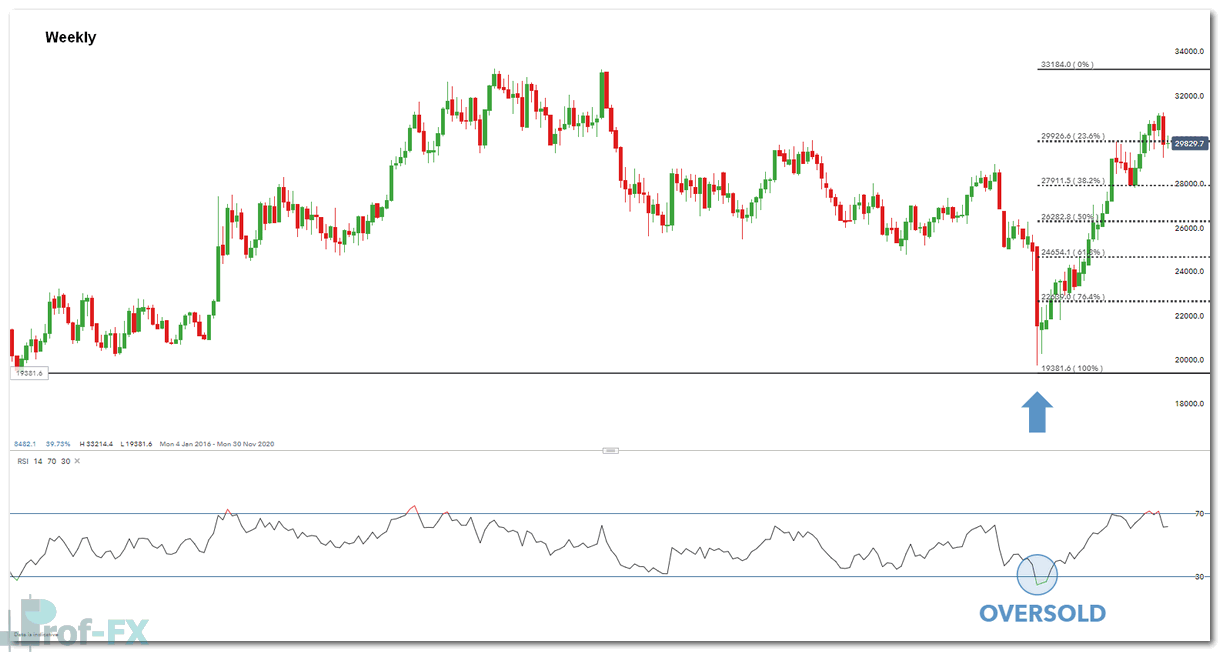
The weekly copper chart above incorporates price action analysis, support and resistance levels, and technical indicators to evaluate a potential market setup.
The Fibonacci retracement was drawn from the January 2016 low to the June 2018 high. This framework generated several key support and resistance zones across the chart. Multiple areas displayed clear confluence, where price repeatedly respected important technical levels.
The $1.93 per pound low (black) acted as a major support level as price approached the zone during March 2020. From a technical perspective, traders monitoring this setup would likely favor long positions provided price held above the $1.93 support area.
The Relative Strength Index (RSI) reinforced this bullish outlook by generating an oversold signal below the 30 threshold (blue). The combination of support-zone confluence and RSI oversold conditions provided stronger technical justification for a potential long trade.
In this scenario, the bullish setup proved successful as copper prices reversed sharply higher and transitioned into a medium-term upward trend.
Fundamental Strategy Example
Developing a strong understanding of the macroeconomic forces influencing copper is essential for building effective fundamental trading strategies.
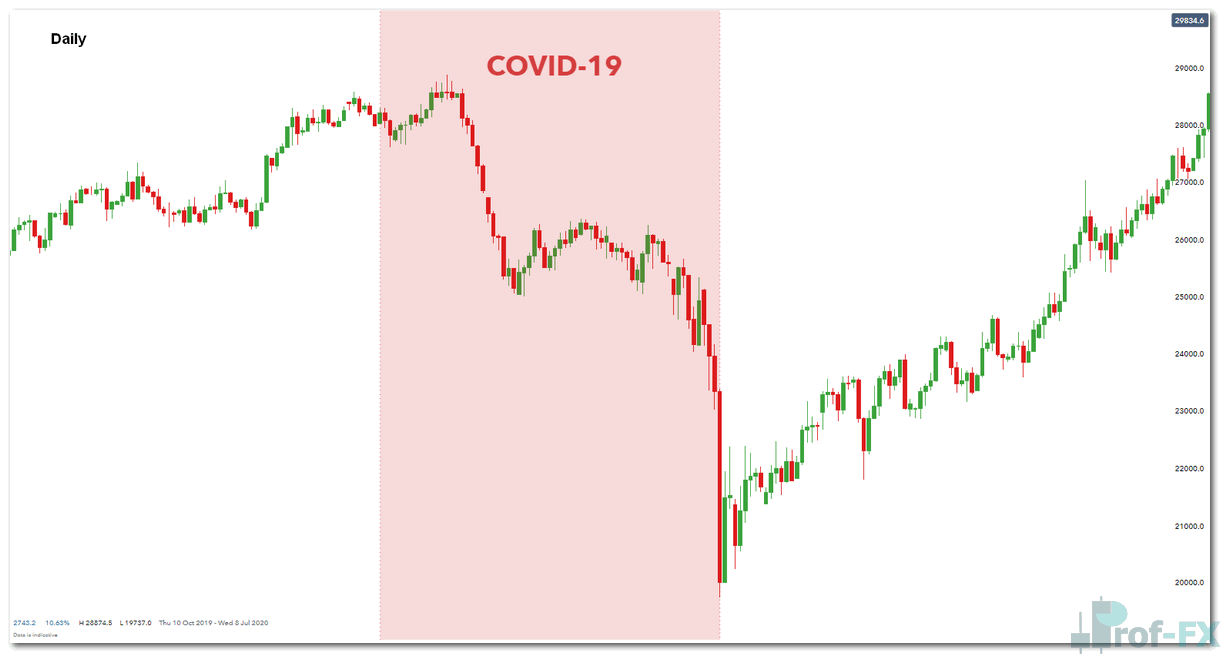
The daily chart above demonstrates the impact of the global COVID-19 pandemic on copper prices.
As previously discussed, copper maintains a strong positive correlation with economic growth. Therefore, any disruption to global economic activity can materially affect copper supply-and-demand conditions.
When the COVID-19 pandemic intensified during early 2020, expectations for global economic contraction increased rapidly as widespread lockdowns disrupted industrial activity, transportation, manufacturing, and construction worldwide.
As anticipated, economic growth weakened substantially, and copper prices declined accordingly. Between January 2020 and mid-March 2020, copper prices fell approximately 30% due to pandemic-related uncertainty and collapsing economic expectations.
This period highlighted the importance of understanding macroeconomic fundamentals when trading copper. Traders capable of correctly interpreting economic conditions were better positioned to make informed and disciplined market decisions.
Fundamental and Technical Strategy Combination
Combining technical analysis with fundamental analysis typically requires more preparation and research, but the additional effort can produce a more robust trading framework because it incorporates broader market intelligence.
At the beginning of 2019, copper prices were trading near one-and-a-half-year lows due to escalating trade tensions between the United States and China, along with reduced Chinese import volumes. However, as trade tensions gradually eased and the US Dollar weakened, copper prices began recovering over the following months.
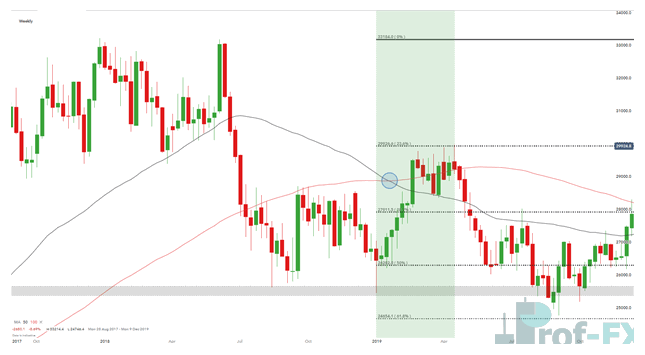
Managing these complex market conditions often begins with establishing a straightforward technical framework. In this example, traders could start with a Fibonacci retracement drawn from the January 2016 low to the June 2018 high, identical to the previous technical analysis example.
Using Fibonacci analysis alone revealed that the 50% retracement level near $2.62 per pound represented an important support zone at the beginning of January. At that stage, price action alone did not provide a strong directional bias because the market continued fluctuating around support.
This is where macroeconomic fundamentals became highly valuable.
Traders actively following developments surrounding US-China trade negotiations would have recognized declining market tensions and reduced volatility surrounding the issue. At the same time, a weakening US Dollar created additional supportive conditions for copper prices.
When these improving macroeconomic conditions aligned with price stability around the 50% Fibonacci support level, the probability of a bullish copper move increased significantly. Traders could reasonably interpret this combination as a favorable environment for establishing long positions in anticipation of further upside momentum.
Stop loss placement would depend on individual risk tolerance. More aggressive traders may have placed stop losses near the recent swing low within the $2.54–$2.56 support zone (black), while more conservative traders may have preferred tighter risk control beneath the $2.62 Fibonacci support level.
Consistent risk management remains one of the most important components of any professional trading strategy and should always be applied systematically.
The next major resistance level was the 38.2% Fibonacci retracement near $2.79 per pound. Traders could use this zone either to secure profits on long positions or evaluate whether bullish momentum remained strong enough for continuation.
In this example, the Moving Average (MA) indicator added further confirmation. The 50-day MA (red) crossed above the 100-day MA (black), generating a bullish crossover signal that supported additional upside potential.
This crossover developed during mid-January 2019, and with macroeconomic conditions remaining supportive, copper prices continued advancing higher. Additional technical confirmation tools such as moving-average crossovers can help traders refine decision-making and improve trade selection accuracy.
How to Trade Copper: Summary
Copper has evolved into a highly diversified and globally important trading asset with increasing appeal as an investment vehicle.
A disciplined understanding of both copper fundamentals and technical analysis can help traders position themselves more effectively to capitalize on price fluctuations. Because copper markets are influenced by a wide range of interconnected economic, industrial, political, and financial factors, successful navigation requires ongoing awareness and structured analysis.
Although copper trading can appear complex, greater market exposure, consistent research, and disciplined strategy development can provide traders with significantly improved clarity and confidence.
Resources to Help You Trade Copper
Both beginner and experienced traders can benefit from the educational resources provided by Prof FX to improve market understanding and strengthen trading performance in commodities such as copper:
- Stay informed with live copper prices using in latest commodities market news.
- Bookmark our Economic Calendar to monitor upcoming events that may influence commodity prices.
- Read our Forex Guide to understand why some traders consistently outperform others.
- Expand your technical analysis knowledge with our guide: 4 Effective Forex Trading Indicators Every Trader Should Know.
Prof FX delivers forex news, commodity analysis, and technical market insights covering the major trends influencing global financial markets.