Trading Rules and Wisdom
This article outlines a series of core rules and trading principles that can help traders stay on the right path consistently. Some of these ideas may sound familiar, and a few may even appear cliché. However, such principles have endured over time for a reason: they are grounded in time-tested trading truths.
For instance, no experienced market participant would dispute the importance of a strong risk management strategy. While some of the concepts below may overlap, that repetition is intentional because certain aspects of trading, particularly discipline and capital preservation, must be emphasized repeatedly.
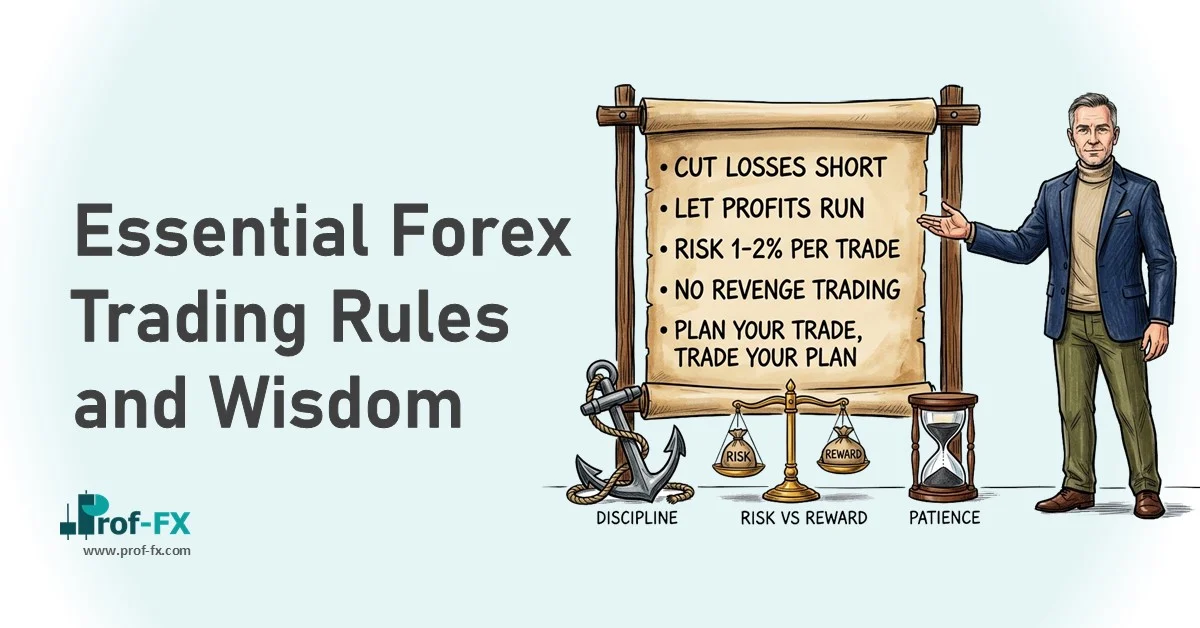
You Can Break Almost Every Rule Except Risk Management
A trader may occasionally survive breaking many technical or strategic rules, but the same cannot be said for risk management.
If risk controls are ignored, it is only a matter of time before the market removes you from the game.
Strict risk management rules exist to ensure that your trading edge remains statistically profitable over time and that your capital survives inevitable losing streaks.
This includes:
- small risk per trade
- overall account exposure limits
- strict stop loss discipline
- controlled leverage and position sizing
You may possess one of the best trading strategies in the market, but without sound risk management, results will eventually deteriorate and may lead to catastrophic losses.
Proper risk management also significantly reduces the psychological pressure associated with trading, allowing for more objective and disciplined decision-making.
From a professional standpoint, risk management is not optional, it is the foundation upon which all sustainable trading performance is built.
Better to Trade Too Small Than Too Big
This principle is a direct extension of risk management, and its importance cannot be overstated.
It is always preferable to trade slightly smaller than slightly too large.
The ideal position size is one that is large enough to keep you engaged and generate meaningful returns, yet small enough to preserve emotional neutrality and discipline.
Oversized positions often lead to:
- emotional decision-making
- early exits
- moving stop losses
- fear-based reactions
- overconfidence after wins
Every trader has a different tolerance for risk.
The correct approach is to trade with a level of exposure that you are genuinely comfortable with.
If the size of a position is causing stress, the position is likely too large.
Professional traders understand that capital preservation always precedes profit maximization.
No Position Is a Position
One of the most overlooked truths in trading is that staying out of the market is itself a valid position.
Very often, the best trade is no trade at all.
This principle is frequently ignored because traders may feel tempted to participate constantly or believe they are not doing their job unless they are actively trading.
In reality, successful trading often involves spending a disproportionately large amount of time doing nothing.
Patience is a strategic advantage.
Markets do not provide high-quality setups continuously, and forcing activity during low-probability conditions often results in unnecessary losses.
Good Trades Find You
Remaining focused and conducting proper market research is essential, but trading opportunities should not feel forced.
High-quality trade setups tend to reveal themselves naturally when your trading plan, market conditions, and technical framework align.
In professional trading, it is far better to under-trade than over-trade.
Overtrading commonly leads to:
- unnecessary losses
- frustration
- reduced discipline
- revenge trading
- emotional fatigue
Market opportunities often appear in clusters due to volatility cycles.
There may be periods of intense activity followed by extended quiet phases.
This is normal.
A disciplined trader follows the plan and allows the market to present opportunities rather than chasing them.
If you do not yet have a structured plan, creating one should be a top priority.
When in Doubt, Stay Out
This principle extends the logic behind “no position is a position” and “good trades find you.”
If there is doubt, hesitation, or lack of conviction, it is generally best to stay out of the market.
Uncertainty may arise because:
- the setup quality is poor
- market conditions are unclear
- volatility is abnormal
- emotions are interfering with judgment
Sometimes the cause is external, but often it is internal.
It is important to examine whether fear, recent losses, or hesitation are affecting execution.
For example, if you are becoming trigger shy after a losing streak, reducing position size can help restore confidence while maintaining process discipline.
Professional traders constantly evaluate not only the market, but also their own mental state.
Losses Are Part of the Game, Get Used to It
This is one of the hardest principles for many traders to accept.
Human nature generally resists loss.
However, in trading, losses are not only normal, they are inevitable.
A professional trader must become highly comfortable with taking losses.
Consistent profitability is not about being right all the time.
It is about ensuring that average profits exceed average losses.
This is the essence of positive expectancy.
Even elite traders experience numerous losing trades throughout their careers.
What separates professionals is their ability to:
- accept the loss
- follow the plan
- move on objectively
- avoid emotional revenge trading
Losses are part of the business model of trading.
They should be treated as operating costs, not personal failures.
Shrink Your Watchlist
The less experienced you are, the more important this principle becomes.
Monitoring too many markets simultaneously can quickly become overwhelming.
Different markets behave differently.
For example:
- currency pairs
- equity indices
- commodities
- stocks
all have their own unique volatility profiles and behavioral nuances.
By focusing on a smaller group of instruments, traders can better familiarize themselves with:
- volatility behavior
- spread conditions
- session activity
- technical responsiveness
This improves the ability to identify high-quality setups.
It is generally advisable to keep your market universe as small as possible without becoming overly restrictive.
Find the level that is comfortable for your trading style.
Mastery of a few instruments is often more profitable than superficial knowledge of many.
Routinely Take a Step Back
Do not operate at full intensity all the time.
Constant exposure to the market without breaks can lead to mental fatigue and burnout.
Take days off.
Take vacations.
The market will still be there when you return.
Short breaks help refresh focus and improve decision quality.
They also provide time to review:
- trade history
- mistakes
- execution quality
- emotional responses
- strategy effectiveness
Periodic self-review is a core component of professional trading development.
If trading starts to feel unusually difficult or emotionally draining, stepping away temporarily is often the most rational decision.
Trading Is Often Stressful Because We Make It So
Trading is inherently challenging, but much of the stress traders experience is self-created.
This usually comes from internal struggles such as:
- lack of discipline
- poor emotional control
- inconsistent execution
- deviation from the trading plan
Some of the most common avoidable stress triggers include:
- trading without a plan
- taking poor-quality setups
- compulsive trading
- risking too much
- adjusting positions out of fear
Often, traders already know which behaviors are creating unnecessary complexity.
The professional solution is to systematize the process as much as possible.
For example, a trend trader can apply a clear trend filter to avoid entering positions in sideways markets or against the dominant trend.
The more objective the process, the less emotional “fuzziness” affects decisions.
Have a Trading Plan
Every trader must have a clearly defined trading plan.
Without one, long-term success is highly unlikely.
This does not need to be an overly complex 50-page document.
However, it must at least provide a structured framework that answers all critical questions, such as:
- What is the setup?
- What confirms entry?
- Where is the stop loss?
- What is the take profit target?
- How much capital is risked?
- What time frames are used?
- What invalidates the trade?
Above all, risk management must be the most important section.
This is where every trader should begin.
Even beginners who are still learning technical analysis can start by building a concrete and disciplined risk management plan.
From a professional perspective, the trading plan is what transforms random market participation into a repeatable, process-driven business model.