
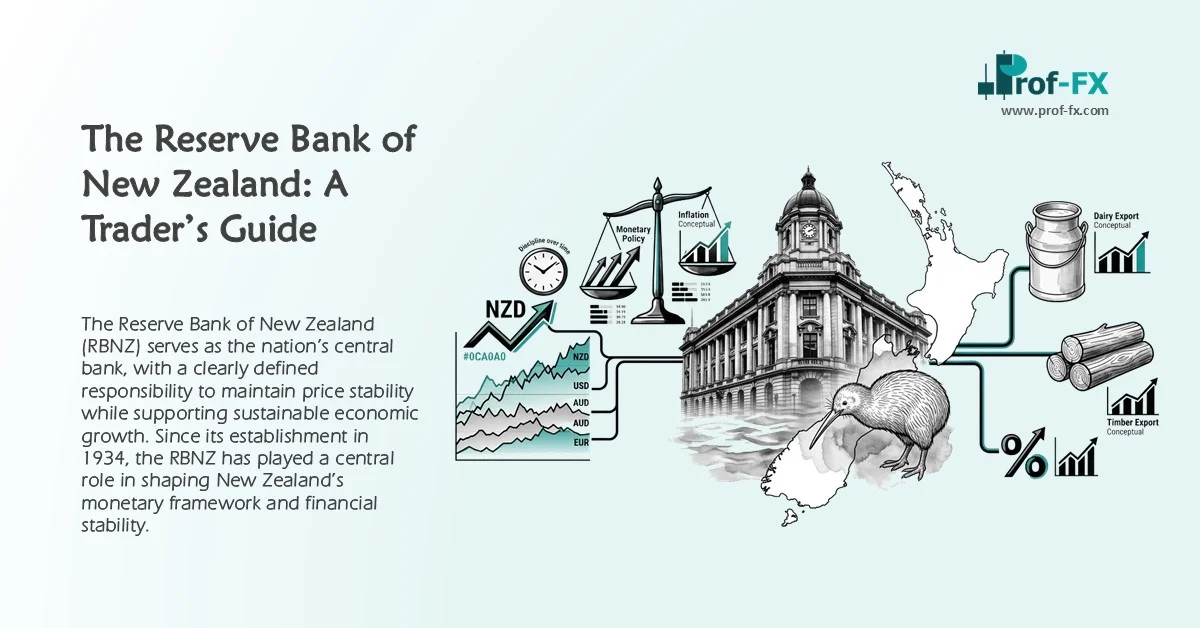
The Reserve Bank of New Zealand (RBNZ) serves as the nation’s central bank, with a clearly defined responsibility to maintain price stability while supporting sustainable economic growth. Since its establishment in 1934, the RBNZ has played a central role in shaping New Zealand’s monetary framework and financial stability. For forex traders, understanding the bank’s structure, mandate, and policy tools is essential for anticipating movements in the New Zealand Dollar (NZD).
History of Reserve Bank of New Zealand
The Reserve Bank of New Zealand was established in 1934 in direct response to the economic instability caused by the Great Depression. Its creation aimed to strengthen the financial system and provide a centralized authority for implementing monetary policy. From its inception, the bank was entrusted with broad responsibilities, including currency issuance, regulation of the banking system, and the setting of interest rates.
Over time, the RBNZ’s role evolved toward a more focused objective. A significant milestone occurred in 1989 with the introduction of the Reserve Bank of New Zealand Act, which formally defined the bank’s mandate: maintaining price stability while promoting sustainable economic growth.
This legislative framework remains the foundation of the RBNZ’s policy approach, reinforcing its credibility and long-term consistency in monetary management.
Current Shareholders
The Reserve Bank of New Zealand operates as a fully state-owned institution. The New Zealand government, represented by the Minister of Finance, acts as the sole shareholder. As a result, any profits generated by the bank are returned directly to the government.
This ownership structure ensures that the RBNZ’s policy direction remains aligned with national economic priorities while maintaining operational independence in executing monetary policy.
Appointment of the Board and Governor
The RBNZ is governed by a board of directors responsible for overseeing operations and ensuring adherence to its statutory mandate. The board is appointed by the Minister of Finance and consists of the Governor—who serves as Chair—along with up to six additional directors.
The Governor is appointed for a five-year term, with the possibility of reappointment. This role carries primary responsibility for implementing monetary policy and managing the bank’s day-to-day operations.
This governance structure ensures accountability while enabling decisive and consistent policy execution, which is critical for maintaining market confidence.
Mandate and Policy Tools
The RBNZ’s mandate is centered on two core objectives:
- Maintaining price stability
- Promoting sustainable economic growth
To achieve these objectives, the bank employs a range of monetary and regulatory tools.
The primary instrument is the Official Cash Rate (OCR), which represents the interest rate applied to overnight lending between the RBNZ and commercial banks. Adjustments to the OCR directly influence broader interest rates across the economy, affecting borrowing costs, consumption, and inflation dynamics.
The chart below illustrates the historical relationship between interest rate hikes and headline inflation:
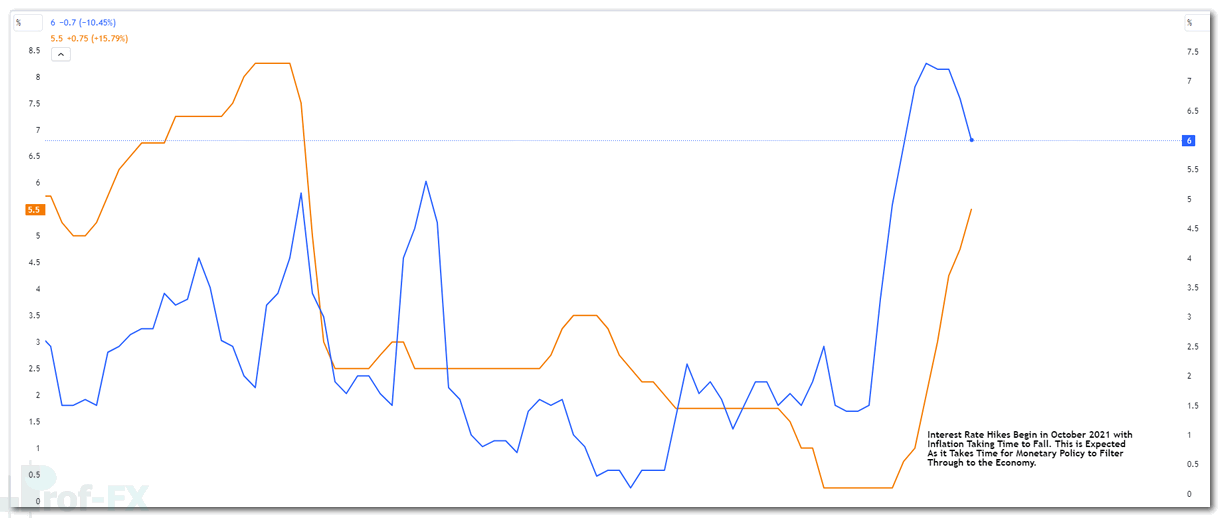
Note: Interest rate increases typically exhibit a lagged effect before fully impacting the broader economy.
Historical data since 1999 indicates a consistent pattern: when the RBNZ raises interest rates, inflation tends to decline in subsequent months. This reflects the delayed transmission mechanism of monetary policy. In more recent cycles, rate adjustments have been more aggressive; however, inflation trends suggest that tightening measures have contributed to moderating price pressures.
It is also important to recognize that inflation is influenced by multiple components, including external factors such as supply chain disruptions and energy prices. Events such as the COVID-19 pandemic and the Russia–Ukraine conflict have demonstrated that inflationary pressures can persist longer when driven by global forces.
Beyond interest rate policy, the RBNZ conducts open market operations to manage liquidity within the financial system. By buying or selling government securities, the bank can influence money supply and indirectly control interest rates.
Additionally, the RBNZ utilizes regulatory tools to safeguard financial stability. These include setting capital requirements for banks, monitoring liquidity conditions, and enforcing regulations designed to ensure transparency and resilience within the financial system.
Collectively, these instruments enable the RBNZ to respond effectively to both domestic and external economic challenges, reinforcing its role as a key driver of NZD valuation in the forex market.
Conclusion
The Reserve Bank of New Zealand has consistently played a pivotal role in guiding the country’s economic stability and growth. With a clearly defined mandate, strong institutional framework, and a comprehensive set of policy tools—including the Official Cash Rate, open market operations, and regulatory oversight—the RBNZ is well-equipped to manage inflation and support long-term economic performance.
From a trading perspective, its policy decisions, forward guidance, and macroeconomic assessments are critical drivers of NZD price action. Monitoring these factors provides a structured and data-driven foundation for anticipating bullish or bearish movements in the currency.
Learn More About Other Central Banks
While central banks globally share similar objectives—primarily price stability and financial system resilience—each operates under distinct frameworks and economic conditions. Key institutions to monitor include:
- The European Central Bank
- The Bank of England
- The Swiss National Bank
- The Federal Reserve
- Reserve Bank of Australia
Understanding the differences in monetary policy across these institutions allows traders to evaluate relative interest rate differentials, a key factor influencing forex trends, currency strength, and cross-pair opportunities.
Prof FX provides forex news and technical analysis focused on the macroeconomic forces and policy decisions that drive global currency markets.