
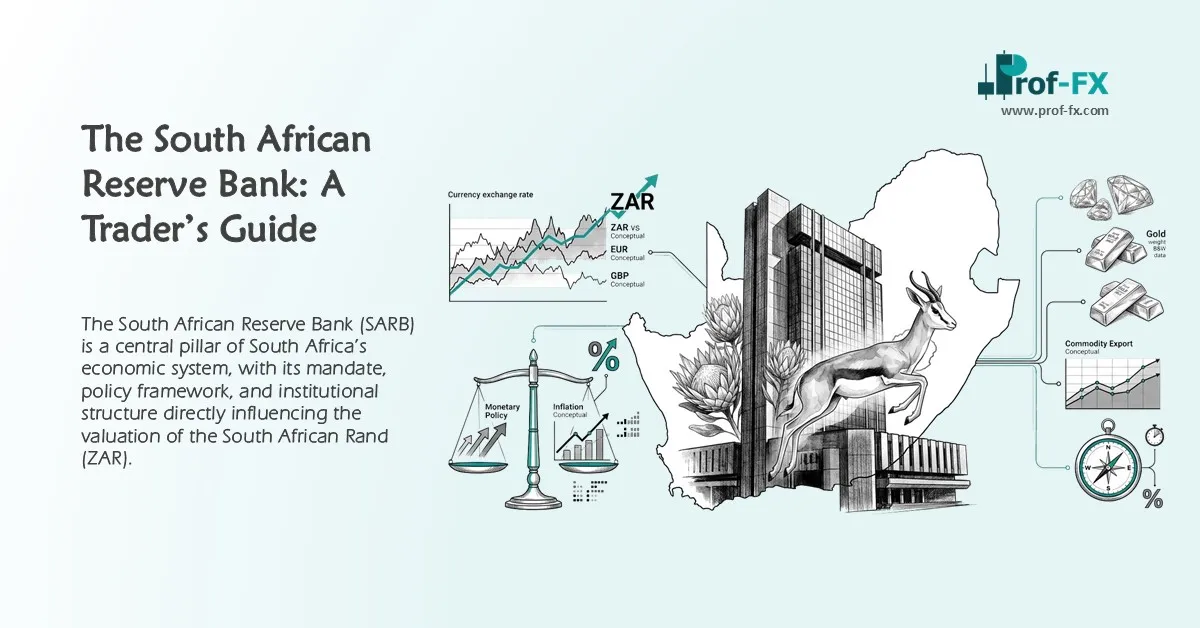
The South African Reserve Bank (SARB) is a central pillar of South Africa’s economic system, with its mandate, policy framework, and institutional structure directly influencing the valuation of the South African Rand (ZAR). For forex traders, a clear understanding of the SARB’s origins, governance, and monetary policy tools is essential to anticipate currency movements and broader market dynamics.
History of the South African Reserve Bank (SARB)
Established on June 30, 1921, the SARB holds the distinction of being the oldest central bank in Africa. Its creation was driven by the need for an independent monetary authority capable of stabilizing the national currency, which had been subject to volatility following the economic disruptions of World War I.
Initially structured as a privately owned institution, the SARB underwent nationalization in 1945, bringing it under the authority of the South African government. Throughout its history, the bank has played a critical role in shaping economic policy, navigating periods such as the Great Depression, World War II, the apartheid era, and the transition to a democratic system.
This long-standing institutional continuity reinforces the SARB’s credibility and its central role in maintaining monetary stability.
Shareholders of the South African Reserve Bank (SARB)
The SARB maintains a unique ownership structure compared to most central banks. It is publicly owned, with more than 650 shareholders holding issued shares. However, these shareholders operate under strict legal limitations designed to preserve the bank’s policy independence.
Shareholders are prohibited from influencing monetary policy decisions, which remain exclusively under the authority of the Governor and the Monetary Policy Committee. Additionally, ownership is capped no individual or associated group may hold more than 10,000 shares, while non-residents are restricted from owning more than 40% of total issued shares.
Their rights are limited primarily to electing a minority of directors and receiving capped dividends. This structure ensures that, despite the presence of shareholders, monetary policy remains insulated from private interests.
The Mandate of the South African Reserve Bank (SARB)
The SARB’s mandate is constitutionally defined in Section 224(1) of the Constitution of the Republic of South Africa. Its primary objective is to protect the value of the currency in the interest of balanced and sustainable economic growth.
To achieve this, the SARB implements monetary policy aimed at maintaining price stability. In addition, the bank is responsible for:
- Safeguarding financial system stability
- Issuing banknotes and coins
- Acting as the government’s banker
- Providing banking services to commercial banks
- Managing gold and foreign exchange reserves
This comprehensive mandate positions the SARB as a key authority in both monetary control and financial system oversight.
Dividends
Although the SARB includes private shareholders, it does not operate with profit maximization as its objective. Dividend payments are strictly regulated and capped at 10 cents per share annually. With approximately two million shares issued, this results in a total annual dividend payout of around R200,000.
Any surplus profits generated beyond this capped amount are transferred to the South African government. This structure ensures that financial returns to shareholders remain minimal, reinforcing the institution’s public policy focus rather than commercial incentives.
Impact of Policy Decisions on the South African Rand (ZAR)
The SARB’s monetary policy decisions have a direct and measurable impact on the ZAR. Its primary policy instrument is the repo rate, which determines the cost at which commercial banks borrow funds from the central bank.
When inflation exceeds the target range, the SARB typically raises the repo rate. Higher interest rates increase borrowing costs, reduce consumer spending, and help contain inflationary pressures. From a forex perspective, this tightening cycle often leads to an appreciation of the ZAR, as higher yields attract foreign capital inflows.
Conversely, when the SARB lowers the repo rate, borrowing becomes more affordable, stimulating economic activity through increased spending and investment. However, this expansionary policy can lead to higher inflation and typically results in a depreciation of the ZAR, as lower yields reduce foreign investment appeal.
The chart below illustrates the relationship between interest rate adjustments and inflation dynamics:
SARB Interest Rate vs SARB Inflation
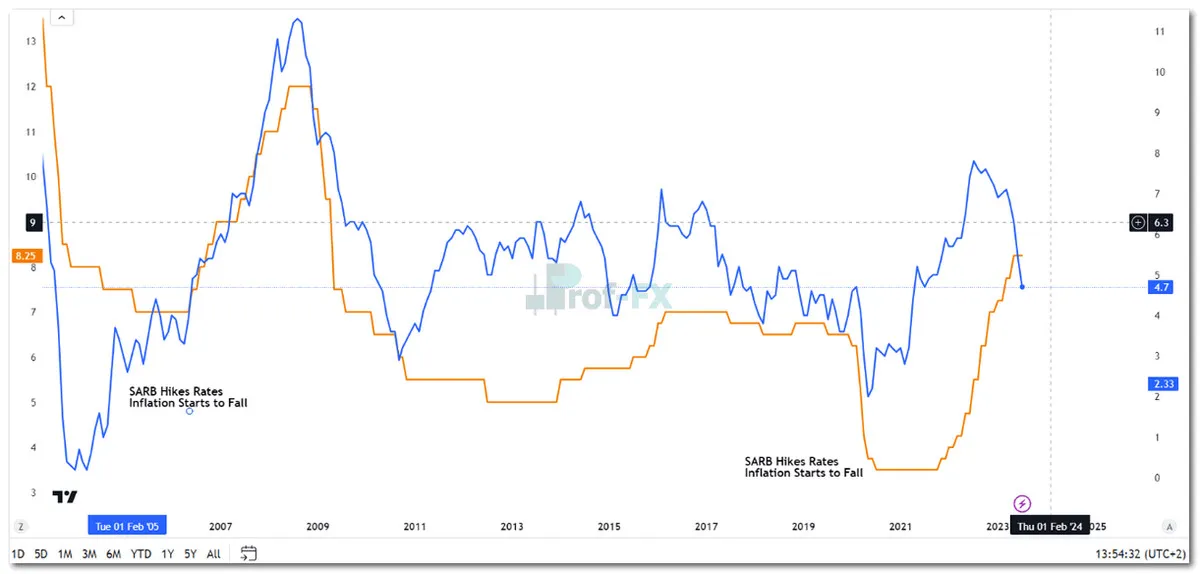
This relationship highlights a critical principle: monetary policy operates with a lag. Interest rate changes do not immediately translate into inflation adjustments, requiring traders to incorporate forward-looking expectations into their analysis.
The SARB must therefore maintain a delicate balance, controlling inflation while supporting economic growth making its policy decisions a key driver of both short-term volatility and long-term currency trends.
Conclusion
The South African Reserve Bank plays a decisive role in shaping the country’s economic landscape. Its historical evolution, distinctive shareholder structure, and constitutionally defined mandate collectively establish it as a credible and authoritative monetary institution.
For traders, the SARB’s policy decisions particularly changes in the repo rate and forward guidance are fundamental indicators of potential bullish or bearish movements in the South African Rand. A structured understanding of these dynamics provides a significant analytical advantage in navigating the forex market.