
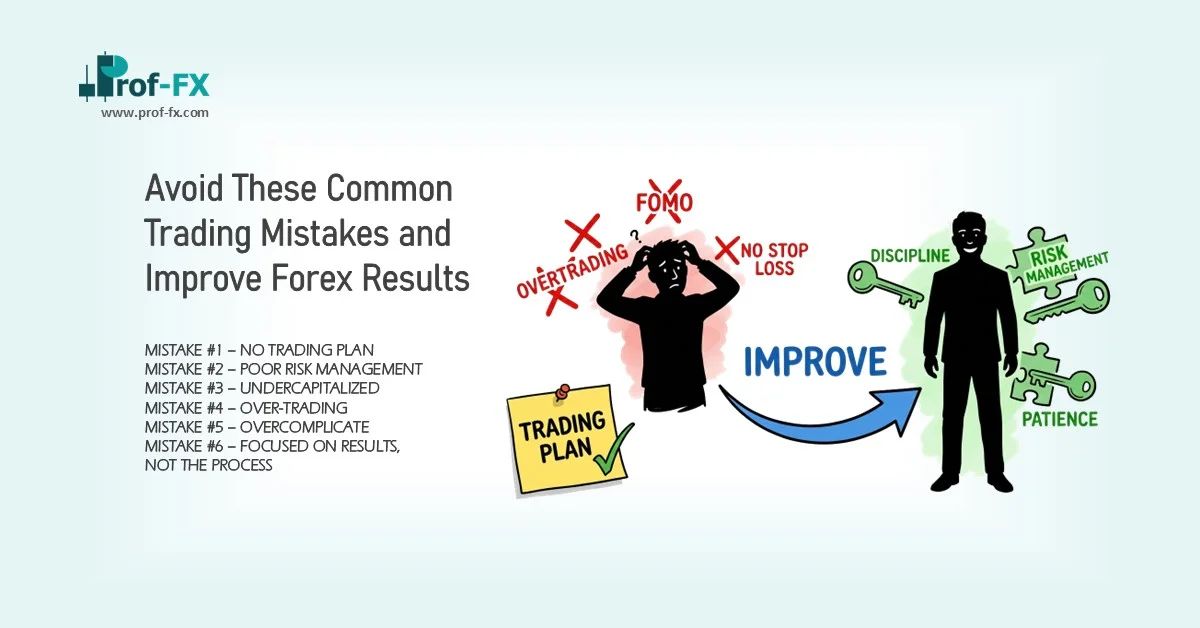
In this article, we discuss some of the most common mistakes made by both inexperienced and experienced traders, along with practical and professional solutions on how to correct them.
The key to improvement begins with self-awareness. A trader must first identify the specific mistake or weakness through honest evaluation and then focus on improving the process, not just the outcome. It is critically important to fix these mistakes one at a time.
Trying to correct everything simultaneously often leads to mental overload, frustration, and slower development.
In trading, slowing down the improvement process often helps you progress faster in the long run.
While it is not listed first below, risk management is one area that must be addressed immediately, whether this is your first day in the market or your thousandth.
MISTAKE #1 – NO TRADING PLAN
One of the most frequent mistakes among traders is operating without a clear trading plan.
Far too many traders are effectively flying blind, making decisions based on impulse, emotion, or isolated market movements.
A trading plan does not need to be excessively long or complicated.
A few well-structured pages are usually sufficient.
That said, the more clearly defined the framework, the better the execution quality.
Your trading plan should include:
- risk management parameters
- position sizing rules
- decision-making framework
- preferred trade setups
- entry and exit criteria
- examples of valid setups for reference
- rules for handling drawdowns
- guidelines for managing profitable periods
A trader without a plan is essentially relying on randomness rather than process.
From a professional standpoint, a trading plan transforms trading from speculation into a repeatable business framework.
MISTAKE #2 – POOR RISK MANAGEMENT
Poor risk management remains one of the biggest reasons traders fail.
Risking too much on a single trade is one of the most dangerous pitfalls in forex trading.
A trader must always operate within a level of risk that feels psychologically manageable.
If the exposure is too large, the decision-making process becomes severely impaired.
This often leads to:
- fear
- anxiety
- emotional exits
- moving stop losses
- revenge trading
- inconsistent execution
Another major issue is inconsistent position sizing.
For example, risking 0.5% on one trade and 3% on another creates unstable performance and makes it difficult to maintain statistical consistency.
Risk-per-trade should remain within a tight and disciplined range.
Poor risk-to-reward ratios are another frequent problem.
Many traders enter setups with a 1:1 ratio or worse, which requires a very high win rate just to break even.
For example, with a 50% win rate and a 1:1 ratio, the trader only reaches breakeven before accounting for spread, commissions, and slippage.
A more favorable structure is a 1:2 risk-reward ratio, where potential reward is twice the risk.
This asymmetry creates a much stronger expectancy profile.
Always use stop loss orders, and more importantly, respect them.
Not using a stop loss or moving it farther away after entry is effectively the same as trading without one.
In addition, traders must understand their aggregate risk exposure.
For instance, holding three long JPY pairs simultaneously may appear to be three separate trades, but due to strong correlation, it can effectively behave like one large position.
In such cases, risk should be spread across the correlated trades as if they were one.
This is a hallmark of professional risk management.
MISTAKE #3 – UNDERCAPITALIZED
A trader must have a clear understanding of their personal financial situation and only risk capital they can genuinely afford to lose.
This is not only prudent financial management but also essential for emotional stability.
When traders risk money they cannot afford to lose, they introduce unnecessary layers of stress into an already demanding activity.
This added pressure often leads to:
- fear-based decisions
- premature exits
- overleveraging
- hesitation on valid setups
Trading is already challenging enough.
Adding financial pressure significantly reduces the ability to think objectively.
Professional trading requires both financial preparedness and emotional resilience.
MISTAKE #4 – OVER-TRADING
Overtrading is one of the most common mistakes traders repeatedly make.
A large number of mediocre setups mixed with a few quality trades usually leads to sub-optimal performance.
In many cases, there is an inverse relationship between trade frequency and profitability.
Generally:
- more trades = lower profitability
- fewer, higher-quality trades = better profitability
Traders who are highly selective and strictly follow their trading plan often achieve significantly better results. The key is efficiency.
How to Become More Efficient
A highly effective solution is to use a trading checklist.
The checklist should directly reflect your trading plan and include all conditions required before entering a position.
For newer traders, a physical checklist is strongly recommended.
More experienced traders may eventually internalize the process mentally.
A proper checklist should include:
- trend direction
- support/resistance confirmation
- risk-reward ratio
- stop loss level
- position size
- confirmation signals
- market conditions
This process helps eliminate unnecessary and impulsive trades.
MISTAKE #5 – OVERCOMPLICATE
A highly valuable principle in trading is the acronym:
K.I.S.S. – Keep It Simple Stupid
In trading, more complexity does not necessarily mean better results.
Very often, more simply means more confusion.
While confluence between multiple factors can strengthen a setup, it is important to ensure those factors are not highly correlated.
For example, using three different indicators that all measure trend direction adds very little additional value.
Instead, use a balanced combination of non-overlapping tools.
A well-rounded technical framework may include:
- one method for trend identification
- one for support and resistance
- one for overbought/oversold conditions
- one for price action quality
This creates a strong analytical structure without unnecessary clutter.
The goal is clarity, not complexity.
MISTAKE #6 – FOCUSED ON RESULTS, NOT THE PROCESS
Many traders become overly focused on short-term results.
While this is understandable, it is highly detrimental over the long term.
Like any performance-based discipline, success comes from consistently following the correct process.
If a trader becomes obsessed with individual trade outcomes, they often lose sight of the system that produces positive expectancy.
Trading is fundamentally about:
- knowing where you are
- evaluating whether you followed the process
- correcting deviations immediately
The professional focus should always remain on process consistency, not isolated outcomes.
How to Stay Process-Focused
Here are several highly effective methods:
- review your trading plan regularly
- maintain a detailed trading journal
- conduct periodic performance reviews
- take regular breaks from the market
- analyze emotional patterns and execution quality
These practices help traders remain aligned with their framework and maintain a disciplined trajectory.
In professional trading, results are a byproduct of a well-executed process.
Focus on the process, and the results will follow.