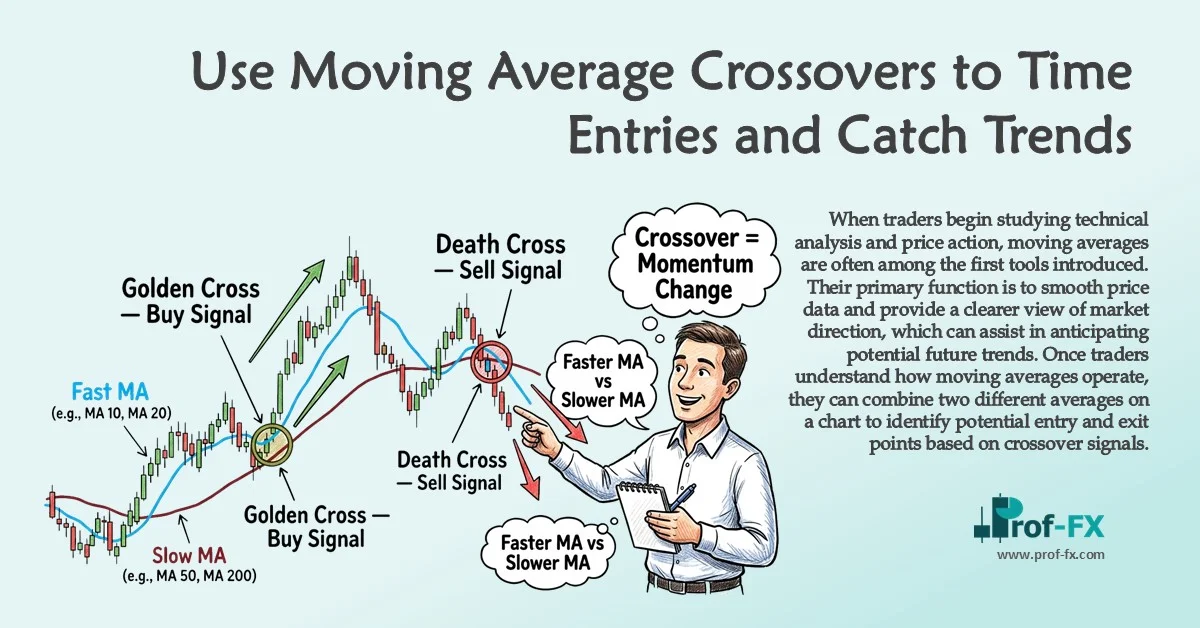
When traders begin studying technical analysis and price action, moving averages are often among the first tools introduced. Their primary function is to smooth price data and provide a clearer view of market direction, which can assist in anticipating potential future trends. Once traders understand how moving averages operate, they can combine two different averages on a chart to identify potential entry and exit points based on crossover signals. In this section, we examine the concept of moving average crossovers and how they can be systematically applied in trading decisions.
What is a Moving Average Crossover?
A moving average crossover occurs when a shorter-term (fast) moving average crosses either above or below a longer-term (slow) moving average on a price chart. This interaction between two averages provides traders with structured insight into trend development. Specifically, crossovers can help identify the prevailing direction of price movement, highlight potential entry opportunities, and signal when a trend may be weakening, ending, or reversing.
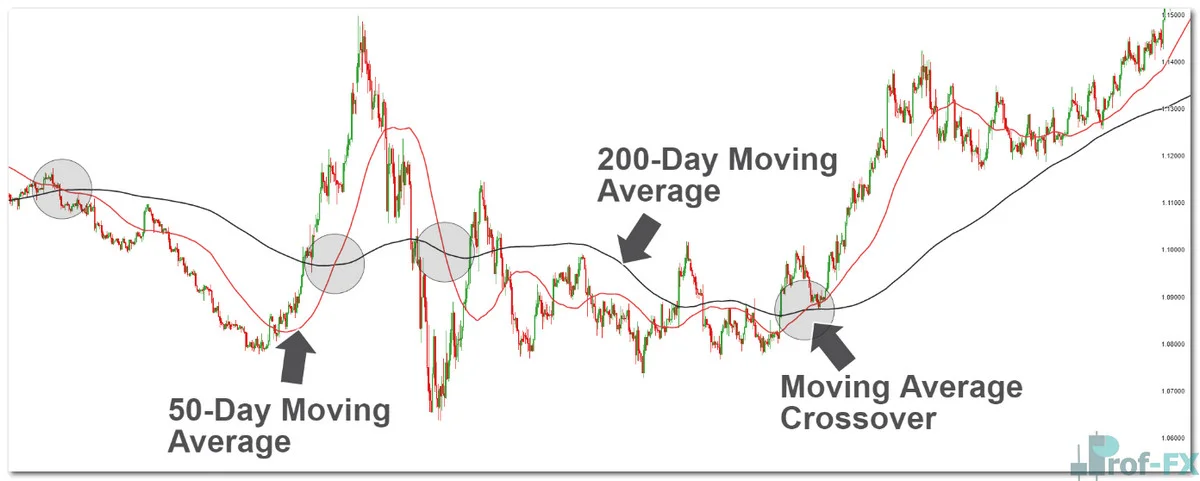
It is important to recognize that there are multiple types of moving averages. For instance, the Exponential Moving Average (EMA) assigns greater weight to recent price data, allowing it to respond more quickly to changes in market conditions compared to a Simple Moving Average (SMA). Despite these differences in calculation, the fundamental principles for interpreting crossovers particularly for entries and exits, remain consistent across all moving average types.
Trading Moving Average Crossovers
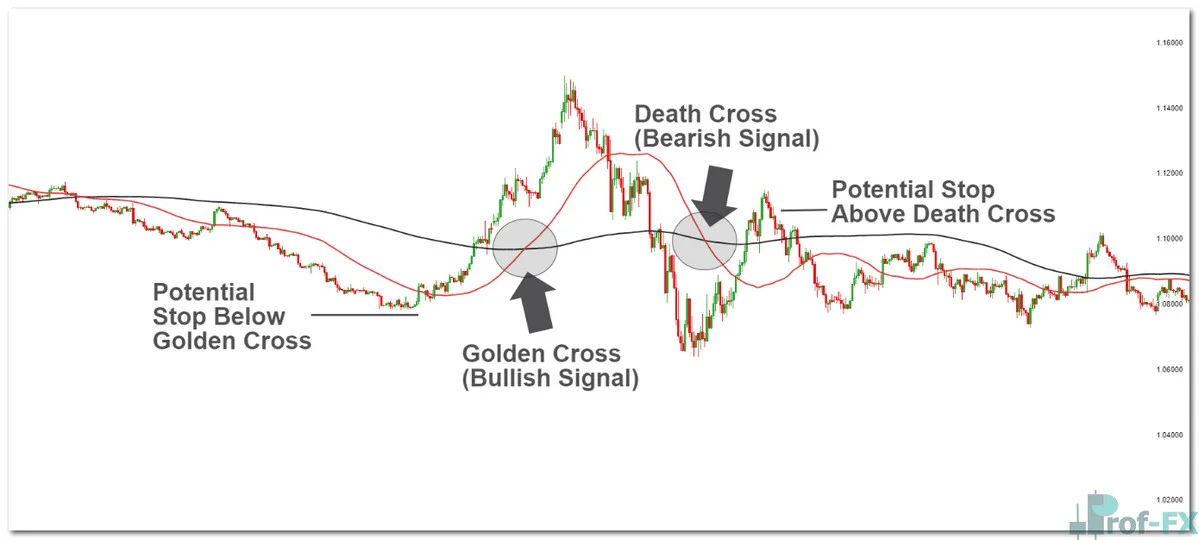
In practice, many trading strategies built around moving average crossovers focus primarily on timing entries and exits. This straightforward methodology has led to widely recognized signals such as the “Golden Cross,” which occurs when a short-term moving average crosses above a long-term moving average, and the “Death Cross,” which forms when the short-term average crosses below the long-term average.
Financial markets generally alternate between trending phases and range-bound conditions. Over time, traders often observe that trend-following approaches can offer favorable risk-to-reward characteristics with relatively less effort compared to attempting to predict reversals. Moving average crossovers play a central role in this approach, as the faster-moving average due to its sensitivity often reacts earlier and provides initial indications of a potential directional shift.
It is also essential to consider that different currency pairs and tradable instruments exhibit varying degrees of trending behavior. When a trader identifies an instrument with a consistent history of trends and observes a valid moving average crossover, it can present an opportunity to enter a position. In such cases, risk can be clearly defined by placing a stop loss above or below the crossover level, thereby aligning trade management with the structure provided by the indicator.
Benefits and Risks of Using a Moving Average Crossover Strategy
One of the primary advantages of a moving average crossover strategy is its objectivity. The signals generated are rule-based and derived directly from price data, allowing traders to make decisions that reflect underlying market strength rather than subjective judgment.
However, despite its simplicity and popularity, this strategy is not without limitations. Moving averages inherently assign equal weighting to all data points within the selected period (in the case of SMA), or apply smoothing mechanisms that still rely on past data. As a result, they are lagging indicators. This lag can delay signal generation, meaning traders may enter trades after a significant portion of the move has already occurred. Consequently, this can reduce potential profit while simultaneously increasing exposure to risk.
It is critical to understand that moving averages do not forecast future trends; they only confirm trends that have already developed. This limitation is evident in scenarios where crossover signals fail to produce the expected outcome. For example, a “Death Cross” may appear, suggesting bearish continuation, but price may instead reverse and move higher resulting in a false signal.
Another notable risk arises in sideways or ranging markets. During such conditions, price may oscillate around the moving averages without establishing a clear trend. This can lead to multiple false crossovers, where stop loss levels are repeatedly triggered without meaningful follow-through. For this reason, applying crossover strategies on lower timeframes or in non-trending environments is generally less effective and requires additional confirmation tools.
Moving Average Crossovers: A Summary
Moving average crossovers provide traders with a structured and time-confirmed approach to identifying trend-based entry and exit points. By relying on objective signals, traders can reduce the emotional influence that often accompanies decision-making in financial markets. This simplicity and clarity make crossover strategies particularly appealing, especially for those who are new to trading.
However, their effectiveness depends on proper context and disciplined application. While they can help traders participate in significant market moves, they must be used with an understanding of their lagging nature and susceptibility to false signals in ranging conditions. When integrated into a broader trading framework that includes risk management and market condition analysis, moving average crossovers can serve as a reliable component of a professional trading strategy.