What is Currency Correlation?
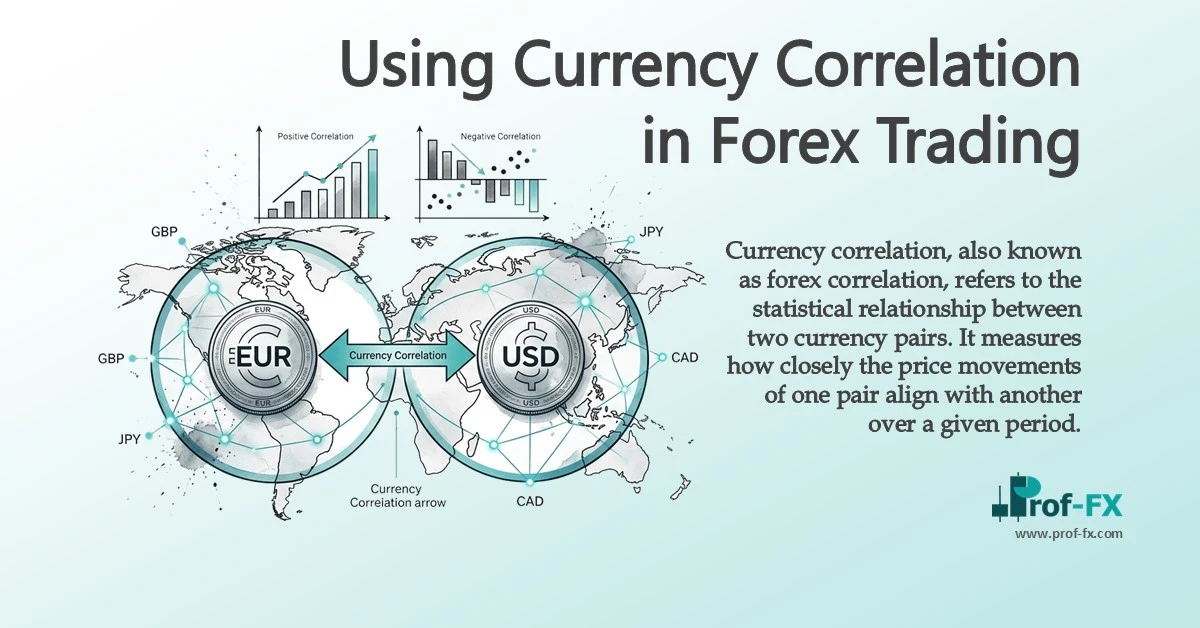
Currency correlation, also known as forex correlation, refers to the statistical relationship between two currency pairs. It measures how closely the price movements of one pair align with another over a given period.
Because currencies are always traded in pairs, no pair operates in isolation. Every trade inherently reflects the relative strength of one currency against another, making it essential for traders to understand how different pairs interact within the broader market.
From a professional perspective, currency correlation is not just a theoretical concept, it is a practical tool for managing exposure, refining trade decisions, and avoiding redundant positions.
Using Currency Correlation in Forex Trading
Understanding correlation allows traders to identify:
- Positions that offset each other (hidden hedging)
- Positions that double exposure (compounding risk)
- Opportunities for portfolio diversification
Forex correlation is expressed through a correlation coefficient, which ranges from -1 to +1:
- +1 (Perfect Positive Correlation) → Pairs move in the same direction consistently
- -1 (Perfect Negative Correlation) → Pairs move in opposite directions
- 0 (No Correlation) → No consistent relationship
For example, a correlation of +0.50 between AUD/USD and EUR/USD suggests that historically, both pairs have moved in the same direction approximately 50% of the time.
This probabilistic nature highlights an important principle: correlation is dynamic, not fixed.
Interpreting Correlation Through Charts
The relationship between currency pairs becomes clearer when visualized over time.
EUR/USD vs GBP/USD Correlation
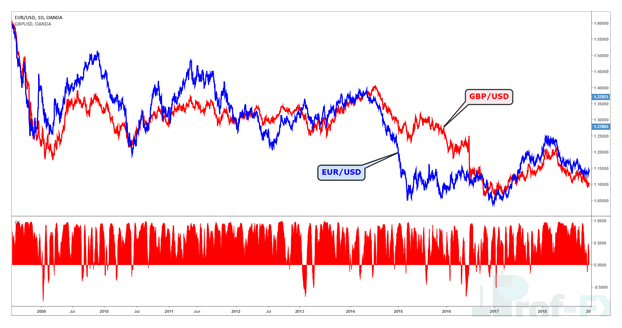
In this example, EUR/USD and GBP/USD tend to move in the same direction due to their shared exposure to the US dollar. However, fluctuations in the correlation coefficient reveal that this relationship is not perfectly stable.
- Peaks indicate strong positive correlation
- Troughs indicate periods of divergence or negative correlation
This reinforces the need for traders to continuously monitor correlations rather than assume consistency.
USD/CHF vs EUR/USD Correlation
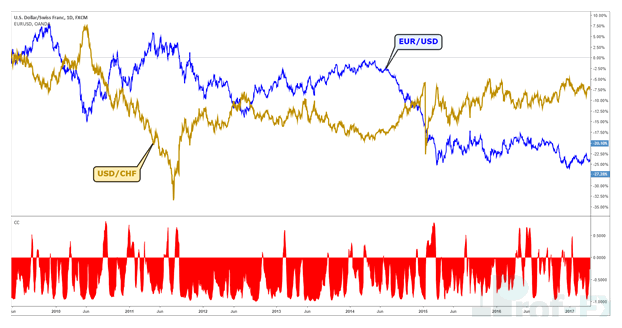
Here, the correlation is generally negative. This inverse relationship exists because:
- USD strength pushes USD/CHF upward
- The same USD strength pushes EUR/USD downward
However, occasional shifts into positive territory demonstrate that market conditions, sentiment, and macroeconomic factors can temporarily override typical correlations.
Reading a Currency Correlation Table
Correlation tables provide a structured way to analyze relationships across multiple timeframes.
Example (GBP/USD vs other pairs):
| Period | EUR/USD | USD/JPY | USD/CHF | USD/CAD | AUD/USD | NZD/USD |
| 20 Days | -0.16 | 0.25 | 0.50 | -0.35 | -0.33 | -0.57 |
| 60 Days | 0.77 | -0.29 | -0.58 | -0.67 | -0.12 | -0.46 |
| 90 Days | 0.61 | 0.20 | -0.36 | -0.45 | -0.01 | -0.03 |
Key professional insights:
- Correlations vary across timeframes
- Short-term relationships may contradict long-term trends
- Strong correlations typically exist above +0.5 or below -0.5
For instance, GBP/USD and USD/CHF may show temporary positive correlation over 20 days but remain structurally negative over longer periods due to safe-haven demand for CHF during risk-off environments.
Why Traders Use Currency Correlation
1. Inter-Market Trading
Correlation extends beyond forex into other asset classes.
For example:
- USD/CAD and Oil: Canada is a major oil exporter, so rising oil prices often strengthen CAD, pushing USD/CAD lower
- AUD and Gold: As a leading gold exporter, Australia’s currency tends to strengthen when gold prices rise
Professional traders use these relationships to:
- Confirm trade setups
- Anticipate currency strength
- Identify leading indicators across markets
2. Hedging a Position
Correlation is a powerful hedging tool.
For example:
- If a trader is long AUD/USD, they may take a position in USD/CHF to offset USD exposure due to their negative correlation
This approach reduces directional risk while maintaining exposure to the underlying trade idea.
Additionally, differences in pip values between pairs can be strategically used to fine-tune hedge ratios.
3. Diversifying Risk
Correlation helps traders avoid overexposure to similar market drivers.
For instance, holding positions in:
- GBP/NZD
- USD/JPY
- EUR/JPY
…requires checking whether these trades are correlated. If they are highly correlated, the portfolio may carry concentrated risk despite appearing diversified.
True diversification occurs when correlations fall between -0.3 and +0.3, indicating weak or no relationship.
Summary: Forex Correlation Trading Tips
When integrating correlation into a trading strategy, professional traders focus on the following principles:
- Leverage intermarket relationships
Use correlations with commodities and indices to gain deeper market insight - Focus on strong correlations
Values above +0.5 or below -0.5 indicate meaningful relationships - Avoid hidden overexposure
Multiple trades in correlated pairs can unintentionally amplify risk - Diversify intelligently
Seek low-correlation pairs to balance portfolio risk - Continuously monitor correlations
Market dynamics shift, and correlations evolve over time
Final Conclusion
Currency correlation is a strategic layer of market analysis that separates retail-level trading from professional execution.
Rather than viewing trades in isolation, experienced traders analyze how positions interact within the broader market structure. This allows for better risk control, improved trade selection, and more consistent performance over time.
In practice, mastering correlation is not about memorizing relationships, it is about understanding the underlying economic forces that drive them.