

The phrase “the trend is your friend” remains one of the most enduring principles in forex trading. Its longevity is not based on theory alone, but on the practical reality that trading in the direction of the prevailing trend significantly improves the probability of success.
Forex trendlines are among the most widely used tools in technical analysis because they offer a clear, objective, and visually simple method for identifying market direction, support and resistance, and potential reversal points.
This guide provides a professional breakdown of what forex trendlines are, how to draw them correctly, and how to apply them effectively in live market conditions.
Why the Trend Is Your Friend in Forex Trading
Experienced traders consistently acknowledge that no trading strategy delivers a 100% win rate. This is a fundamental reality of financial markets.
Because losses are inevitable, the objective is not perfection, but probability enhancement.
One of the most reliable ways to improve trade quality is by aligning positions with the dominant market trend.
Trading with the trend helps compensate for imperfections in entry timing, temporary price pullbacks, and short-term volatility spikes.
For example, a short position entered slightly early may still become profitable if the broader market trend remains strongly bearish.
This is precisely why trend-based trading remains a core principle among professional forex traders.
Even when price temporarily moves against the trade, a strong underlying trend can convert a potentially losing position into a profitable one, depending on stop loss placement and risk tolerance.
The chart below clearly demonstrates that more pips are typically available in the direction of the trend than against it.
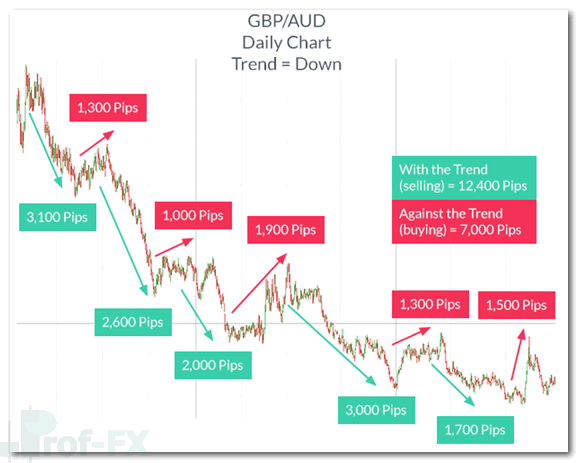
This is the key reason why trend-following strategies remain highly effective across multiple market environments.
How to Determine the Trend in Forex Trading
The first step in trend analysis is to open a price chart of your chosen currency pair and review approximately 100 to 200 candles.
Then ask a simple but critical question:
In which direction is price generally moving?
This straightforward process helps eliminate unnecessary complexity and keeps the analysis objective.
Identifying an Uptrend
A valid uptrend is confirmed when the market forms a consistent sequence of:
- higher highs
- higher lows
This structure indicates that buyers continue to push price upward while pullbacks remain shallow and controlled.
A typical uptrend formation looks like this:
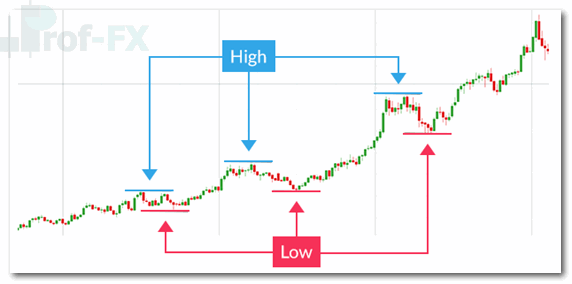
Notice that:
- each new high exceeds the previous high
- each new low remains above the prior low
This price behavior objectively confirms bullish market structure.
From a technical perspective, as long as this sequence remains intact, the market bias should remain bullish.
Recognizing When an Uptrend Ends
No trend lasts forever.
A trend reversal begins when the previous market structure is broken.
In the case of an uptrend, traders should monitor for the formation of:
- lower highs
- lower lows
The first major warning sign appears when price breaks below the previous swing low.
This often signals weakening bullish momentum and the potential beginning of a bearish reversal.
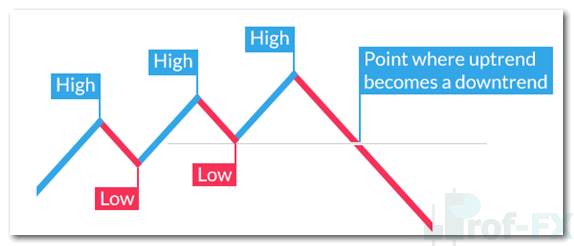
At this stage, traders should exercise caution and prepare for a possible shift in market bias.
The most objective confirmation comes when the market begins establishing a sustained sequence of lower highs and lower lows.
Identifying a Downtrend
A valid downtrend is confirmed when price consistently forms:
- lower highs
- lower lows
This structure indicates sustained selling pressure and bearish control.
A typical downtrend chart appears as follows:
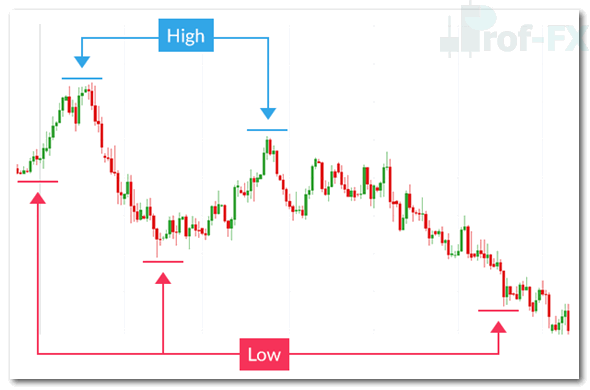
Each rally fails to exceed the previous high, while each new decline pushes lower than the previous low. This is the clearest technical confirmation of bearish momentum. As long as this structure remains intact, traders should maintain a short bias.
Recognizing a Downtrend Reversal
A downtrend transitions into an uptrend when price begins forming:
- higher highs
- higher lows
This shift in structure indicates that sellers are losing control and buyers are beginning to dominate.
The image below illustrates this transition.
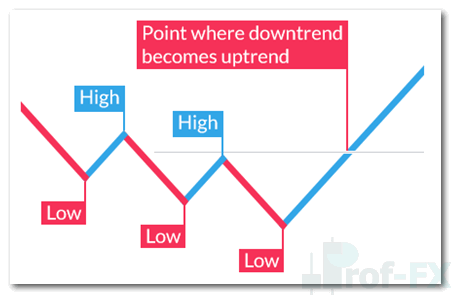
This structural change is one of the most important reversal signals in price action analysis.
For professional traders, market structure always takes priority over assumptions.
Focus Only on Obvious Trends
It is important to understand that there are no rigid rules for selecting every swing high and swing low during trend analysis.
The goal is not perfection.
The objective is to identify the most obvious and clearly visible market structure.
A highly effective practical rule is this:
Only trade trends that are immediately obvious at first glance.
If the direction is unclear, uncertain, or open to interpretation, move to another forex pair.
A strong trend should be so visually obvious that, figuratively speaking, even a child could identify its direction from across the room.
This level of clarity helps eliminate emotional decision-making and weak trade setups.
Using Forex Trendlines in Technical Analysis
One of the easiest ways to identify and confirm a trend is by drawing forex trendlines.
Trendlines help traders visually define:
- market direction
- dynamic support and resistance
- potential breakout zones
- possible reversal points
In an uptrend, draw a trendline by connecting multiple swing lows. In a downtrend, connect multiple swing highs.
This creates a clear visual framework that simplifies trend recognition.
The chart below shows a strong uptrend confirmed by higher highs and higher lows.
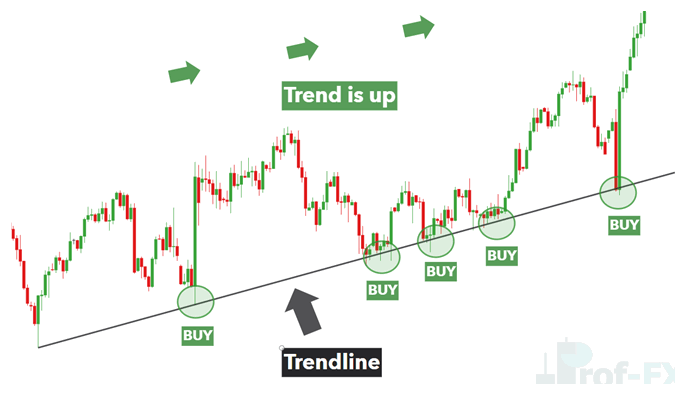
By connecting the lows, the trendline acts as dynamic support.
This allows traders to identify potential buy zones whenever price retraces toward the trendline.
As long as price continues to respect this support and the overall bullish structure remains intact, the preferred strategy is to look for long entries.
Conversely, if price decisively breaks below the trendline and market structure shifts, this may signal a potential trend reversal or breakout opportunity.
This is why trendlines are not merely drawing tools—they are highly practical decision-making instruments.
Professional Application of Trendlines in Forex Trading
From a professional trading perspective, trendlines should be used to support decision-making, not replace it.
The most effective approach is to combine trendlines with:
- support and resistance
- candlestick confirmation
- breakout analysis
- momentum indicators
- stop loss and take profit planning
A trendline that aligns with key horizontal support or resistance levels often produces higher-probability setups.
This layered confirmation significantly improves trade quality.
The conclusion is clear:
Trading in the direction of the dominant trend remains one of the most statistically sound approaches in forex trading.
Trendlines provide an objective framework for identifying that direction with precision.
Further Reading on Forex Technical Analysis
Many traders understand the theory behind trendlines but struggle with real-market execution.
The next step is learning how to build a trend-following trading strategy that includes:
- entry confirmation
- stop loss placement
- take profit targets
- breakout validation
- reversal detection
Trendlines are only one part of a broader technical analysis framework.
Mastering them, however, establishes a strong foundation for more advanced forex trading techniques.
Prof FX continues to provide professional forex news and technical analysis on the trends that shape the global currency markets.