
Range trading is one of the most overlooked market conditions among newer retail traders. This often happens because many assume that profit potential is inherently limited.
The common perception is simple:
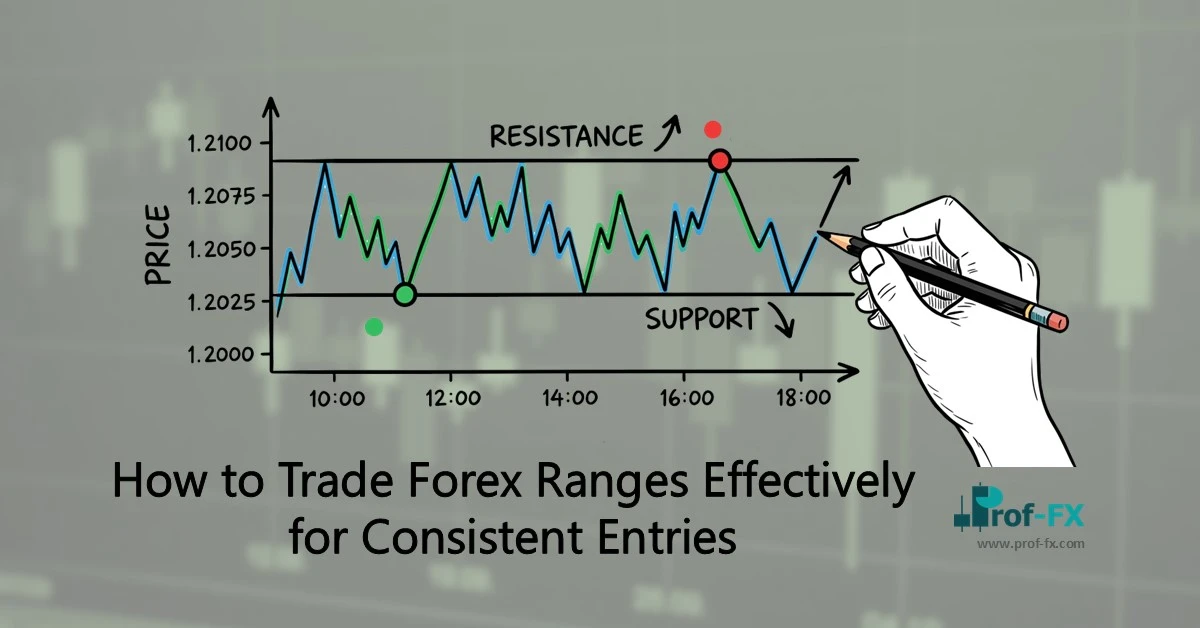
- buy at support
- sell at resistance
- profit is capped by the width of the range
While this logic is partially correct, professional range trading is far more flexible than that.
In reality, range-bound markets can offer consistent, repeatable setups with highly controlled risk, making them particularly attractive for traders focused on discipline and capital preservation.
This guide explains how to identify ranges, how to trade them using price action and indicators, and why experienced traders often value these “less exciting” environments.
What Is Range Trading?
Range trading, also known as mean-reversion trading, is based on the expectation that price will continue moving back and forth between clearly defined support and resistance levels.
The core logic is straightforward:
- buy near support in anticipation of a bounce higher
- sell near resistance expecting price to move lower
This strategy assumes that the market is currently lacking a strong directional trend.
Instead, price repeatedly reverts toward its average.
However, range trading does not necessarily mean profit must be limited strictly to the opposite side of the range.
A more advanced approach involves scaling out of positions and leaving part of the trade open for a possible breakout.
For example:
A trader sells near resistance. When price falls toward support, they close part of the position to lock in profit.
At the same time, they may move the stop loss to break-even. This protects the remaining position.
If support breaks, the remaining trade can continue into a fresh bearish breakout, allowing profit potential beyond the original range.
This is one of the most effective ways to combine mean-reversion with breakout logic.
Using Price Action to Find Support and Resistance
Price action remains one of the most reliable methods for identifying range zones.
Support and resistance levels are often visible as areas where price has previously reversed multiple times.
These prior inflection zones provide objective reference points.
The most effective approach is to locate price areas where the market has repeatedly:
- bounced upward → support
- reversed downward → resistance
Once these zones are identified, traders can wait for evidence that buyers or sellers are re-entering the market.
One of the strongest confirmation signals comes from candlestick wicks.
Long lower wicks near support often suggest buyer absorption. Long upper wicks near resistance often suggest seller rejection.
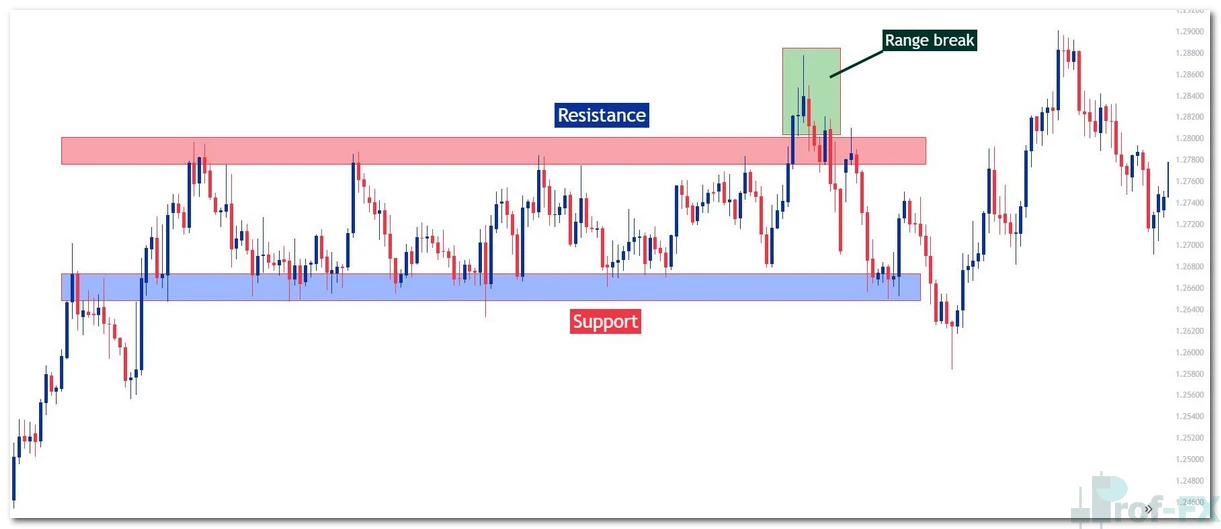
This wick-based confirmation helps improve entry timing and reduce premature trades.
Using Indicators to Trade Ranges
While price action is highly effective, many traders prefer additional confirmation through technical indicators. One of the most practical tools for identifying range conditions is the Average Directional Index (ADX).
Average Directional Index
ADX measures trend strength. When ADX remains below a threshold such as 20, it generally suggests that the market lacks a strong trend.
This creates a favorable environment for mean-reversion strategies.
A professional framework often looks like this:
- ADX below 20 → investigate range trades
- ADX above 20 → avoid range entries
This helps filter out trending environments where mean-reversion setups are less reliable.
Combining ADX with Stochastic for Entry Signals
Once the market condition is confirmed as range-bound, traders can use oscillators to identify entries.
Two widely used tools are:
- Slow Stochastic
- Commodity Channel Index (CCI) Commodity Channel Index
Stochastic Oscillator
For example:
- bullish stochastic crossover near support → potential buy signal
- bearish stochastic crossover near resistance → potential sell signal
This creates a clear two-step framework:
Step 1
Use ADX to confirm the market is non-trending.
Step 2
Use stochastic crossover signals for entries.
In the example below:
- blue lines indicate bullish signals
- red lines indicate bearish signals
Signals are only valid while ADX remains below 20. Once ADX rises above 20, signals are ignored.
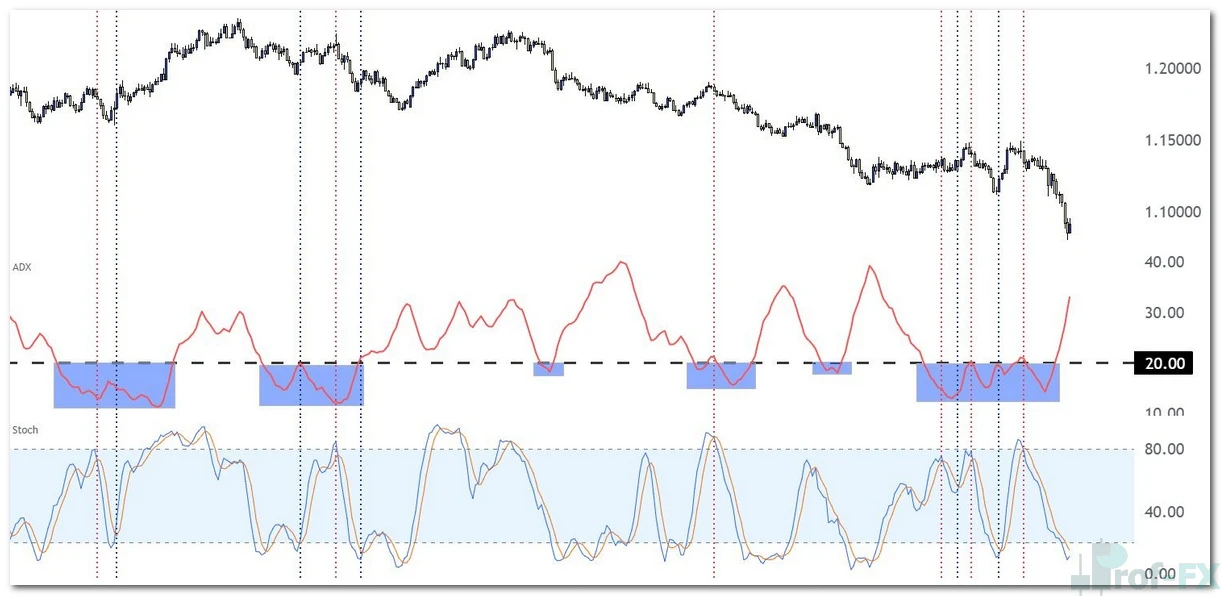
This simple logic helps remove emotional decision-making and improves consistency.
Why Range Trading Is Valuable
One of the biggest advantages of range trading is risk control. Because support and resistance levels are clearly defined, stop loss placement becomes highly objective.
For example:
- long positions → stop below support
- short positions → stop above resistance
This means traders know relatively early whether the trade thesis remains valid.
If support or resistance breaks, the setup is no longer working. This clarity is extremely valuable from a professional risk management standpoint.
Compared to highly volatile breakout environments, range trading often offers more predictable stop placement and tighter risk exposure.
Why New Traders Often Ignore Range Markets
Many new traders overlook range-bound environments because they are not as exciting as strong trends or breakout moves.
A range does not offer the dramatic volatility that many associate with fast-moving markets.
It lacks the “explosive move” appeal often seen in assets like:
- crypto
- gold
- major forex pairs
However, from a professional trading perspective, this is precisely what makes range trading attractive.
The reduced volatility often allows for:
- cleaner technical structure
- clearer risk management
- repeatable trade setups
- better emotional control
Experienced traders frequently prefer these “less entertaining” conditions because they support consistency over excitement.
Trading Insight
The key principle behind range trading is this:
“trade the boundaries until the market proves otherwise”
As long as support and resistance continue holding, the mean-reversion thesis remains valid.
At the same time, traders should remain aware that ranges can eventually transition into breakouts.
This is why scaling out and leaving a partial position open can be a highly effective advanced strategy.
It combines:
- controlled mean-reversion profits
- breakout continuation potential
This hybrid approach significantly improves flexibility.
Final Conclusion
Range trading is not about chasing maximum volatility. It is about exploiting repeatable price behavior within clearly defined risk parameters. For disciplined traders, this often creates a more sustainable framework than emotionally driven trend chasing.
The most important takeaway is clear:
“Range markets may be less exciting, but they often provide some of the most manageable risk setups in forex trading”
Prof FX continues to provide authoritative forex news and technical analysis on the trends influencing the global currency markets.