
The Emotional Impact of a Losing Trade
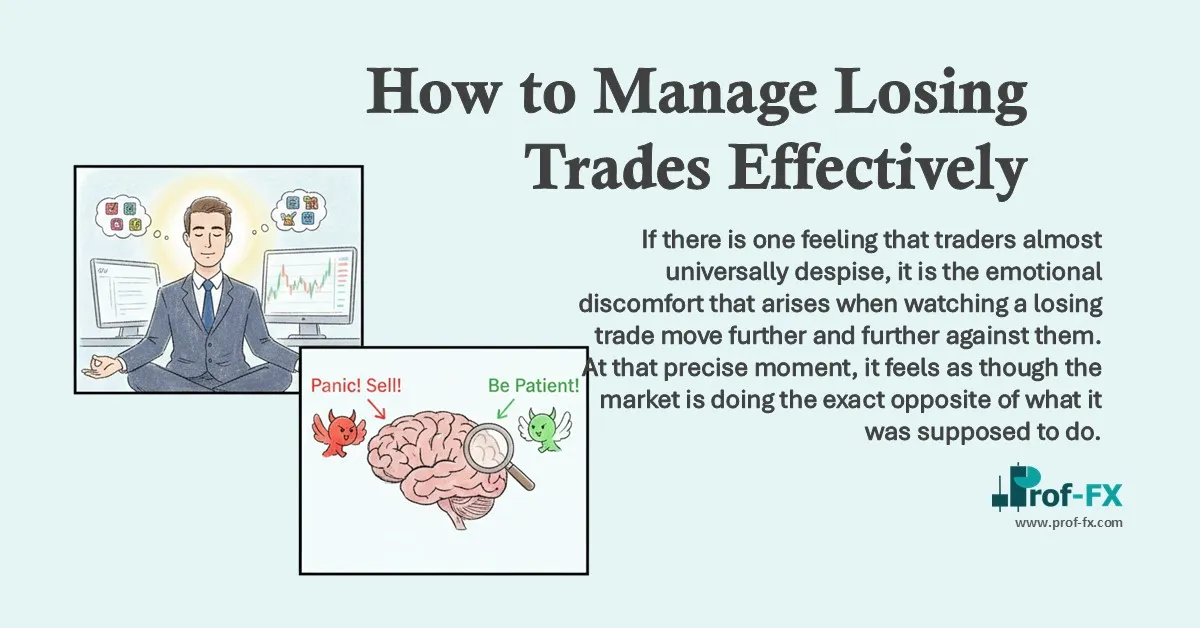
If there is one feeling that traders almost universally despise, it is the emotional discomfort that arises when watching a losing trade move further and further against them. At that precise moment, it feels as though the market is doing the exact opposite of what it was supposed to do.
In that situation, you are essentially watching your account equity decline in real time – the complete contradiction of why you participate in financial markets in the first place. If the position is left unmanaged, losses can escalate rapidly. An overleveraged trade without a clear exit plan can quickly spiral into an outsized loss, and prolonged adverse price movement can cause damage that is difficult – or even impossible – to recover from.
This is why learning how to manage losing trades is not optional. It is a core survival skill for every forex trader, regardless of experience level.
Prevention Is Always the Best Medicine in Trading
By prevention, we do not mean avoiding losses entirely – that would be unrealistic. Losses are a natural and unavoidable part of trading. What traders should focus on instead is preventing unmanageable trading situations, where emotions replace logic and decisions are made reactively rather than strategically.
A common example is entering an oversized position without a stop-loss. Once price begins moving against the trader, they are forced to watch the loss grow while debating emotionally how to react – already down money and facing the possibility of losing much more. At that stage, objectivity is often gone.
This behavioral flaw has been extensively documented. In the Prof FX Forex Education research, one critical finding stood out clearly:
The number one mistake forex traders make is allowing losses to be too large while cutting winning trades too short.
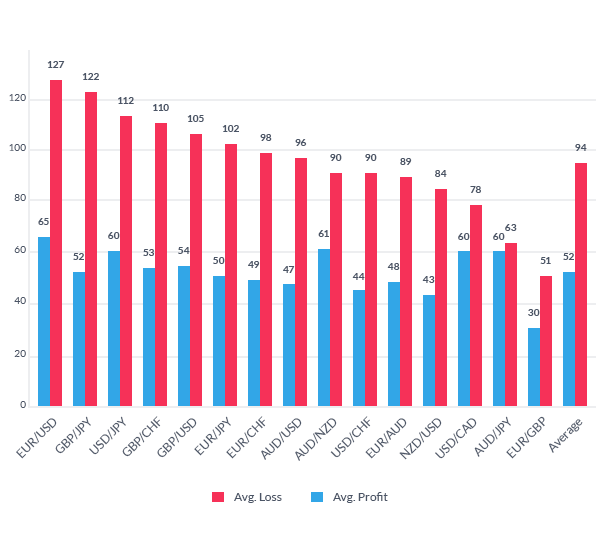
The data shows that many traders experience average losses that are significantly larger than their average gains. In fact, some traders can maintain a winning percentage of 60% and still lose money overall – simply because their losses outweigh their wins.
Overconfidence Can Be Just as Dangerous as Inexperience
Many assume this mistake is exclusive to new traders. That assumption is incorrect. Overconfidence is often a major contributor to poor loss management, especially among experienced traders.
Confident traders may believe they can manage positions “on the fly,” entering large trades based on what feels like a rare or exceptional opportunity. In doing so, they forget a fundamental truth of trading: nobody can predict the future with certainty.
This happens to all of us. We convince ourselves that we have an edge, an insight, or a special read on the market. But hope can quickly turn into despair. When that happens, even seasoned traders can suffer from the same lack of planning that afflicts beginners.
If this has happened to you, there is no value in dwelling on past mistakes. It has happened to me, and it has happened to nearly every trader who has spent enough time in the markets. The solution is not regret – the solution is education and structure.
Always Define Risk Before Entering the Trade
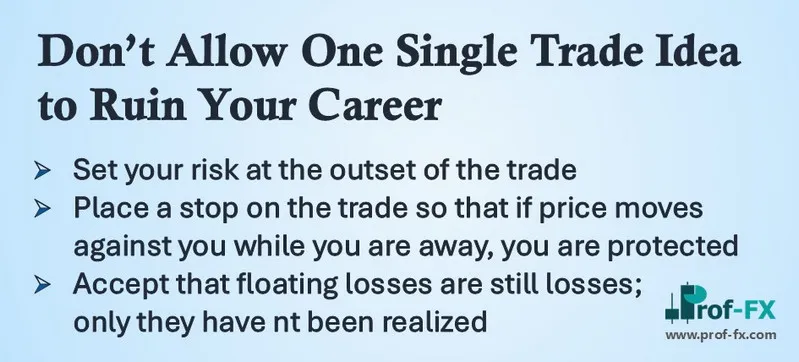
The most effective way to manage losing trades is to address them before they ever occur. As Martin Thomas stated in The Number One Mistake that Forex Traders Make: “Always trade with a stop.”
A stop-loss should be defined at the outset of the trade – before you have any emotional attachment or “skin in the game.” This removes the need to ask painful questions like “How much is too much?” while you are already holding a losing position.
By predefining risk, you transform uncertainty into a controlled variable. You already know the worst-case scenario, and you have accepted it in advance.
Acceptance: A Floating Loss Is Still a Loss
Some traders convince themselves that a losing trade is not truly a loss until it is closed. This mindset is dangerous.
Make no mistake: a floating loss is still a loss. The capital tied up in that position is no longer available to you, and the market price has already moved away from your entry. The only difference is that the loss has not yet been realized.
Accepting this reality is critical. If you are asking yourself, “When should I stop the bleeding?”, the first step is acknowledging that the loss already exists – and that it can still grow larger if unmanaged.
Draw Your Line in the Sand
Once you assess your account equity – factoring in both realized and floating Profit or Loss – you can then decide how much additional risk you are willing to commit to that trade idea.
In the Prof FX Trading Course, traders are advised to keep total account risk below 5% of equity. For example, if a trader has $10,000 in account equity, they would aim to limit total potential losses to $500.
Some traders further refine this approach by diversifying risk across multiple positions. If the trader wants to manage four trades simultaneously while keeping total risk under 5%, they could risk 1.25% per trade. In this case, with a $10,000 account, that equals $125 risk per position.
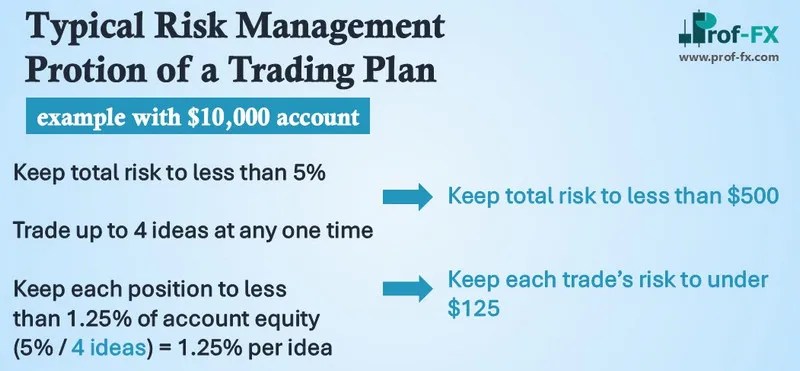
Once you calculate the portion of equity you are willing to risk, the final step is straightforward: place a stop-loss at the price level where that risk is reached. If price moves against you to that point, the loss is capped—and the bleeding stops.
Trade Survival Comes Before Trade Perfection
Managing losing trades is not about being right—it is about staying solvent. Traders who survive long enough to let probability work in their favor are the ones who succeed over the long term.
By accepting losses, defining risk in advance, and respecting account equity, you ensure that no single trade has the power to derail your trading career. That is the mindset of a professional trader—and it is the foundation upon which consistent performance is built.