
Traders frequently compare forex and stocks to determine which market offers the best opportunities. While both markets are interconnected through global financial systems, they operate under fundamentally different structures. The forex market, in particular, possesses unique characteristics that distinguish it from equities and, for many participants, make it a more flexible and accessible trading environment.
Choosing between forex and stocks ultimately depends on individual trading goals, time availability, and preferred strategy. However, understanding their differences and similarities is essential for making informed decisions based on liquidity, volatility, and overall market conditions.
Top 5 Differences Between Forex and Stocks
Below is a simplified comparison of the two markets:
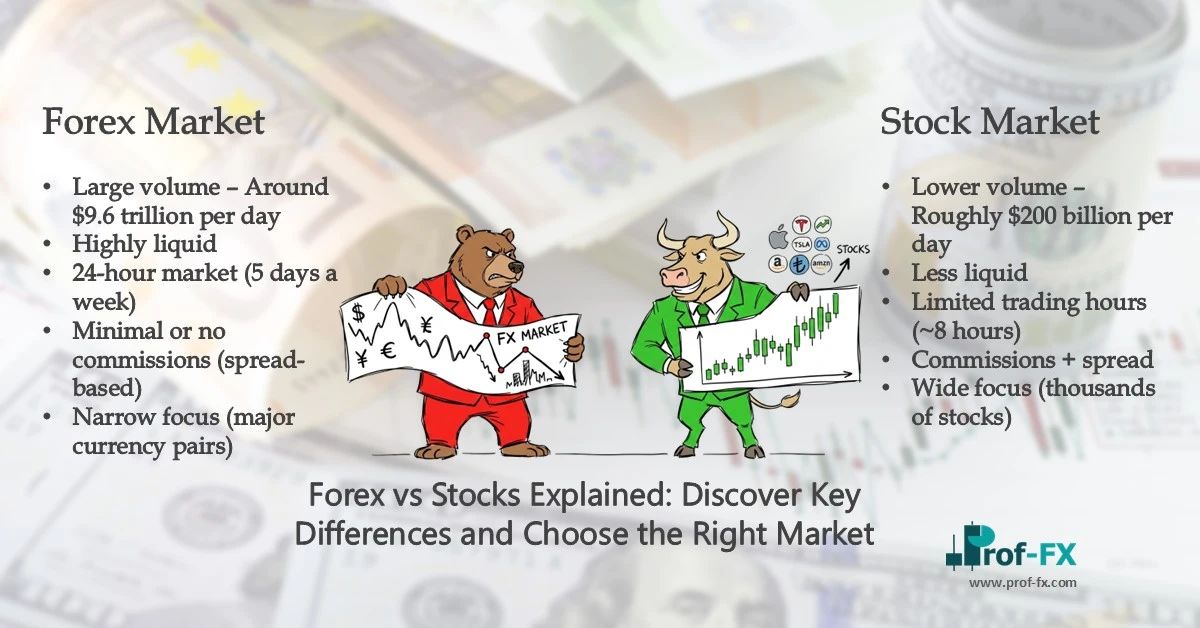
| Forex Market | Stock Market |
| Large volume – Around $9.6 trillion per day | Lower volume – Roughly $200 billion per day |
| Highly liquid | Less liquid |
| 24-hour market (5 days a week) | Limited trading hours (~8 hours) |
| Minimal or no commissions (spread-based) | Commissions + spread |
| Narrow focus (major currency pairs) | Wide focus (thousands of stocks) |
1) Volume
One of the most significant distinctions is trading volume. The forex market processes approximately $9.6 trillion in daily transactions, with the majority concentrated in major currency pairs such as EUR/USD, USD/JPY, GBP/USD, and AUD/USD. In contrast, global stock markets collectively average around $200 billion per day.
This substantial volume provides a structural advantage. High trading activity ensures smoother execution, enabling traders to enter and exit positions more efficiently and closer to their desired price levels. While all markets can experience price gaps, deeper liquidity in forex reduces this risk compared to equities.
2) Liquidity
Liquidity is directly linked to volume. The forex market’s high liquidity results in tighter spreads and lower transaction costs, especially for major currency pairs. This is a key reason why many traders favor forex over stocks.
In contrast, stock markets often experience wider spreads, particularly in less frequently traded equities. Lower liquidity can also lead to slippage, especially during volatile conditions.
From a cost-efficiency perspective, forex trading offers a clear structural advantage.
3) 24-Hour Market Access
Forex operates as an over-the-counter (OTC) market, meaning transactions occur through a global network of banks and financial institutions rather than a centralized exchange. This structure allows trading to continue across different time zones, providing nearly 24-hour access, five days a week.
Stock markets, on the other hand, are bound by exchange-specific trading hours. This limitation restricts when traders can react to market developments.
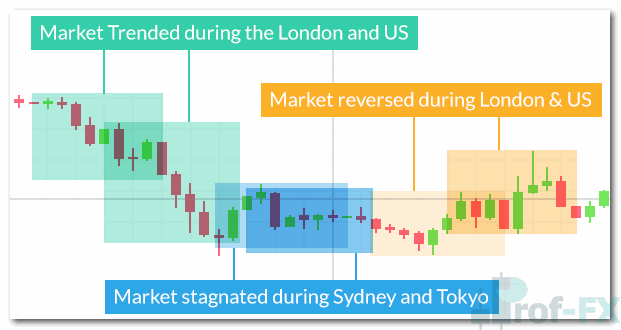
Continuous access in forex enables traders to respond to global economic events in real time, offering greater flexibility in execution.
4) Minimal or No Commission
Most forex brokers operate on a spread-based model, where the cost of trading is embedded in the difference between the bid (buy) and ask (sell) price. This eliminates the need for separate commission fees in many cases.
In stock trading, traders typically incur both spreads and broker commissions, increasing overall transaction costs.
Forex spreads are also highly transparent. For example, in major pairs like EUR/USD, traders can clearly see the spread before executing a trade, allowing for precise cost calculation.
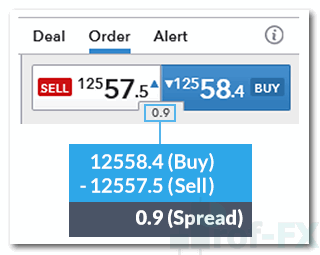
This cost transparency and efficiency make forex particularly attractive for active traders.
5) Narrow Focus vs Wide Focus
Forex trading involves a relatively small set of major currencies, typically eight primary economies. Since currencies are traded in pairs, traders focus on the relationship between two economies, analyzing divergence or convergence in economic performance.
In contrast, the stock market includes thousands of individual companies, each influenced by unique factors such as earnings, management decisions, and industry performance.
This difference means:
- Forex traders benefit from a more concentrated analytical focus
- Stock traders must track a broader and more complex set of variables
Economic calendars make it easier for forex traders to monitor key drivers such as interest rates, inflation, and employment data.
Should You Trade Forex or Stocks?
The choice between forex and stocks depends largely on trading style and objectives. Each market offers advantages depending on the approach:
Short-Term Trading (Scalping)
- Definition: Opening and closing trades within minutes to capture small price movements
- Advantages: Focus on volatility rather than long-term fundamentals
- Disadvantages: High trade frequency increases risk if strategy is not refined
- Best Fit: Forex, due to low transaction costs and high liquidity
Medium-Term Trading
- Definition: Holding positions for several days based on technical setups
- Advantages: Lower capital requirements compared to long-term investing
- Disadvantages: Requires consistent analysis and monitoring
- Best Fit: Suitable for both forex and stocks
Long-Term Trading
- Definition: Holding positions for months or years, often based on fundamental analysis
- Advantages: Less frequent monitoring required
- Disadvantages: Requires larger capital to withstand market fluctuations
- Best Fit: Stocks, as equities tend to exhibit more sustained directional trends compared to forex
Forex vs Other Markets: FAQs
How can I transition from forex to stock trading?
Transitioning requires understanding that forex prices are primarily driven by interest rates, monetary policy, and macroeconomic expectations. In contrast, stock prices depend on company performance, earnings reports, and broader economic conditions. Adapting to these different drivers is essential for a successful transition.
Are there differences between forex and commodities trading?
Yes. Forex markets are generally less regulated and more liquid, allowing for higher leverage usage. Commodities, like stocks, trade on centralized exchanges and are subject to regulatory limits, including price ceilings and floors that can temporarily halt trading. Forex markets do not impose such restrictions, allowing continuous trading.
Conclusion
Forex and stock markets each offer distinct advantages. Forex stands out for its high liquidity, low transaction costs, and 24-hour accessibility, making it ideal for short-term and active traders. Stocks, on the other hand, provide opportunities for long-term growth driven by company fundamentals.
The key takeaway is clear: selecting the right market depends on aligning its characteristics with your trading style, risk tolerance, and time commitment. A structured, informed approach is essential regardless of the market you choose.
Prof FX provides forex news and technical analysis focused on the key trends shaping global currency markets.