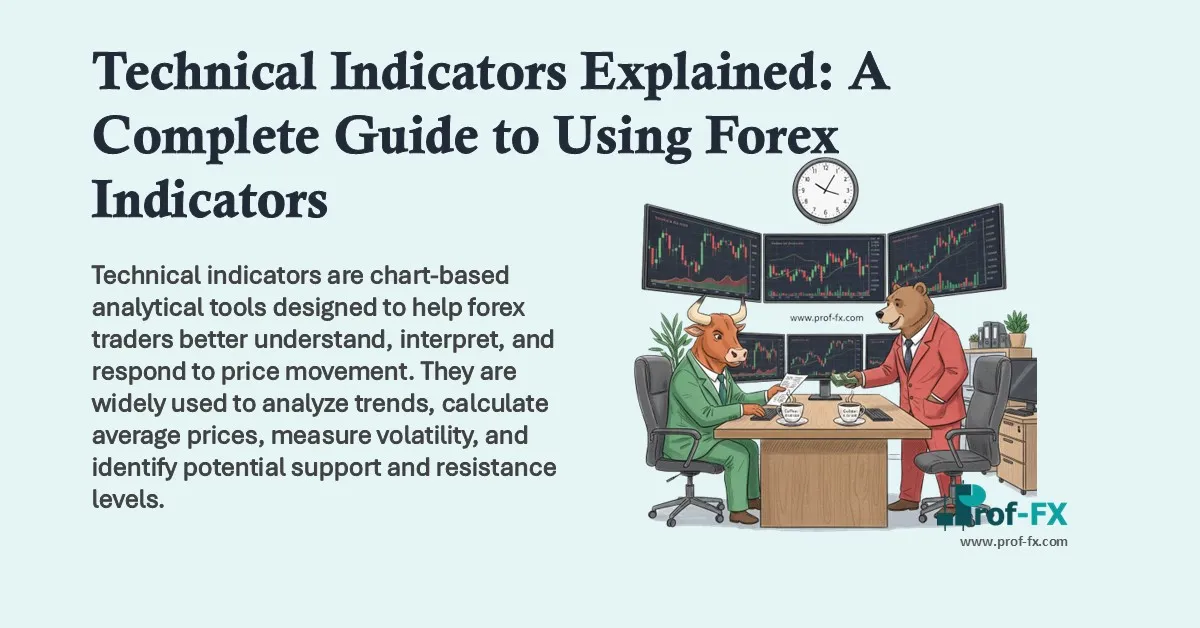
Technical indicators are chart-based analytical tools designed to help forex traders better understand, interpret, and respond to price movement. They are widely used to analyze trends, calculate average prices, measure volatility, and identify potential support and resistance levels.
In this guide, we will walk through the main types of technical indicators used in forex trading, explain how traders typically respond to indicator signals, and share practical guidance on how to integrate these tools effectively into your trading process – without overcomplicating your charts.
This article is written with beginner and developing traders in mind, using clear explanations while maintaining professional trading terminology.
Understanding the Main Types of Technical Indicators
Technical indicators are generally grouped based on their primary function. While there are hundreds of indicators available, most fall into one of the following four categories:
- Trend-Following Indicators
- Oscillator Indicators
- Volatility Indicators
- Support and Resistance Indicators
Each category serves a different purpose, from identifying market direction to measuring momentum and volatility.
1. Trend-Following Indicators: Trading in the Direction of the Market
Trend-following indicators are designed to help traders identify whether a currency pair is trending up, down, or moving sideways. These tools support the well-known trading principle:
“The trend is your friend.”
Their main purpose is to confirm that a trend exists and to help traders stay aligned with it.
Moving Average Indicator (MA): The Foundation of Trend Analysis in Forex Trading
The Moving Average (MA) is one of the most widely used and foundational technical indicators in forex trading. Its primary purpose is to smooth price data by calculating the average price of a currency pair over a defined number of periods. By reducing short-term price noise, moving averages allow traders—especially beginners—to more clearly identify the underlying market direction.
Instead of reacting to every fluctuation, traders can use moving averages to answer a critical question:
Is the market trending higher, trending lower, or moving sideways?
How Moving Averages Work
A moving average continuously recalculates as new price data becomes available, which is why it is called “moving.” Each new candle causes the average to update, reflecting the most recent market activity while still considering historical price action.
When price consistently trades above a moving average, it suggests bullish conditions. When price remains below the moving average, bearish conditions are more likely. When price frequently crosses back and forth over the moving average, the market is typically consolidating or ranging.
Simple Moving Average (SMA)
The Simple Moving Average (SMA) assigns equal weight to every price within the selected period. For example, a 50-period SMA calculates the average of the last 50 closing prices, treating each price point the same.
Because of this equal weighting, the SMA reacts more slowly to recent price changes. This characteristic makes it useful for:
- Identifying longer-term trends
- Acting as stable dynamic support or resistance
- Filtering out short-term volatility
Many traders use longer-period SMAs, such as the 100 SMA or 200 SMA, to define overall market bias and trend direction.
Exponential Moving Average (EMA)
The Exponential Moving Average (EMA) differs from the SMA by placing greater emphasis on recent prices. This makes the EMA more responsive to current market conditions.
Because of its faster reaction time, the EMA is commonly used by:
- Short-term and intraday traders
- Traders looking for earlier trend signals
- Traders focusing on momentum-based strategies
Popular EMA settings include the 20 EMA, 50 EMA, and 200 EMA, which are often combined to analyze trend structure across multiple time horizons.
Practical Uses of Moving Averages in Trading
Moving averages are extremely versatile and can be applied in several practical ways:
- Trend Identification: Determining whether price is trending up, down, or sideways
- Dynamic Support and Resistance: Price often reacts near widely followed moving averages
- Trade Filtering: Only taking buy trades above a moving average or sell trades below it
- Crossover Signals: Using two moving averages to generate entry or exit signals
- Read: Using Moving Average 200 Period to Conquer Forex Market
While moving averages do not predict price movement, they provide valuable context that helps traders stay aligned with prevailing market conditions.
Key Takeaway for Beginner Traders
The true strength of moving averages lies in their simplicity and consistency. They help traders focus on the broader picture rather than short-term fluctuations. When used in combination with price action and proper risk management, moving averages can become a reliable cornerstone of a well-structured forex trading strategy.
Ichimoku Indicator: A Complete Market Snapshot in One Forex Trading System
The Ichimoku Cloud, formally known as Ichimoku Kinko Hyo, is a comprehensive trend-following indicator developed in Japan. Unlike most technical indicators that focus on a single function, Ichimoku was designed to operate as a standalone trading system, giving traders an immediate and well-rounded view of market conditions at a glance.
Although it may appear complex when first applied to a chart, Ichimoku is highly structured and logical. Once understood, it provides clear and actionable insights into trend direction, support and resistance, momentum, and potential trend reversals—all without the need for additional indicators.
The Core Purpose of the Ichimoku Cloud
The name Ichimoku Kinko Hyo loosely translates to “equilibrium chart at a glance.” This perfectly describes the indicator’s objective: to help traders quickly determine whether price is in balance, trending, or preparing for a transition.
By combining multiple calculations into one visual framework, Ichimoku allows traders to assess the overall health of the market in a single view.
How Ichimoku Identifies Trend Direction
Trend direction in Ichimoku is primarily determined by the relationship between price and the cloud (Kumo):
- When price is above the cloud, the market is considered bullish
- When price is below the cloud, the market is considered bearish
- When price is inside the cloud, the market is typically consolidating or indecisive
This simple structure helps traders avoid trading during unclear market conditions and focus on higher-probability trend environments.
Support and Resistance Through the Cloud
One of Ichimoku’s most powerful features is its ability to identify dynamic support and resistance levels.
The cloud itself is formed by two lines that project forward in time, creating zones where price may:
- Stall
- Reverse
- Accelerate once broken
Unlike static horizontal levels, Ichimoku support and resistance adapt to changing market conditions, making them especially useful in trending markets.
Measuring Momentum and Trend Strength
Ichimoku also provides insight into momentum and trend strength through the interaction of its internal lines. When these lines are aligned in the direction of the trend, momentum is considered strong. When they begin to flatten or cross, it may signal slowing momentum or a potential transition.
This allows traders to:
- Stay in strong trends longer
- Recognize early signs of weakening price movement
- Avoid entering trades late in the trend cycle
Identifying Potential Trend Reversals
While Ichimoku is primarily a trend-following tool, it can also help identify early warning signs of trend reversals. These often appear when:
- Price moves from one side of the cloud to the other
- Internal Ichimoku lines shift alignment
- The cloud changes shape, thickness, or direction
Rather than predicting reversals, Ichimoku helps traders recognize when market conditions are changing, allowing for more informed decision-making.
Why Traders Choose Ichimoku Over Multiple Indicators
Many traders prefer Ichimoku because it reduces chart clutter and eliminates the need for stacking multiple indicators. Instead of combining moving averages, support and resistance tools, and momentum oscillators, Ichimoku integrates these concepts into one coherent system.
For traders who value clarity, structure, and efficiency—especially those trading higher time frames—Ichimoku offers a powerful way to analyze the forex market with confidence and discipline.
ADX Indicator (Average Directional Index): Measuring Trend Strength in Forex Markets
The Average Directional Index (ADX) is a specialized technical indicator designed to measure trend strength, not trend direction. This distinction is extremely important for forex traders, especially beginners, because many traders mistakenly assume ADX tells them whether to buy or sell. In reality, ADX answers a different—but equally critical—question:
Is the market trending, or is it ranging?
By providing this information, ADX helps traders choose the right type of strategy for current market conditions.
What ADX Measures and What It Does Not
Unlike moving averages or trendlines, the ADX does not indicate whether price is moving up or down. Instead, it quantifies how strong the current price movement is, regardless of direction.
- A strong ADX reading means price is moving decisively
- A weak ADX reading suggests price lacks directional commitment
This makes ADX a powerful context indicator, helping traders avoid applying trend strategies in markets that are not trending.
Interpreting ADX Levels
ADX is typically displayed as a single line on a scale from 0 to 100. While exact thresholds may vary slightly among traders, common interpretations include:
- Below 20: Weak trend or range-bound market
- 20–25: Trend may be forming
- Above 25: Strong trend present
- Above 40: Very strong or extended trend
A rising ADX indicates that trend strength is increasing, while a falling ADX suggests that momentum is fading—even if price continues to move in one direction.
ADX as a Strategy Filter
One of the most effective uses of ADX is as a strategy filter rather than a standalone trading signal.
- When ADX is rising and above key levels, traders may favor trend-following strategies, such as moving average breakouts or pullback entries
- When ADX is low or declining, traders may shift toward range-based strategies, focusing on support and resistance levels
This approach helps traders align their methods with market conditions instead of forcing trades that do not fit the environment.
Combining ADX with Directional Analysis
Although ADX itself does not show direction, it is often used alongside price action, moving averages, or support and resistance to determine whether bullish or bearish setups are worth trading.
For example:
- A downtrend identified through lower highs and lower lows becomes more attractive when ADX is rising
- A breakout signal is more reliable when ADX confirms increasing trend strength
In this way, ADX acts as a confirmation tool, reinforcing confidence in existing trade ideas.
Key Takeaway for Forex Traders
The ADX indicator excels at keeping traders out of low-quality market conditions. By helping traders distinguish between trending and ranging markets, it prevents unnecessary losses caused by applying the wrong strategy at the wrong time.
When used correctly, ADX does not tell you what to trade—but it plays a crucial role in deciding how and when to trade.
2. Oscillator Indicators: Measuring Momentum and Extremes
Oscillators help traders understand momentum—how fast price is moving—and whether price is approaching extreme conditions.
As price rises, oscillators move higher. As price falls, oscillators move lower. When an oscillator reaches extreme levels, it may suggest that price is extended and could revert toward its average.
However, it is critical to remember:
Overbought does not mean sell, and oversold does not mean buy—by itself. Oscillators can remain extreme for long periods during strong trends.
RSI Indicator (Relative Strength Index): Understanding Momentum and Market Extremes in Forex Trading
The Relative Strength Index (RSI) is one of the most widely used and recognized momentum oscillators in forex trading. Its primary function is to measure the speed and magnitude of recent price movements, helping traders determine whether a currency pair may be reaching extreme conditions.
Because of its simplicity and versatility, RSI is commonly used by both beginner and professional traders across multiple time frames.
How the RSI Indicator Works
RSI is plotted as a single line that oscillates on a fixed scale from 0 to 100. The calculation compares the average gains and average losses over a selected number of periods—most commonly 14 periods, which is the standard default setting.
This bounded scale makes RSI easy to interpret and particularly useful for identifying conditions where price may be stretched too far in one direction.
Overbought and Oversold Levels Explained
Two key levels dominate RSI analysis:
- Above 70: The market is considered overbought
- Below 30: The market is considered oversold
An overbought reading suggests that price has risen aggressively and may be vulnerable to a pullback, while an oversold reading indicates strong downside momentum that could eventually slow or reverse.
However, it is critical to understand that overbought does not automatically mean price will fall, and oversold does not guarantee price will rise. In strong trends, RSI can remain at extreme levels for extended periods.
Using RSI in Trend-Aligned Trading
One of the most effective ways to use RSI is in the direction of the prevailing trend.
- In an uptrend, traders often wait for RSI to pull back toward 30–40 and then look for a move back above 30 or 40 to enter buy positions
- In a downtrend, traders may look for RSI to rise toward 60–70 and then cross back below 70 to initiate sell trades
This approach helps traders avoid countertrend entries and instead use RSI as a timing tool rather than a reversal predictor.
RSI Crosses as Trading Signals
Many traders watch for RSI level crossings as potential trade signals:
- A sell signal may occur when RSI crosses below 70 from above
- A buy signal may occur when RSI crosses above 30 from below
When these signals occur in alignment with price action, trend structure, or key support and resistance levels, they tend to be far more reliable.
RSI as a Confirmation Tool, Not a Standalone Signal
While RSI is powerful, it works best when used as a confirmation indicator. Combining RSI with trend analysis, moving averages, or price structure can significantly improve signal quality.
Used correctly, RSI helps traders:
- Gauge momentum
- Avoid chasing extended moves
- Enter trades with better timing
Key Takeaway for Forex Traders
The RSI indicator is not about predicting tops and bottoms. Its true value lies in helping traders understand market momentum and context. When applied with discipline and aligned with the broader trend, RSI becomes an effective and intuitive tool for improving trade decisions in the forex market.
Stochastics Indicator: Identifying Momentum Shifts and Market Extremes in Forex Trading
The Stochastic Oscillator is a widely used momentum-based indicator that helps forex traders evaluate where the current price sits relative to its recent trading range. Instead of focusing on price direction alone, Stochastics measures momentum, operating on the principle that momentum often changes before price itself reverses.
Because of this characteristic, the Stochastic Oscillator is particularly useful for identifying potential turning points, timing entries, and confirming pullbacks within established trends.
How the Stochastic Oscillator Works
The Stochastic Oscillator compares the current closing price to the highest high and lowest low over a selected number of periods—commonly 14 periods.
The logic is straightforward:
- In strong uptrends, price tends to close near the upper end of its range
- In strong downtrends, price tends to close near the lower end of its range
When price no longer closes near these extremes, it may indicate slowing momentum.
Understanding the %K and %D Lines
The Stochastic Oscillator is composed of two lines plotted on a scale from 0 to 100:
- %K Line
This is the primary momentum line and reflects the current position of price within the recent range. It reacts quickly to price changes. - %D Line
This is a moving average of %K, which smooths momentum readings and helps reduce noise.
The interaction between these two lines forms the basis of most Stochastic trading signals.
Overbought and Oversold Zones
Like RSI, the Stochastic Oscillator uses predefined extreme levels:
- Above 80: Overbought conditions
- Below 20: Oversold conditions
These levels suggest that price may be stretched relative to its recent range. However, as with all oscillators, price can remain overbought or oversold for extended periods during strong trends.
Using Line Crosses as Trading Signals
One of the most common Stochastic signals occurs when:
- %K crosses above %D near the oversold zone, suggesting a potential bullish move
- %K crosses below %D near the overbought zone, suggesting potential bearish pressure
These signals are most effective when they occur:
- In the direction of the prevailing trend
- Near key support or resistance levels
- After a pullback rather than at market extremes
Best Practices for Forex Traders
Stochastics performs best when used as a timing tool, not a standalone decision-maker. Traders often combine it with:
- Trend identification tools (such as moving averages)
- Price action analysis
- Support and resistance levels
When aligned with market structure, the Stochastic Oscillator can help traders enter trades with improved timing and reduced emotional bias.
Key Takeaway
The Stochastic Oscillator provides valuable insight into momentum shifts and potential exhaustion in the forex market. When used thoughtfully and in context, it helps traders refine entries, avoid chasing price, and trade more systematically.
CCI Indicator (Commodity Channel Index): Identifying Momentum Extremes and Trend Opportunities in Forex Trading
The Commodity Channel Index (CCI) is a versatile momentum-based oscillator originally developed to identify cyclical trends in commodity markets. Over time, it has become widely adopted in forex trading due to its ability to highlight overextended price movement, emerging momentum, and potential trend opportunities.
What sets CCI apart from many other oscillators is that it is not bounded by fixed upper or lower limits. This gives traders additional flexibility when interpreting strong momentum conditions.
How the CCI Indicator Works
The CCI measures the distance between a currency pair’s current price and its statistical average price over a selected number of periods, most commonly 20 periods.
Instead of operating within a fixed scale like RSI or Stochastics, CCI fluctuates freely above and below a central reference point known as the zero line. This allows traders to assess both momentum direction and intensity.
Understanding the Zero Line and Key Levels
The zero line plays a critical role in CCI analysis:
- Values above zero indicate bullish momentum
- Values below zero indicate bearish momentum
While CCI can move to extreme values, traders typically focus on two key threshold levels:
- Above +100: Overbought or strong bullish momentum
- Below -100: Oversold or strong bearish momentum
These levels help traders identify when price may be moving aggressively away from its average.
Trading Signals with the CCI Indicator
One common approach to using CCI is to treat breaks of the ±100 levels as momentum continuation signals, rather than immediate reversal signals.
- A sell signal may occur when CCI falls back below +100, suggesting bullish momentum is weakening
- A buy signal may occur when CCI rises above -100, indicating bearish momentum is fading
When aligned with trend direction and price structure, these signals can help traders enter trades with improved timing.
Using CCI in Trending Markets
CCI is particularly effective in trending environments, where momentum tends to push price away from the average for extended periods.
In strong trends:
- CCI may remain above +100 or below -100 for long durations
- Traders should avoid treating extreme readings as automatic reversal signals
Instead, CCI is best used to identify pullbacks within trends and to confirm renewed momentum in the direction of the prevailing move.
Best Practices for Forex Traders
To maximize effectiveness, traders often combine CCI with:
- Trend identification tools (such as moving averages or price structure)
- Support and resistance levels
- Clear risk management rules
This combination helps ensure CCI is used as a confirmation tool rather than a standalone trading signal.
Key Takeaway
The Commodity Channel Index offers a flexible and powerful way to analyze momentum strength and market extension. When used correctly and in context, CCI can help forex traders spot high-probability continuation opportunities and avoid premature countertrend trades.
MACD Indicator (Moving Average Convergence/Divergence): Combining Trend and Momentum in Forex Trading
The MACD (Moving Average Convergence/Divergence) is one of the most respected and widely used technical indicators in forex trading because it blends trend-following and momentum analysis into a single, easy-to-read tool. This dual functionality makes MACD especially useful for traders who want confirmation of both direction and strength before entering a trade.
How the MACD Indicator Is Constructed
MACD is built using exponential moving averages (EMAs), which place greater weight on recent price data.
- The MACD line is calculated by subtracting the 26-period EMA from the 12-period EMA
- This difference visually represents the momentum between the two moving averages
To smooth the MACD line and create clearer signals, a 9-period EMA of the MACD line is added. This is known as the Signal line.
Together, these two lines form the core of MACD analysis.
Understanding MACD Crossovers
One of the most common ways traders use MACD is through line crossovers:
- A bullish signal occurs when the MACD line crosses above the Signal line
- A bearish signal occurs when the MACD line crosses below the Signal line
These crossovers suggest a shift in momentum and are often used to time entries in the direction of the prevailing trend rather than as standalone buy or sell decisions.
MACD Histogram and Momentum Insight
Many trading platforms also display a MACD histogram, which represents the distance between the MACD line and the Signal line.
- Expanding histogram bars indicate increasing momentum
- Contracting bars suggest weakening momentum
This visual element helps traders assess whether momentum is accelerating or fading before a crossover even occurs.
Using MACD Divergence to Spot Potential Reversals
Another advanced but valuable use of MACD is identifying divergence between price and the indicator.
- Bullish divergence occurs when price makes lower lows, but MACD makes higher lows
- Bearish divergence occurs when price makes higher highs, but MACD makes lower highs
Divergence does not guarantee a reversal, but it often serves as an early warning sign that the current trend may be losing strength.
Best Practices for Using MACD Effectively
MACD performs best when used in conjunction with:
- Trend identification tools such as moving averages
- Key support and resistance levels
- Clear risk management rules
In sideways markets, MACD crossovers can generate false signals, which is why confirming market context is essential.
Key Takeaway for Forex Traders
The MACD indicator provides a structured way to evaluate trend alignment and momentum shifts. When used correctly and in the proper market environment, it helps traders avoid premature entries and improves overall trade timing.
3. Volatility Indicators: Understanding Market Movement Size
Volatility indicators measure how much price fluctuates, not the direction of movement. Knowing volatility helps traders adjust:
- Position size
- Stop-loss placement
- Take-profit targets
High volatility means wider price swings, while low volatility indicates tighter ranges.
Bollinger Bands® Indicator: Measuring Volatility and Price Extremes in Forex Trading
Bollinger Bands® are one of the most widely used volatility-based indicators in forex trading. They are designed to adapt dynamically to changing market conditions, allowing traders to visualize price extremes, volatility expansion, and contraction directly on the price chart.
Because of this adaptability, Bollinger Bands® are effective across different currency pairs, time frames, and trading styles.
Structure of Bollinger Bands®
Bollinger Bands® consist of three lines plotted directly over price:
- Middle Band
A 20-period Simple Moving Average (SMA), which represents the average price and serves as a baseline for analysis. - Upper Band
Plotted two standard deviations above the 20-period SMA, reflecting elevated price levels during higher volatility. - Lower Band
Plotted two standard deviations below the 20-period SMA, indicating lower price levels during increased volatility.
The use of standard deviation allows the bands to automatically adjust based on how volatile the market is at any given time.
Understanding Volatility Expansion and Contraction
One of the most valuable features of Bollinger Bands® is how they visually represent changes in volatility:
- When volatility increases, the bands expand, signaling larger price swings
- When volatility decreases, the bands contract, indicating consolidation or reduced market activity
Periods of very tight bands—often referred to as a “Bollinger squeeze”—can signal that the market is preparing for a significant breakout.
Common Ways Traders Use Bollinger Bands®
Bollinger Bands® can be applied in multiple ways depending on market conditions:
- Identifying Price Extremes
Price touching or moving outside the outer bands may indicate extended conditions, especially in ranging markets. - Volatility-Based Breakouts
Expansion after a squeeze can highlight the start of a new directional move. - Trend Confirmation
In strong trends, price may repeatedly ride the upper band in uptrends or the lower band in downtrends, signaling sustained momentum rather than reversal.
It is important to interpret band touches in context, as they do not automatically imply a reversal.
Best Practices for Forex Traders
Bollinger Bands® are most effective when combined with:
- Trend identification tools
- Momentum indicators
- Support and resistance analysis
Using them in isolation can lead to false assumptions, particularly during strong trending markets.
Key Takeaway
Bollinger Bands® provide traders with a clear, visual framework for understanding volatility and price behavior. When used properly, they help traders adapt to changing market conditions and make more informed trading decisions.
Bollinger Bands® is a registered trademark of John Bollinger.
ATR Indicator (Average True Range): Measuring Volatility to Improve Risk Management in Forex Trading
The Average True Range (ATR) is a widely used volatility indicator that helps forex traders understand how much a currency pair typically moves over a given period of time. Unlike trend or momentum indicators, ATR does not provide buy or sell signals. Instead, it offers critical insight into market behavior that can significantly improve risk management and trade planning.
Because volatility directly affects stop placement, position sizing, and profit targets, ATR plays an essential supporting role in professional trading strategies.
How the ATR Indicator Works
ATR calculates the average “true range” of price movement over a selected number of periods—most commonly 14 periods. The true range takes into account:
- The current high minus the current low
- The distance between the current high and the previous close
- The distance between the current low and the previous close
By incorporating price gaps and sudden moves, ATR provides a more accurate measure of real market volatility than a simple high–low calculation.
Interpreting ATR Values
ATR values are displayed as a numerical figure, usually measured in pips for forex markets.
- Higher ATR values indicate higher volatility, meaning price is making larger swings
- Lower ATR values indicate lower volatility, suggesting tighter ranges and slower movement
ATR does not tell traders whether price is moving up or down—it simply shows how far price is likely to move.
Using ATR for Stop-Loss Placement
One of the most practical uses of ATR is setting realistic stop-loss distances.
Instead of using arbitrary pip values, traders can:
- Place stops a multiple of ATR away from the entry price
- Adjust stop distance as volatility increases or decreases
This approach helps avoid stops that are too tight in volatile markets or unnecessarily wide in calm conditions.
ATR and Position Sizing
ATR also plays a key role in position sizing. When volatility is high, traders may reduce position size to maintain consistent risk. When volatility is low, position size can be adjusted accordingly.
By linking ATR with position sizing, traders maintain balanced risk exposure across different currency pairs and market environments.
Best Practices for Forex Traders
ATR is most effective when combined with:
- Clear entry strategies
- Defined risk parameters
- Trend or price action analysis
It should be viewed as a risk management tool, not a trade signal generator.
Key Takeaway
The ATR indicator helps traders adapt to changing market conditions by quantifying volatility in a clear and objective way. When used correctly, it supports smarter stop placement, consistent risk management, and more professional trading decisions.
4. Support and Resistance Indicators: Identifying Key Price Levels
Support and resistance levels act as barriers where price often pauses, reverses, or accelerates.
Pivot Points: Identifying Key Intraday Support and Resistance in Forex Trading
Pivot Points are one of the most widely used support and resistance indicators across financial markets, including forex, equities, and commodities. They are especially popular among intraday and short-term traders because they provide objective price levels that can be calculated in advance, before the trading session begins.
By using mathematical formulas rather than subjective chart drawing, Pivot Points help traders anticipate where price may react during the day.
How Pivot Points Are Calculated
Pivot Points are derived from the previous period’s price data, typically using the high, low, and close of the prior trading day. From these values, a central pivot level is calculated, along with multiple support and resistance levels above and below it.
The most common structure includes:
- Pivot Point (PP) – the central reference level
- Resistance levels (R1, R2, R3) above the pivot
- Support levels (S1, S2, S3) below the pivot
These levels remain fixed throughout the session, giving traders clear reference points to work with.
Why Pivot Points Matter to Traders
Pivot Points are effective because they are widely followed. When many market participants monitor the same levels, price reactions around those areas become more likely.
Traders often use Pivot Points to:
- Identify potential intraday support and resistance
- Anticipate areas of price rejection or consolidation
- Set profit targets and stop-loss levels
- Determine bullish or bearish bias relative to the central pivot
When price trades above the main pivot, traders may favor bullish setups. When price trades below it, bearish setups often take priority.
Using Pivot Points in Different Market Conditions
Pivot Points can be applied in both ranging and trending markets:
- In range-bound conditions, traders may look to buy near support levels and sell near resistance levels
- In trending markets, Pivot Points often act as pause or continuation levels, where price may briefly consolidate before continuing in the trend direction
Combining Pivot Points with price action or momentum indicators helps confirm whether a level is likely to hold or break.
Best Practices for Forex Traders
Pivot Points are most effective when used alongside:
- Market structure analysis
- Trend direction from higher time frames
- Proper risk management
They should be treated as areas of interest, not exact price levels.
Key Takeaway
Pivot Points provide traders with a structured and objective way to identify important intraday price levels. When used correctly, they enhance market awareness, improve trade planning, and help traders make more disciplined trading decisions.
Donchian Channels: Dynamic Support, Resistance, and Breakout Identification in Forex Trading
Donchian Channels are a classic technical analysis tool designed to highlight price extremes over a defined period of time. By plotting the highest high and the lowest low within a selected lookback period, these channels create a clear visual framework that helps traders identify breakouts, trend continuation, and dynamic support and resistance levels.
Because of their simplicity and effectiveness, Donchian Channels are widely used in trend-following and breakout trading strategies, particularly by professional and systematic traders.
How Donchian Channels Are Constructed
Donchian Channels consist of two primary lines plotted directly on the price chart:
- Upper Channel Line
Represents the highest high over a defined number of periods. - Lower Channel Line
Represents the lowest low over the same number of periods.
Some platforms also include a middle line, which is the average of the upper and lower bands, though the core functionality comes from the outer channels.
The lookback period is adjustable, with common settings ranging from 20 to 55 periods, depending on trading style and timeframe.
Donchian Channels as Dynamic Support and Resistance
Unlike static horizontal levels, Donchian Channels adjust automatically as price action evolves.
- In an uptrend, the lower channel often acts as dynamic support
- In a downtrend, the upper channel can function as dynamic resistance
These levels shift as new highs or lows are formed, allowing traders to stay aligned with current market structure.
Using Donchian Channels for Breakout Trading
One of the most popular uses of Donchian Channels is identifying breakout opportunities.
- A bullish breakout occurs when price closes above the upper channel
- A bearish breakout occurs when price closes below the lower channel
These breakouts signal that price is moving beyond its recent range, often marking the beginning or continuation of a strong trend.
Traders commonly place entry orders just beyond the channel boundary to ensure they are only triggered when a true breakout occurs.
Trend-Following Applications
In trend-following strategies, Donchian Channels help traders:
- Enter trades in the direction of the prevailing trend
- Stay in winning positions as long as price remains within the channel structure
- Use channel boundaries as trailing stop references
This approach allows traders to ride trends while managing risk in a systematic way.
Best Practices for Forex Traders
Donchian Channels are most effective when combined with:
- Higher-timeframe trend analysis
- Momentum confirmation
- Sound risk management rules
Like all indicators, they should not be used in isolation, especially during low-volatility or choppy market conditions.
Key Takeaway
Donchian Channels offer a clean, objective method for identifying price extremes, breakout levels, and trend continuation zones. When used correctly, they help traders stay disciplined, follow trends more effectively, and capitalize on sustained market moves.
Technical Indicators: Key Takeaways for Forex Traders
Technical indicators can significantly enhance your understanding of price behavior—but only when used correctly.
Using too many indicators often leads to information overload, commonly known as paralysis by analysis. Instead, successful traders focus on a small, well-understood set of tools that align with their trading plan.
Best Practices to Remember
- Indicators support price action—they do not replace it
- Choose indicators that match your strategy and personality
- Simplicity and consistency outperform complexity
When applied with discipline, technical indicators become powerful allies in helping traders make informed, structured, and confident trading decisions over the long term.