
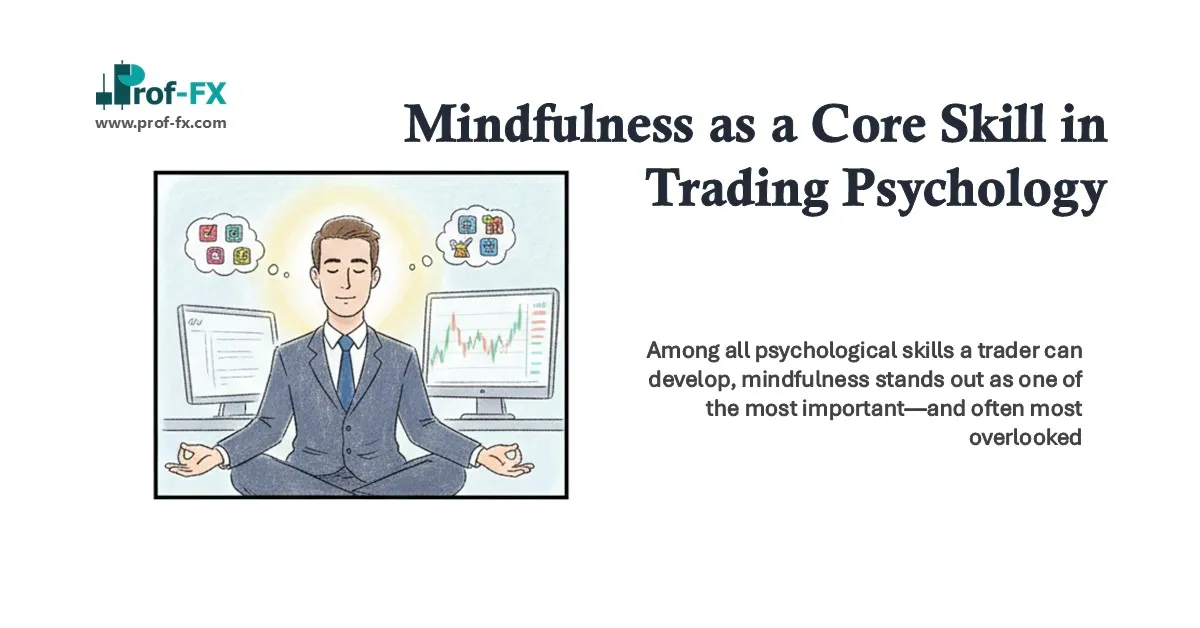
Among all psychological skills a trader can develop, mindfulness stands out as one of the most important—and often most overlooked. While many traders focus heavily on strategy, indicators, or market timing, long-term consistency is frequently determined by how well a trader manages attention, emotion, and perspective. This is precisely where mindfulness plays a critical role.
Although mindfulness originates from ancient Eastern traditions such as Buddhism and Yoga, it is not a spiritual requirement or belief system. In modern contexts, mindfulness is a practical mental skill, widely studied in neuroscience and cognitive psychology, and increasingly applied in high-performance fields—including trading.
The Scientific Research Behind Mindfulness
Recent scientific research has demonstrated that mindfulness practice can lead to measurable physical changes in the brain.
Studies examining changes in gray matter density found that individuals who practiced mindfulness for as little as 30 minutes per day over an eight-week period showed significant structural changes in key brain regions, including:
- The hippocampus, associated with learning, memory, and information retention
- The amygdala, responsible for emotional regulation, stress response, and fear processing
These findings marked the first time researchers confirmed that mindfulness practice can directly influence brain structure. From a trading perspective, this research is especially relevant because learning, emotional control, and stress management are fundamental to consistent decision-making.
Why Mindfulness Matters for Traders
Mindfulness offers several concrete benefits that directly impact trading performance. Let’s walk through how this skill translates into better execution and psychological stability in the markets.
Improved Market Awareness and Focus
When traders are mindful, their ability to concentrate and sustain attention improves. Mindfulness strengthens cognitive functions such as pattern recognition and memory—skills essential for reading price action, identifying setups, and recalling past market behavior.
By practicing mindfulness, traders place themselves in a better position to process complex market information without becoming mentally overwhelmed.
Reduced Emotional Trading
One of the biggest challenges traders face is emotional hijacking—when fear, greed, or frustration overrides rational decision-making.
Mindfulness directly supports emotional regulation. Research shows that regular practice positively influences the brain’s emotional centers, helping traders respond rather than react. Over time, mindfulness acts as a buffer against impulsive actions such as revenge trading, panic exits, or chasing price.
For traders striving for consistency, this emotional stability is a significant advantage.
A Clearer and More Accurate Trading Perspective
Mindfulness keeps traders anchored in the present moment. This presence reduces the influence of common psychological biases such as:
- Recency bias (“My last few trades were losers, so this one will be too.”)
- Future projection (“This trade might go against me—I should exit early.”)
When mindful, traders can recognize that these thoughts are mental noise, not objective information about a trade’s expectancy. This awareness helps traders follow their plan more consistently, avoid premature exits, and execute with greater confidence.
How to Develop a Mindfulness Practice as a Trader
Building mindfulness does not require major lifestyle changes. Like trading skills, it improves through consistent, simple practice.
Start small by setting aside 5 to 10 minutes per day, gradually increasing the duration as the habit becomes more comfortable.
A Simple Mindfulness Routine
- Sit quietly in a comfortable position
- Focus your attention on your breathing
- Notice your abdomen rising and falling
- Or feel the air moving across your nostrils
- As the mind inevitably wanders into past events or future concerns, gently return your focus to the breath
- Afterward, take note of how you feel mentally and emotionally
This practice strengthens awareness, patience, and emotional balance—qualities that directly support disciplined trading behavior.
Final Thoughts: Mindfulness as a Trading Edge
Mindfulness is not about eliminating thoughts or emotions. Instead, it is about recognizing them without being controlled by them.
For traders, this skill enhances focus, reduces emotional interference, and promotes a realistic, unbiased perspective on the market. Over time, mindfulness becomes a powerful complement to technical analysis, risk management, and strategy execution.
In an environment where uncertainty is constant, the ability to remain present and composed may be one of the most valuable edges a trader can develop.