
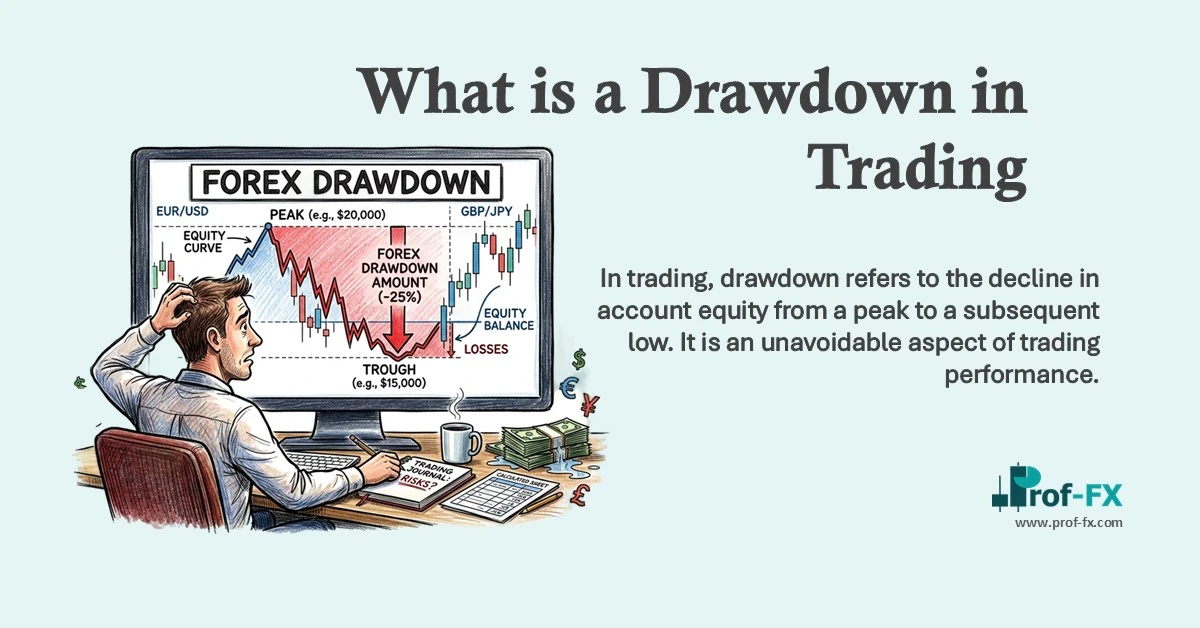
In trading, drawdown refers to the decline in account equity from a peak to a subsequent low. It is an unavoidable aspect of trading performance. Periods of loss will occur throughout any trading career, but the way these periods are managed determines whether a trader maintains long-term consistency or faces significant setbacks.
Broadly, drawdowns can be classified into two categories: normal drawdowns and problematic drawdowns.
Normal Drawdowns
Normal drawdowns are a natural consequence of market fluctuations and trading activity. They arise from changing market conditions, minor deviations from a trading plan, or a combination of both. These drawdowns are expected and should not be perceived as a threat, provided they remain controlled.
However, if not properly managed, normal drawdowns can escalate into more serious issues, impacting both trading capital and psychological stability.
To manage normal drawdowns effectively, traders must focus on process consistency, not just financial outcomes. This includes adhering strictly to a well-defined trading plan and executing trades according to predetermined rules.
The first step during a normal drawdown is to perform a self-assessment:
- Are you following your trading plan consistently?
- Are your entries, exits, and risk parameters aligned with your strategy?
If the answer is yes, then the drawdown may simply reflect unfavorable market conditions. No trading strategy performs optimally at all times; performance will vary depending on the environment.
Maintaining discipline during such periods is critical. Deviating from a proven strategy often leads to worse outcomes than the drawdown itself.
A practical adjustment is to reduce position size, even if losses are relatively small. This approach:
- Limits further drawdown
- Enhances objectivity in decision-making
- Preserves both capital and psychological confidence
Ultimately, the objective is to protect not only financial resources but also the trader’s confidence and execution quality.
Problematic Drawdowns
Problematic drawdowns are more severe and typically result from breakdowns in discipline, risk management, or decision-making. While they can occur, they should be infrequent and must never be allowed to escalate into catastrophic losses.
Despite their intensity, problematic drawdowns can be resolved effectively with a structured approach.
The immediate priority is to eliminate further losses:
- Close all open positions
- Stop trading temporarily
This action alone reduces stress and prevents additional damage, allowing for a more rational evaluation of the situation.
Taking time away from the market is often necessary. Although counterintuitive for competitive individuals, stepping back provides:
- Emotional recovery
- Objective perspective
- Improved analytical clarity
Identifying the Root Cause
The next step is to diagnose the underlying issues. Problematic drawdowns are rarely caused by a single factor; they often result from multiple compounding mistakes.
Common causes include:
- Poor risk management (e.g., risking too much per trade, ignoring stop loss levels)
- Overtrading or excessive trade frequency
- Impulsive execution without valid setups
- Inconsistent adherence to a trading plan
Among these, risk management failures are often the primary driver. Effective trading begins and ends with strict control over risk exposure.
Implementing Corrective Measures
Once the issues are identified, solutions must be applied systematically, not all at once. Attempting to fix multiple problems simultaneously can lead to confusion and further losses.
A practical method to improve discipline is to use a trade checklist, where every trade must meet predefined criteria before execution. This ensures that only high-quality setups are taken and reduces impulsive decisions.
Other contributing factors, including personal or external influences, should also be considered if they affect performance.
Returning to the Market
After implementing corrective measures, traders should resume trading gradually:
- Start with significantly reduced position sizes (e.g., 25–50% of normal)
- Focus on executing high-quality trades
- Prioritize consistency over profit recovery
The primary goal at this stage is to rebuild confidence and execution discipline. Attempting to recover losses quickly often leads to further drawdowns and reinforces negative trading behavior.
Summary
- Losses are an inherent part of trading and must be accepted
- Distinguish between normal and problematic drawdowns
- During normal drawdowns:
- Maintain discipline
- Follow your trading plan
- Consider reducing position size
- During problematic drawdowns:
- Stop trading immediately
- Reassess and identify root causes
- Implement corrective measures
- Return gradually with reduced risk
- Prevent severe drawdowns through proactive planning and strict risk management controls (e.g., predefined limits or “circuit breakers”)
Conclusion
Drawdowns are not a sign of failure but a structural element of trading. What defines a successful trader is not the absence of losses, but the ability to manage and recover from them effectively.
By maintaining discipline, applying structured risk management, and responding appropriately to different types of drawdowns, traders can protect their capital, preserve confidence, and sustain long-term performance in the forex market.