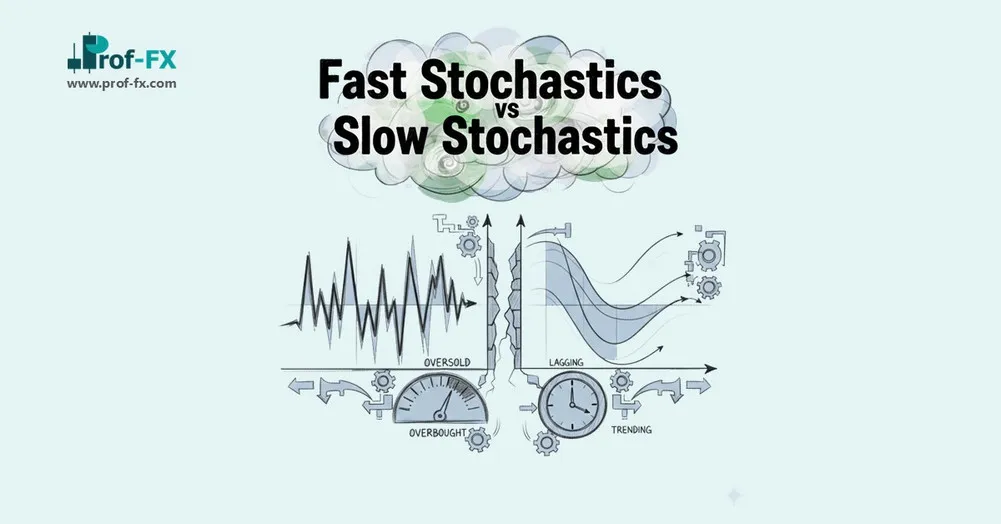
How Stochastic Settings Reveal Market Momentum, Trend Alignment, and Entry Timing for Forex Traders
Introduction — Why Forex Traders Must Understand Stochastics
The Stochastic Oscillator is one of the most frequently used technical indicators in Forex trading. Yet, during many of our educational sessions at Prof FX, traders consistently ask the same question:
“What’s the actual difference between Fast Stochastics and Slow Stochastics?”
Understanding how each version behaves is essential for selecting the right tool for your trading style—whether you’re a short-term intraday trader or a swing trader following daily trends.
To illustrate the distinctions, let’s examine a daily chart of USD/CHF, which includes both Slow and Fast Stochastics plotted together.
Visual Comparison — Slow Stochastics vs. Fast Stochastics on USD/CHF
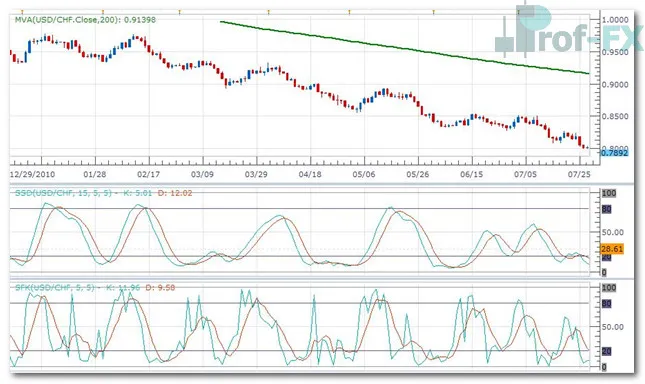
In this example:
- Slow Stochastics is displayed on the top panel
- Fast Stochastics is displayed on the bottom panel
Both indicators measure momentum and provide signals using the same baseline rules. However, their sensitivity to price movements varies significantly.
Core Trading Rules — Identical but Interpreted Differently
Although the formulas differ in how they smooth data, the interpretation rules remain consistent:
- When Stochastics crosses above 80 and then closes back below 80, it signals weakening momentum — a potential bearish reversal.
- When Stochastics crosses below 20 and then closes back above 20, it reflects strengthening momentum — a potential bullish reversal.
These signals are momentum-based, not trend predictors. Stochastics helps confirm when momentum aligns with the broader market structure, not where the long-term trend is heading by itself.
Why Slow Stochastics Is Preferred for Trend Traders
Slow Stochastics is generally recommended for most Forex traders because it:
- Applies smoothing to reduce noise
- Produces clearer, more readable signals
- Responds less dramatically to minor fluctuations
- Helps avoid overtrading caused by rapid oscillations
Because Slow Stochastics reacts more gradually, it becomes a more reliable companion for analyzing trend direction on higher timeframes such as the Daily chart.
This makes it an especially suitable tool for swing trading, position trading, and systematic trend-following strategies.
Why Fast Stochastics Appeals to Short-Term Traders
Fast Stochastics reacts sharply to price movements. Its sensitivity offers advantages for:
- Scalpers
- Intraday momentum traders
- Traders who require faster oscillation signals
- Strategies that rely on short-term volatility
However, this speed comes at a cost. Fast Stochastics can:
- Generate more false signals
- Overreact to small candles
- Create whipsaw entries in choppy markets
Because of this high responsiveness, beginner traders often find Fast Stochastics harder to interpret accurately.
Stochastics Does Not Predict Trends — It Measures Momentum
This is a critical concept that many traders misunderstand:
Stochastics does not determine the trend. It reveals momentum inside the trend.
The indicator simply measures where price is trading relative to its recent range.
Therefore, the professional approach is:
- Identify the dominant trend using higher timeframes (e.g., Daily chart).
- Use Slow or Fast Stochastics as a timing tool to enter trades in the direction of that trend.
Practical Application — Using Stochastics to Time a Trend-Based Entry
Assume the USD/CHF Daily trend is bearish, as reflected on the chart.
A well-structured trading plan would work like this:
- Confirm the overall trend is down
- Wait for Stochastics to rise above 80 (overbought in a downtrend)
- Enter a short position once Stochastics closes back below 80
This technique allows traders to enter during temporary pullbacks and capture momentum as it resumes in the direction of the prevailing trend.
It is a classic trend-following entry approach — combining market structure with oscillator timing.
Final Thoughts — Choosing the Right Stochastic Type for Your Strategy
Both Fast and Slow Stochastics serve the same purpose: identifying shifts in momentum.
The difference lies in their responsiveness:
- Slow Stochastics → smoother, more reliable, better for trend trading
- Fast Stochastics → highly sensitive, better suited for short-term traders
Regardless of which version you choose, remember:
- Stochastics should complement a clear trend analysis
- Momentum signals work best when aligned with broader market bias
- Using Stochastics alone will not predict trends, but it can greatly improve entry timing
By integrating Stochastics into a disciplined, trend-focused strategy, traders can enhance timing precision, reduce emotional decision-making, and improve long-term consistency.