Consistency is one of the most underestimated yet powerful elements in successful forex trading. Many traders spend years searching for the perfect trading system – one that captures every pip and never experiences drawdowns. In reality, such a system does not exist.
Professional traders understand that consistent execution of a simple, repeatable approach will always outperform an inconsistent attempt to chase perfection. In this guide, I will walk you through why consistency matters more than having a flawless strategy, and how traders can build consistency across analysis, execution, and risk management.
Why Consistency Matters More Than a Perfect Strategy
In forex trading, consistency refers to the trader’s ability to apply the same principles, rules, and risk parameters repeatedly over time. This disciplined repetition reduces emotional interference and prevents destructive behaviors such as over-trading or impulsive decision-making.
Markets are probabilistic by nature. No strategy wins all the time. However, traders who follow a consistent methodology allow probability to work in their favor over a large sample of trades.
Key characteristics of consistent trading include:
- Adhering to a defined trading strategy
- Using the same analytical framework
- Avoiding over-trading and under-trading
- Applying structured risk management
- Reviewing and tracking performance objectively
Consistency acts as a psychological anchor. When traders deviate from their rules, emotions such as fear, greed, and impatience take control—often leading to unpredictable results.
How Strategy Changes Create Inconsistency
To illustrate this, consider two technical approaches applied to the same market.
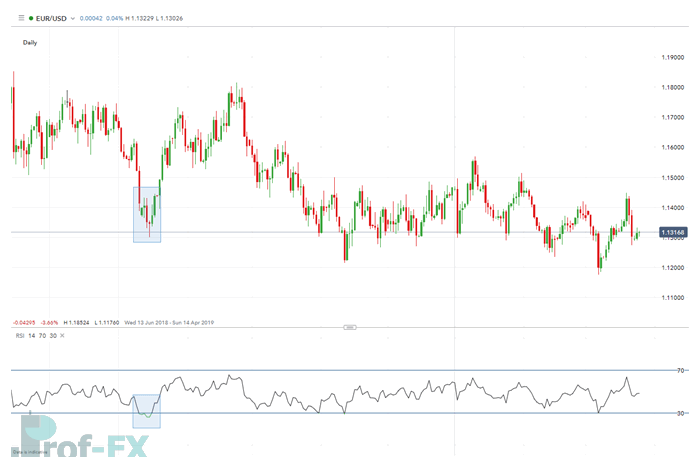
- Chart One uses the RSI (Relative Strength Index) to time entries and exits within a trending market.
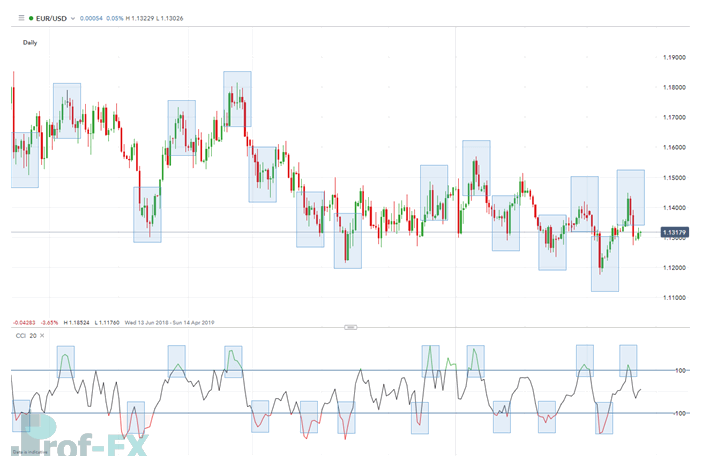
- Chart Two uses the CCI (Commodity Channel Index) for the same purpose.
While both are valid momentum oscillators, the frequency of signals differs significantly. The CCI often generates more overbought and oversold readings, which can increase trade frequency and emotional pressure if not planned for properly.
This example highlights a critical lesson: even small changes in indicators can drastically alter trading behavior. If traders frequently switch tools or rules, results will naturally become inconsistent.
Daily EUR/USD with RSI Indicator
Daily EUR/USD with CCI Indicator
How to Build a Consistent Trading Approach
Consistency is not accidental—it is designed. Below are four foundational pillars that experienced traders rely on to maintain stable performance.
1. Create and Follow a Trading Plan
A trading plan provides structure and accountability. While traders cannot control market outcomes, they can control how they analyze price, enter trades, and manage risk.
A minimalist analytical approach often works best. Using too many indicators or conflicting methodologies can lead to analysis paralysis. There is no universally “correct” way to analyze markets—what matters is committing to one approach and applying it consistently.
2. Execute Trades the Same Way Every Time
Once a trading opportunity has been identified, execution becomes the deciding factor between consistency and randomness. Many traders underestimate this phase, assuming that a good analysis alone is enough. In reality, inconsistent execution can neutralize even the most well-researched trading strategy.
Trade execution must follow a repeatable, rule-based process. This means that once a trader defines how entries are triggered, that process should be applied the same way across all market conditions.
Consider a common scenario: breakout trading.
Some traders choose to:
- Enter immediately when price breaks above or below a key support or resistance level.
- Wait for a candlestick close beyond the level to confirm the breakout.
- Use a hybrid confirmation, such as a break followed by a pullback or an indicator-based confirmation.
All three approaches are valid. The problem arises when a trader switches between them emotionally, rather than methodically.
For example, entering immediately during one trade but waiting for confirmation on the next—simply because the last trade failed—introduces inconsistency. Over time, this behavior distorts performance statistics and makes it impossible to accurately assess whether the strategy actually has an edge.
Professional traders understand that execution rules exist to remove emotion from the decision-making process. Whether the breakout turns into a winning or losing trade is secondary. What matters is that the trade was executed exactly according to plan.
Consistent execution also improves:
- Risk control, as stop-loss placement becomes standardized
- Trade expectancy, since outcomes are measured over a large sample size
- Psychological stability, because decisions are no longer reactive
From a practical standpoint, traders should define execution criteria in advance, such as:
- Exact entry trigger (price level, candle close, or retest)
- Timeframe used for confirmation
- Maximum acceptable slippage
- Stop-loss and take-profit placement rules
Once these rules are set, the trader’s job is not to predict the market—but to execute the plan with discipline. Over time, this consistency allows probabilities to unfold naturally and reveals whether the strategy is truly effective.
In forex trading, how you enter a trade is often more important than why. Consistent execution transforms a strategy from a theoretical idea into a measurable, repeatable process capable of delivering long-term results.
3. Apply Risk Management With Discipline
Risk management is the cornerstone of long-term survival in forex trading. Many traders fail not because their strategy is poor, but because their risk per trade is inconsistent.
Forex trading is a game of probabilities:
Win Rate × Risk-to-Reward Ratio = Expectancy
If risk varies from trade to trade, expectancy becomes meaningless. For example:
- +2% gain
- -4% loss
- +1% gain
Despite winning more trades than losing, the outcome is negative. Professional traders maintain fixed risk parameters, typically risking 1–2% per trade, while ensuring favorable risk-to-reward ratios.
4. Maintain a Trading Journal
A trading journal transforms trading from guesswork into data-driven improvement. By documenting entries, exits, emotions, and rationale, traders can objectively assess whether they are following their plan.
Regular review helps identify:
- Emotional decision-making
- Deviations from strategy
- Strengths and weaknesses in execution
Journaling reinforces accountability and long-term consistency.
Choosing a Consistent Forex Trading Strategy
Consistency begins with selecting a strategy that aligns with:
- Available time
- Risk tolerance
- Personality and discipline
Forex traders typically gravitate toward technical analysis, fundamental analysis, or a combination of both. Regardless of the approach, success depends on applying it the same way across market conditions.
Understanding how to combine technical structure with macroeconomic context can further strengthen consistency in decision-making.
Final Thoughts: Consistency Is the Real Edge
There are many advantages to consistent trading:
- It reduces emotional interference
- It stabilizes performance
- It allows probabilities to play out over time
This is why many professional and institutional traders focus less on finding new strategies and more on executing the same strategy well.
Look for clarity, simplicity, and repeatability. The market rewards discipline—not perfection.
Prof FX provides forex news and technical analysis on the trends that influence the global currency markets.