The Piercing Line pattern is a classic bullish reversal candlestick formation that frequently appears in the forex market, particularly after sustained downside pressure. When interpreted correctly, this pattern can provide traders with early insight into a potential shift in market sentiment – from selling pressure to emerging buying interest.
However, like all candlestick patterns, the Piercing Line should never be traded in isolation. Professional traders always combine it with price action analysis, trend confirmation, and supporting technical indicators to increase reliability and manage risk effectively.
In this article, I will explain the Piercing Line pattern in a clear, practical way, as if presenting it directly to beginner forex traders.
This guide will cover:
- What the Piercing Line pattern is
- How to identify the Piercing Line on forex charts
- Practical tips and strategies for trading the pattern
- How reliable the Piercing Line pattern is in real market conditions
What Is the Piercing Line Pattern?
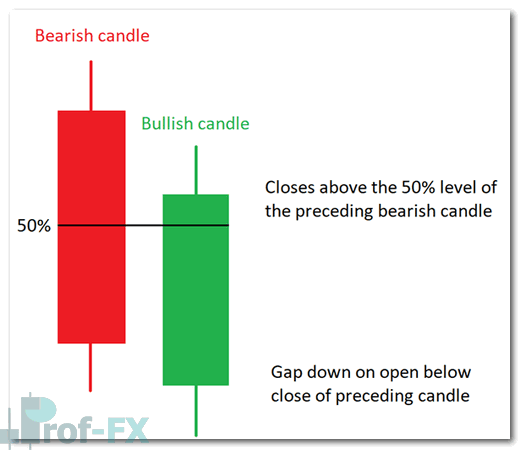
The Piercing Line pattern is a bullish reversal candlestick pattern that forms at the bottom of a downtrend. Its appearance suggests that selling pressure is weakening and that buyers (bulls) are beginning to regain control of the market.
This pattern consists of two candlesticks:
- The first candle is bearish, reflecting strong selling momentum.
- The second candle is bullish, opening below the close of the first candle and then closing above the 50% midpoint of the bearish candle’s body.
This price behavior indicates a decisive shift in sentiment, where buyers not only absorb selling pressure but also push price significantly higher within the same period.
The structure of the Piercing Line pattern is illustrated below:
How to Identify a Piercing Line Pattern on Forex Charts
Correct identification is essential, as not every two-candle formation qualifies as a Piercing Line. Traders should focus on both structure and market context.
Key Characteristics of a Piercing Line Pattern
A valid Piercing Line pattern typically:
- Occurs at the bottom of a downtrend
- Consists of one bearish candle followed by one bullish candle
- Shows the bullish candle opening below the close of the bearish candle
- Closes above 50% of the bearish candle’s body, but not above its high
What This Pattern Tells Traders
From a market psychology perspective, the Piercing Line pattern suggests:
- A potential bullish reversal
- Sellers are losing momentum at a key price level
- Buyers are stepping in with enough strength to reclaim a meaningful portion of lost ground
This shift often marks the early stages of a trend change, particularly when it occurs near support levels or after extended selling pressure.
Why Traders Use the Piercing Line Pattern
The Piercing Line pattern is favored by many traders because it is:
- Relatively easy to identify, even for beginners
- Often associated with favorable risk-to-reward opportunities
- Capable of offering well-defined entry and stop-loss levels once confirmed
That said, confirmation is critical before committing capital.
Trading the Piercing Line Pattern: Practical Tips and Strategy
To illustrate how professional traders approach this pattern, let’s examine the example below.

The weekly EUR/USD chart shows a Piercing Line pattern highlighted in blue. Prior to the pattern, price was clearly in a downtrend, defined by lower highs and lower lows.
In this example, the downtrend is identified using price action, though many traders prefer additional confirmation through a long-term moving average, where price transitioning above the moving average reinforces the bullish bias.
Because the Piercing Line pattern alone is not sufficient, further confirmation is required. In this case, the RSI (Relative Strength Index) provides that confirmation by signaling oversold conditions, strengthening the case for a bullish reversal.
Risk Management and Trade Planning
- Stop-loss placement is typically set below the recent swing low, often the low of the bullish piercing candle.
- Take-profit levels can be identified using Fibonacci extensions, prior resistance levels, or broader price action targets.
This structured approach helps traders control downside risk while allowing upside potential to develop naturally.
How Reliable Is the Piercing Line Pattern?
The Piercing Line pattern is a useful reversal signal, but its reliability depends heavily on context. Trading this pattern against a strong, dominant trend without confirmation can expose traders to unnecessary risk.
Professional traders improve reliability by ensuring:
- The broader trend is weakening
- The pattern forms at a key technical level
- Additional confirmation tools align with the setup
The Piercing Line works best when treated as a warning signal, not a standalone trade trigger.
Advantages and Limitations of the Piercing Line Pattern
Like all technical patterns, the Piercing Line has both strengths and weaknesses.
Advantages
- Appears frequently across financial markets
- Easy to identify for novice traders
- Can offer attractive risk-reward opportunities
- Provides clear structural clues about market sentiment
Limitations
- Signals bullish reversals only
- Requires confirmation from indicators or price structure
- Must be evaluated within the context of the broader market trend
- Less effective in strong, uninterrupted trends
Continue Learning Candlestick Trading
To build a stronger foundation in candlestick analysis, traders are encouraged to explore additional chart patterns such as:
- Rising wedge and falling wedge patterns
- Head and shoulders formations
- Double top and double bottom structures
A solid understanding of how to read candlestick charts will significantly improve pattern recognition and decision-making.
When combined with trend analysis, momentum indicators, and disciplined risk management, the Piercing Line pattern can become a valuable tool in a trader’s forex strategy.