
Woodies Pivot Points offer a practical and dynamic way to identify short-term support and resistance levels, making them especially popular among intraday and day traders. While they belong to the broader family of pivot point indicators, Woodies pivots place greater emphasis on recent price data, which can make them more responsive to current market conditions.
At first glance, Woodies Pivot Points may look similar to classical or Camarilla pivots. However, understanding the subtle calculation differences and trading logic behind them is essential if traders want to develop a consistent edge.
In this article, I will explain Woodies Pivot Points in a clear, structured way—presenting the concept as I would to beginner forex traders who are learning how to frame intraday price action professionally.
This guide covers:
- What Woodies Pivot Points are
- How Woodies Pivot Points are calculated
- How traders apply Woodies Pivot Points in real market conditions
- Advantages and limitations of the Woodies Pivot Point approach
What Are Woodies Pivot Points?
Woodies Pivot Points are a set of predefined price levels calculated using previous market data. These levels help traders anticipate where price may find support or resistance during the current trading session.
The structure typically includes:
- A central pivot point
- Multiple resistance levels (R1, R2, R3)
- Multiple support levels (S1, S2, S3)
Traders use these levels as reference zones rather than exact turning points. When price approaches a Woodies pivot level, traders observe price behavior to decide whether the market is likely to bounce, consolidate, or break through.
Typical layout of Woodies Pivot Points on a forex chart:
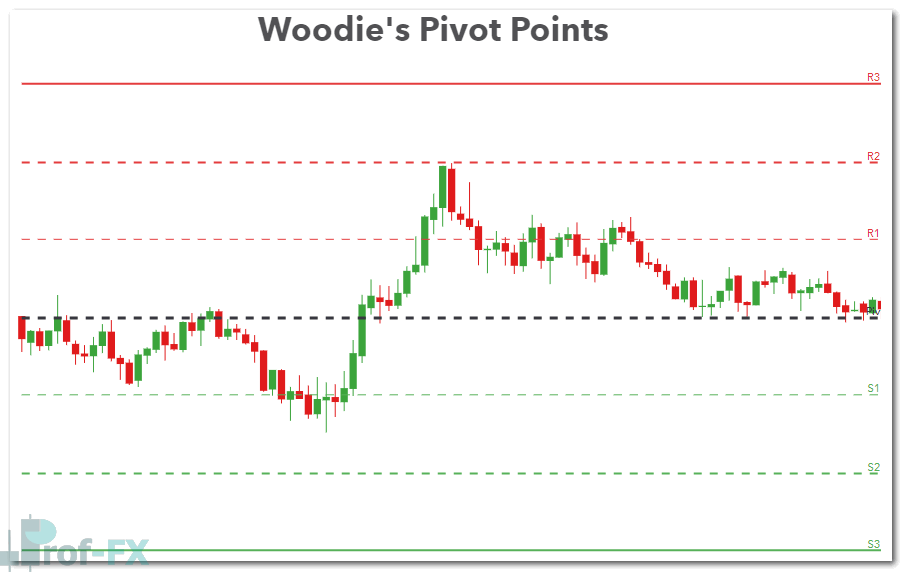
This framework allows traders to approach the market with a predefined plan instead of reacting emotionally to price fluctuations.
How to Calculate Woodies Pivot Points
At first, the calculation of Woodies Pivot Points may appear complex. In reality, it is straightforward once the logic is understood.
The key difference between Woodies pivots and other pivot variations is that more weight is placed on the previous closing price. This reflects the belief that the close better represents the true market consensus, while intraday highs and lows may be driven by short-term emotion.
Woodies Pivot Formula
Pivot Point
(Previous High + Previous Low + 2 × Previous Close) ÷ 4
Directional Bias Based on Pivot Location
When price trades above the pivot, traders generally maintain a bullish bias.
When price trades below the pivot, traders generally maintain a bearish bias.
Support and Resistance Levels
- R1 = (2 × Pivot) – Previous Low
- R2 = Pivot + High – Low
- R3 = High + 2 × (Pivot – Low)
- S1 = (2 × Pivot) – Previous High
- S2 = Pivot – (R1 – S1)
- S3 = Low – 2 × (High – Pivot)
From a conceptual standpoint, Woodies pivots behave similarly to an Exponential Moving Average (EMA). Both indicators emphasize recent price action, making them more responsive than indicators like the Simple Moving Average (SMA).
This responsiveness makes Woodies Pivot Points particularly suitable for fast-moving intraday markets.
How to Trade with Woodies Pivot Points
Woodies Pivot Point strategies are typically short-term in nature. Traders commonly use:
- Daily pivot levels
- Lower timeframes, such as 5-minute or 15-minute charts
The daily pivot acts as a market compass, while lower timeframes are used for precise entries, exits, and risk management.
Intraday Range Trading with Woodies Pivot Points
In many intraday sessions, price tends to oscillate between Woodies pivot levels rather than trend aggressively. This creates tradable ranges that skilled traders can exploit.
In the EUR/USD example below, price repeatedly reacts around S1, S2, R1, and the central pivot.
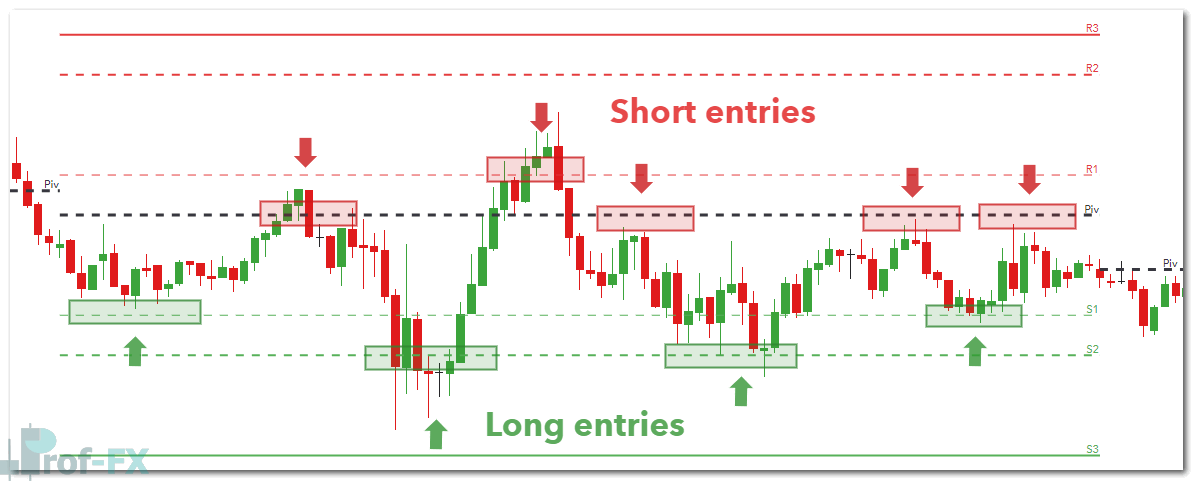
For long trades, traders often look for price to bounce from S1 or S2, targeting the central pivot as a logical take-profit level. Stop-loss orders are typically placed below the next lower support.
For short trades, traders may sell near R1 or the pivot, targeting S1 or S2, with stops placed above the next resistance.
However, since price started the session below the pivot, a bearish bias is maintained. While both long and short trades may be possible, short positions generally offer a higher probability of success unless price proves otherwise.
Momentum Breakout Strategy Using Woodies Pivot Points
While range trading is common, Woodies Pivot Points are also effective during high-momentum breakout scenarios.
In the GBP/NZD chart below, price breaks out of its typical intraday range with strong momentum, confirmed by expansion in the MACD histogram.
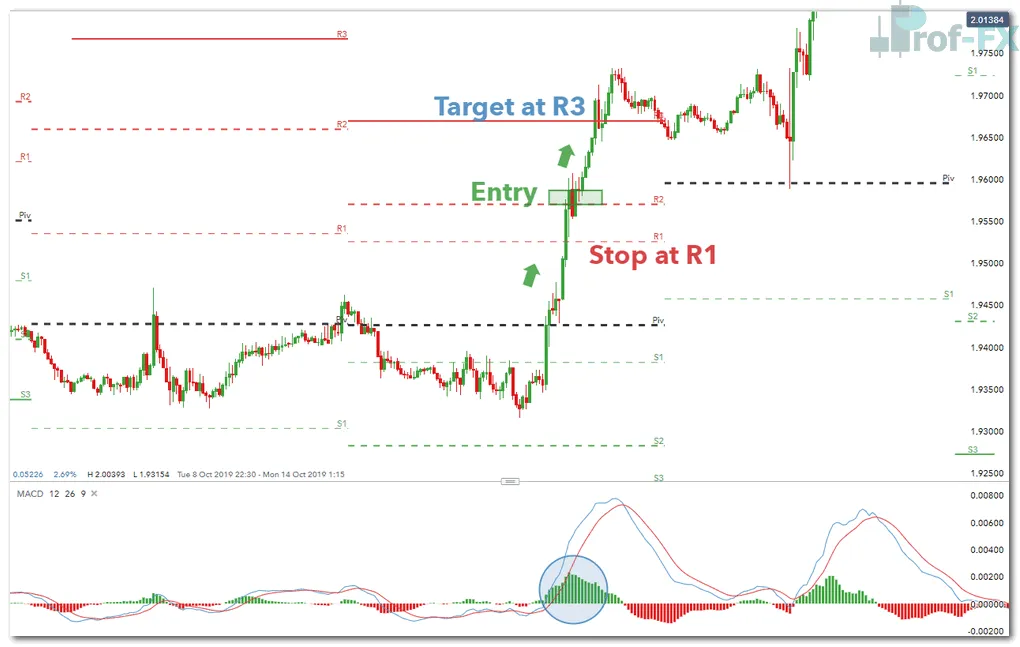
Initially, price traded below the pivot. After a sharp bullish move, traders monitor whether price respects R1. If price fails at R1, a mean-reversion trade back toward the pivot may be considered.
However, once price breaks cleanly above R1, bearish bias is invalidated. Traders then shift focus to bullish continuation setups.
A conservative long entry may occur:
- Just above R2
- With a stop-loss placed near R1
- And a take-profit target near R3, ensuring a favorable risk-to-reward ratio
This structured approach prevents emotional decision-making during fast market conditions.
Advantages and Limitations of Woodies Pivot Points
Like all technical tools, Woodies Pivot Points have both strengths and weaknesses that traders must understand.
Advantages
Woodies Pivot Points place greater importance on recent price action, making them more adaptive to current market conditions. They are particularly beneficial for short-term and intraday traders and help improve risk management by providing predefined stop and target zones.
Limitations
Woodies pivots may be less suitable for long-term traders, as they are designed for short time horizons. Additionally, novice traders may initially feel overwhelmed by the multiple formulas and horizontal levels displayed on the chart.
Further Learning on Pivot Points
Pivot points remain a cornerstone of technical analysis because they are rooted in the universal concept of support and resistance. To deepen your understanding, consider exploring:
- Comprehensive pivot point strategies for forex traders
- Differences between Woodies, Camarilla, and Classical pivot points
- How support and resistance guide market behavior
When applied with discipline and proper market context, Woodies Pivot Points can become a powerful framework for structuring intraday forex trades.