Key Points: Why Every Trader Needs a Trading Journal
- What is a trading journal?
- Why trading journals matter for long-term performance
- How to build an effective trading journal step-by-step
- Downloadable trading journal template
What Is a Trading Journal in Forex and Financial Markets?
A trading journal is a structured log used to record every trade you make. Professional traders rely on trading journals to evaluate past decisions, identify behavioral patterns, and measure the effectiveness of their trading plan. Keeping an organized journal helps you understand where improvements are needed – whether in strategy, risk management, or trader psychology.
Why Trading Journals Are a Core Tool for Consistent Traders
Here are the primary reasons every trader—from beginner to expert—should maintain a journal:
- Identify strengths and weaknesses in your trading style.
- Improve trading consistency through data-backed decisions.
- Hold yourself accountable to your trading plan.
- Determine which strategies deliver the best long-term performance.
Maintaining a journal is one of the simplest yet most powerful ways to refine your trading plan—a framework of rules covering strategy, risk parameters, and psychological discipline.
How to Create an Effective Trading Journal
Building a trading journal is straightforward, and you can customize it based on your trading goals, markets traded (e.g., forex, commodities, indices), and preferred trading strategies. Below are the core steps:
- Choose between a notebook or spreadsheet (a spreadsheet is highly recommended).
- Define what data to record (date, instrument, position size, strategy, etc.).
- Record every trade immediately after placing your stop-loss and take-profit.
- Review and analyze your journal weekly or monthly.
Step 1: Spreadsheet vs. Notebook
A spreadsheet is recommended because it allows for advanced analytics—such as calculating win rate, expectancy, average risk-reward ratio, and conviction-based performance.
Step 2: Select the Data Points to Record
The basic structure of a trading journal typically includes:
| Currency Pair | Size | Long/Short | Date | Conviction | Strategy Used | Points | Successful? |
| USD/JPY | 1 lot | Long | 30 Jan 19 | High | Fundamentals | 100 | Successful |
This basic template is helpful, but adding more fields will make your journal far more powerful and insightful.
Reason for Trade: Document whether your trade is based on technical analysis, fundamental analysis, or a hybrid approach. This helps evaluate which methodology yields better long-term performance.
Conviction: Conviction reflects how confident you are in the trade. A “high” conviction trade typically meets multiple criteria from your trading strategy. Over time, you can analyze your results and determine whether only high-conviction trades produce the best outcomes.
Other Notes: This is flexible—many traders record emotional state, market conditions, volatility level, or macroeconomic catalysts (e.g., NFP, CPI, central bank decisions).
Step 3: Record Each Trade Immediately
Enter your trade details right after placing your stop-loss and take-profit. This ensures accuracy and prevents emotional bias when documenting your trade rationale.
Step 4: Review, Compile, and Analyze Your Trades
After accumulating enough data—ideally over several weeks or months—review your journal. If you include a conviction field, evaluate your performance by conviction level.
Example: If 8 out of 10 high-conviction trades are winners, you have an 80% historical success rate for that category. If low-conviction trades only win 20% of the time, the data clearly suggests you should avoid them.
This type of analysis strengthens your discipline and helps refine your trading system.
Trading Journal Template (Spreadsheet Example)
Below is a sample trading journal template that includes strategy types, psychological notes, and conviction tracking.
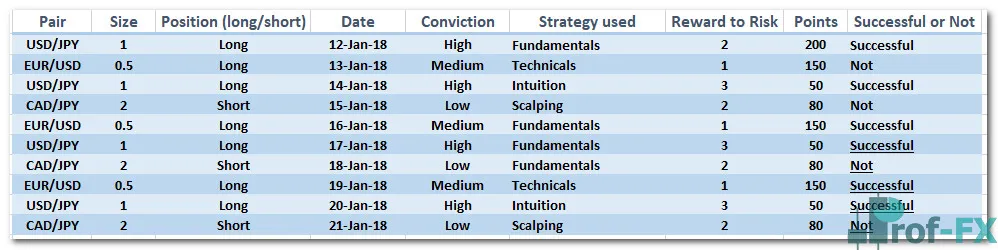
This structured table illustrates how you could organize trading data efficiently. You can download a complete version of this template on page five of our free building confidence in trading guide.
Trading Journals: Final Summary
A trading journal is one of the most important tools for any trader learning to trade or seeking consistent performance. Journals allow traders to test different trading strategies, refine their trading plan, and clearly identify strengths and weaknesses.
To summarize:
- A trading journal records all your trading activity.
- It helps traders evaluate and improve multiple strategies.
- It highlights patterns in performance and trader psychology.
For further insights, read our research-based study on the Number One Mistake Traders Make, based on thousands of live trades.
If you trade forex actively, explore our detailed guide on maintaining a forex trading journal tailored specifically to currency trading strategies.