The CBOE Volatility Index (VIX) is arguably the best gauge of risk and sentiment available to the investing public; it can be used effectively by any trader in the Forex market. The VIX is often nicknamed the “fear index,” which is actually somewhat misleading, since it doesn’t directly measure fear of any kind. The VIX is actually a measure of traders’ expectations about volatility in the S&P 500. It is charted like an index, and the higher it goes, the higher traders’ expectations for short-term market volatility are.
The VIX rises with higher market volatility because it measures the prices of the out-of-the-money S&P 500 index options. If option sellers think that volatility is going to increase in the near term, they will require larger premiums from option buyers. This increase in option prices is used in the calculation of the VIX index. Conversely, if they think that volatility is going to drop, option sellers will reduce their premiums to attract buyers. Falling option prices will be reflected in a falling VIX index.
The VIX tracks these changes in investor sentiment and option premiums in real time on each trading day. The VIX reading is an annualized number of how much traders think the S&P 500 will move during the next 30 days. If the VIX has a reading of 30, or 30 percent, it means that traders think the S&P 500 is likely to move about 2.5 percent (30 percent/12 months = 2.5 percent) during the next month.
Traders’ expectations as shown on the VIX are directionless. In the previous example, we can recognize that traders are expecting a 2.5 percent move in one direction or the other, but not specifically whether it will be up or down. However, because unexpected market volatility is biased to the downside, a rising VIX is usually associated with bearish expectations. Remember that the market doesn’t crash up, it only crashes down.
This means that if traders are expecting a lot of volatility, this is generally a bearish sign. That is one of the reasons that the VIX is often called a measure of fear. If investors are concerned that volatility is increasing, the VIX will rise. Conversely, if investors are expecting low volatility, the VIX will drop, which is considered to be a bullish sign. This rule is generally true, but you will see exceptions to it on a day-to-day basis.
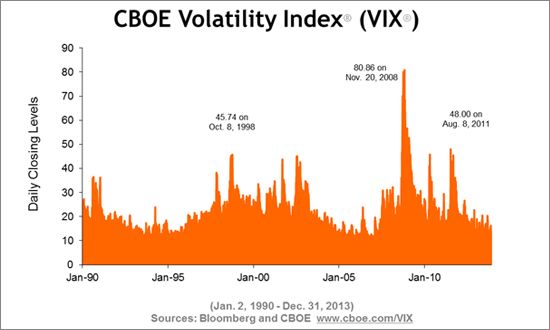
The implications here are obvious. If the VIX is falling, investors are trading bullish strategies and taking on more risk. If the VIX is rising, traders may be shorting the market and trying to limit risk within their portfolio. Because the VIX is typically range bound, traders are particularly interested in periods when the index is hitting support or resistance levels.
How bearish or bullish traders feel based on the VIX is important because it indicates what is going on with their attitudes toward risk. Recently, increases in investor fear have been associated with falling stocks, rising bonds, and a stronger dollar. The opposite is also true.
The VIX can be used as an analytical tool to identify entry and exit opportunities or periods when market risk is likely to be higher or lower. This information is especially useful because it is not just another iteration of a price-and-time study but is derived from investor expectations for near-term volatility.
So what should you be watching for when you analyze the VIX? You should be looking for the following:
- When the VIX starts to rise, look for safe-haven currencies to appreciate in value.
- When the VIX starts to fall, look for riskier, higher-yielding currencies to appreciate in value.