Introduction: What Are Commodities and Why They Matter in Global Markets
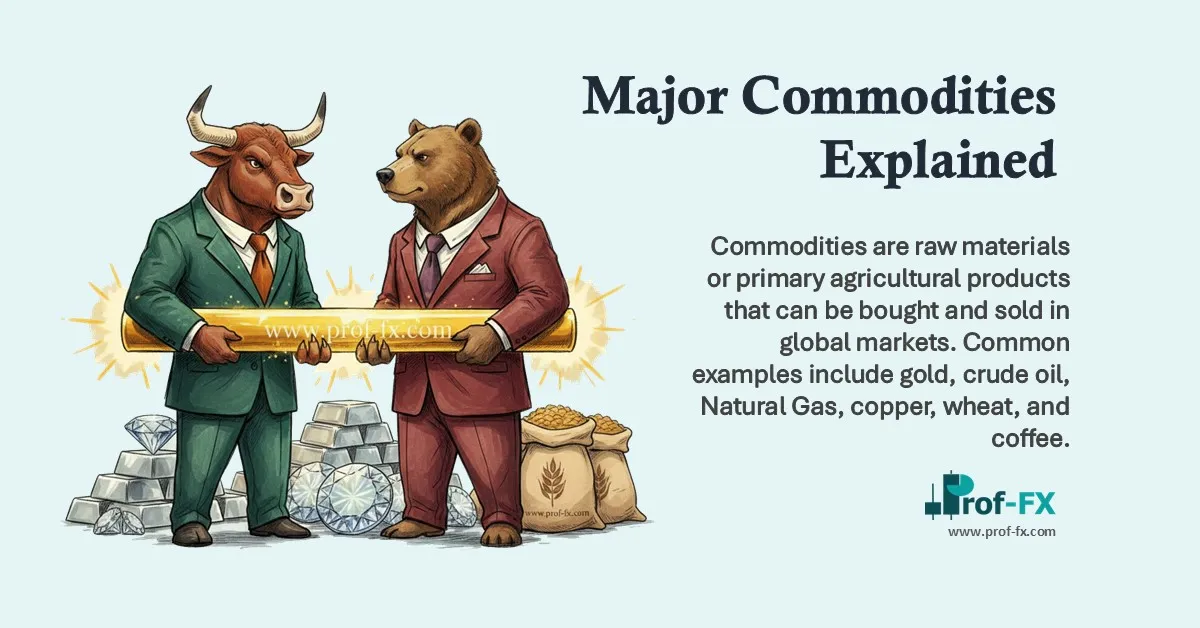
Commodities are raw materials or primary agricultural products that can be bought and sold in global markets. Common examples include gold, crude oil, Natural Gas, copper, wheat, and coffee. From energy production to food supply and industrial manufacturing, commodities play a critical role in everyday life, impacting billions of people worldwide.
Price fluctuations in commodities influence:
- Inflation levels
- Economic growth
- Currency strength
- Global trade flows
For traders, these price movements create unique opportunities driven by supply, demand, geopolitics, and macroeconomic trends.
How Commodities Are Traded
There are two primary ways traders gain exposure to commodity markets:
1. Trading Through Exchanges
This involves buying and selling commodities directly via regulated exchanges such as:
- CME Group
- ICE (Intercontinental Exchange)
This method is commonly used by producers, consumers, and institutional participants.
2. Trading Commodities via Derivatives
Retail traders typically access commodities through derivatives (where permitted), including:
- CFDs (Contracts for Difference)
- Binary options
- Spread betting
Derivative trading allows traders to speculate on price movements without owning the physical commodity, making it more accessible and flexible.
Most Liquid Commodity Markets
Liquidity is a key factor for traders, as it affects:
- Spread size
- Execution quality
- Slippage risk
Highly Liquid Commodities in the US
- WTI Crude Oil
- Brent Crude
- Natural Gas
- RBOB Gasoline
- Soft commodities such as sugar and wheat
Globally Traded Commodities by Volume
- Steel
- Aluminum
- Iron ore
These markets attract traders due to their tight spreads, high volume, and strong volatility characteristics.
What Commodities Can Be Traded?
Commodities are commonly grouped by type and usage, helping traders understand market behavior.
Hard vs Soft Commodities
- Hard commodities: Extracted or mined (gold, oil, Natural Gas)
- Soft commodities: Grown or farmed (coffee, wheat, cotton)
Commodity Categories
“gambarprof”
| Energy Commodities | Metal Commodities | Agriculture Commodities | Other Commodities |
| Brent Crude | Copper | Coffee | Ethanol |
| WTI Crude | Gold | Cotton | Polypropylene |
| Natural Gas | Silver | Wheat | Wool |
| Heating Oil | Platinum | Maize | |
| Propane | Palladium | Rice | |
| Uranium | Sugar Cane |
This classification helps traders align strategies with market fundamentals and seasonality.
What Are the Most Traded Commodities?
By global trading volume, the most actively traded commodities include:
- Gold
- Silver
- WTI Crude Oil
- Brent Crude
- Copper
- Natural Gas
Soft commodities such as coffee, sugar, and wheat are also popular due to their volatility.
Gold: The Ultimate Safe-Haven Asset
For thousands of years, gold has been regarded as a store of value.
Why Traders Trade Gold
- Acts as a safe-haven asset
- Performs well during:
- Political instability
- Economic uncertainty
- Inflationary periods
- Often shows an inverse relationship with the US Dollar
Gold is closely monitored alongside:
- Central bank policy
- Interest rates
- Inflation expectations
Silver: A Hybrid Industrial and Monetary Metal
Silver is used in:
- Jewelry
- Electronics
- Industrial manufacturing
Key Trading Characteristics
- Strong liquidity
- Sensitive to supply and demand
- Often used as an inflation hedge
- Inversely correlated with the US Dollar
Silver tends to be more volatile than gold, making it attractive to active traders.
Crude Oil: The Most Influential Energy Commodity
Crude oil is a naturally occurring fossil fuel refined into products such as:
- Gasoline
- Diesel
- Jet fuel
- Heating oil
Why Traders Focus on Crude Oil
- High volatility
- Strong reaction to:
- OPEC decisions
- Geopolitical tensions
- Inventory data
- Ideal for day traders and swing traders
Oil prices influence inflation, currencies, and global economic stability.
Copper: A Barometer of Global Economic Health
Copper is widely used in:
- Construction
- Electrical wiring
- Manufacturing
- Renewable energy infrastructure
Because supply is relatively abundant, copper prices are driven mainly by industrial demand, making it a strong indicator of:
- Economic growth
- GDP trends
- Infrastructure investment
Natural Gas: A Volatile Clean Energy Commodity
Natural Gas is a fossil fuel formed over millions of years and is increasingly important as a transition energy source.
Why Traders Trade Natural Gas
- Strong seasonal demand
- High volatility
- Influenced by:
- Weather conditions
- Storage reports
- Energy policy
Its price behavior offers opportunities but requires disciplined risk management.
Coffee: One of the Most Volatile Soft Commodities
Coffee belongs to the soft commodities group alongside cocoa and sugar.
What Drives Coffee Prices
- Weather patterns in producing countries
- Agricultural yield
- Political and economic conditions in emerging markets
Demand remains high in Western economies, making coffee highly volatile and attractive to experienced traders.
What Is Commodity Trading?
Commodity trading refers to:
- Buying and selling physical commodities via exchanges
- Speculating on price movements using derivatives
Liquidity Considerations
Not all commodities are equally tradeable:
- Low liquidity: Orange juice, oats, feeder cattle
- High liquidity: Natural Gas, crude oil, corn
Liquidity directly affects execution quality and risk exposure.
What Moves Prices in Commodity Markets?
Supply and Demand: The Core Driver of Commodity Price Movements
At the most fundamental level, commodity prices are driven by supply and demand dynamics. When demand for a commodity exceeds available supply, prices tend to rise. Conversely, when supply outpaces demand, prices generally fall.
Unlike equities or cryptocurrencies, commodities are physical assets, meaning their availability is constrained by:
- Natural resources
- Production capacity
- Transportation and storage
This makes commodity markets particularly sensitive to imbalances, where even small disruptions can result in sharp and sometimes sudden price movements.
Seasonality: A Critical Factor in Agricultural Commodities
Seasonality plays a major role in agricultural commodities such as:
- Wheat
- Corn
- Coffee
- Sugar
Crop cycles, weather patterns, and harvest seasons directly affect supply levels.
Real Case Example: Coffee Prices and Weather Risk
Coffee production is heavily concentrated in countries like Brazil and Vietnam. In recent years, unexpected frosts and droughts in Brazil significantly reduced coffee output. As a result:
- Global supply tightened
- Prices surged sharply in a short period
For traders, this highlights why agricultural commodities can be highly volatile and why monitoring weather forecasts and harvest reports is essential.
Production Costs: How Expenses Influence Commodity Prices
Production costs—including:
- Energy costs
- Labor
- Transportation
- Environmental regulations
have a direct impact on commodity supply.
When production becomes more expensive, producers may reduce output, tightening supply and pushing prices higher.
Real Case Example: Energy Prices and Mining Costs
Rising oil and electricity prices have increased production costs for mining metals such as copper and aluminum. In some cases, higher costs forced producers to:
- Scale back operations
- Delay new projects
This reduction in output contributed to price increases, particularly during periods of strong industrial demand.
Technological Advancements: Expanding or Restricting Supply
Technology can either increase or disrupt supply, depending on how it is applied.
- Improved extraction methods can boost production
- Automation can lower costs
- New technologies can unlock previously inaccessible resources
Real Case Example: US Shale Oil Revolution
Advancements in hydraulic fracturing and horizontal drilling dramatically increased crude oil production in the United States. This led to:
- A surge in global oil supply
- Periods of oversupply
- Sustained downward pressure on oil prices
For traders, this case demonstrates how technological innovation can reshape entire commodity markets over the long term.
Market Competition: The Impact of New and Existing Producers
Supply dynamics are also influenced by the competitive landscape:
- New producers entering the market can increase supply
- Existing producers exiting the market can tighten supply
Real Case Example: OPEC and Oil Supply Management
In the crude oil market, OPEC and its allies (OPEC+) actively manage supply by:
- Increasing output to stabilize prices
- Cutting production to support prices during downturns
OPEC production decisions often lead to immediate market reactions, making oil prices highly sensitive to policy announcements.
Supply Imbalances: Shortages and Oversupply
When supply and demand fall out of balance, markets react quickly.
Shortage Scenario
- Demand exceeds supply
- Prices rise rapidly
- Volatility increases
Oversupply Scenario
- Supply exceeds demand
- Prices decline
- Producers may cut output
Real Case Example: Natural Gas Supply Shocks
Natural Gas prices have historically reacted strongly to:
- Cold winters increasing heating demand
- Low storage levels
- Supply disruptions
During extreme weather events, shortages have caused sharp price spikes, especially in regional markets.
Why Supply and Demand Matter for Beginner Traders
For traders new to commodities, understanding supply and demand provides:
- A logical framework for price movement
- Context for sudden volatility
- Better timing around news and data releases
Rather than memorizing indicators alone, beginners benefit from asking:
Is supply tightening, or is demand weakening?
This mindset helps traders avoid emotional decisions and trade with market fundamentals, not against them.
Macroeconomic Performance: How the Economy Shapes Commodity Prices
Macroeconomic performance refers to the overall health of an economy, usually measured through indicators such as:
- GDP growth
- Industrial production
- Employment levels
- Consumer spending
- Inflation
Because commodities are core inputs for manufacturing, construction, energy production, and food supply, changes in economic conditions have a direct impact on commodity demand.
Weak Economic Conditions: Reduced Demand for Commodities
When an economy slows down or enters a recession:
- Consumer spending declines
- Manufacturing activity contracts
- Infrastructure and construction projects are delayed
As a result, demand for commodities falls, especially for:
- Industrial metals (copper, aluminum, steel)
- Energy commodities (crude oil, Natural Gas)
Real Case Example: Global Slowdown and Copper Prices
Copper is often referred to as “Dr. Copper” because of its ability to signal economic health. During periods of global economic slowdown, such as trade tensions or recession fears:
- Factory output decreases
- Demand for electrical wiring, machinery, and construction materials falls
- Copper prices tend to weaken
Traders closely watch copper because falling prices often reflect declining industrial activity.
Strong Economic Growth: Increased Commodity Consumption
In a strong economy:
- Businesses expand production
- Governments invest in infrastructure
- Consumers spend more
This leads to higher consumption of raw materials, pushing commodity prices upward.
Real Case Example: Post-Recovery Growth and Oil Demand
During periods of economic recovery:
- Transportation activity increases
- Air travel and logistics expand
- Energy demand rises
Crude oil prices often strengthen during these phases because oil is essential for:
- Transportation fuel
- Manufacturing
- Global trade
For traders, rising oil prices often signal stronger global demand expectations.
GDP Growth: A Key Indicator for Commodity Traders
Gross Domestic Product (GDP) measures the total economic output of a country. Rising GDP usually implies:
- Increased industrial activity
- Higher commodity consumption
Falling GDP growth can indicate:
- Lower demand
- Excess supply
- Potential downward pressure on prices
Example in Practice
- Strong GDP data from major economies (such as the US or China) often supports prices of industrial commodities
- Weak GDP figures may trigger sell-offs in metals and energy markets
Industrial Output: Direct Link to Commodity Demand
Industrial production data tracks output from factories, mines, and utilities. This data is particularly important for commodities like:
- Copper
- Aluminum
- Iron ore
- Crude oil
When industrial output rises:
- Factories consume more energy
- Demand for metals increases
When output contracts:
- Energy usage declines
- Raw material demand softens
Real Case Example: China’s Industrial Activity
China is the world’s largest consumer of many commodities. When Chinese industrial data shows:
- Expansion → commodity prices often rise
- Contraction → commodity prices often weaken
This is why commodity traders closely monitor Chinese economic releases.
Inflation and Interest Rates: Secondary Macroeconomic Effects
Macroeconomic performance also affects:
- Inflation levels
- Central bank interest rate decisions
High inflation can:
- Increase commodity prices as input costs rise
- Drive investors toward commodities as inflation hedges
Rising interest rates, however:
- Can slow economic growth
- Reduce borrowing and consumption
- Eventually weaken commodity demand
Why Macroeconomic Performance Matters for Beginner Traders
For beginners, macroeconomic analysis helps:
- Understand why prices move, not just how
- Avoid trading against major economic trends
- Align trades with broader market direction
Instead of reacting only to price charts, beginner traders should ask:
Is the economy expanding or contracting? This simple question provides powerful context when trading commodities.
Political and Geopolitical Events: A Major Price Driver in Commodity Markets
Political and geopolitical events are among the most powerful catalysts in commodity markets. Unlike technical factors, political developments can trigger sudden and aggressive price movements because they directly affect:
- Supply chains
- Production capacity
- Trade flows
- Market sentiment
For commodity traders, understanding political risk is essential because commodities are often strategic assets tied to national interests.
Government Policies and Their Direct Impact on Commodity Prices
Government decisions can quickly alter supply-demand dynamics through regulation and policy changes. The most influential policy tools include:
Import and Export Restrictions
Governments may restrict imports or exports to protect domestic industries or secure national supply.
- Export bans reduce global supply, often pushing prices higher
- Import restrictions increase costs for buyers, leading to higher domestic prices
Real Case Example: Agricultural Export Bans
Several countries have imposed grain export restrictions during food shortages. When a major exporter limits supply:
- Global prices spike
- Import-dependent countries face higher costs
- Volatility increases across agricultural markets
Sanctions and Embargoes
Sanctions limit or completely block a country’s ability to sell commodities on global markets.
- Reduced supply increases global prices
- Traders price in uncertainty and risk premiums
Real Case Example: Energy Sanctions
Sanctions on major oil- or gas-producing nations often lead to:
- Supply disruptions
- Higher crude oil and Natural Gas prices
- Increased volatility in energy markets
For traders, sanctions are often bullish catalysts for prices due to sudden supply constraints.
Trade Wars and Tariffs
Trade wars involve the use of tariffs and counter-tariffs between countries, impacting commodity flows.
- Tariffs raise costs for importers
- Demand may shift to alternative suppliers
- Price inefficiencies emerge across markets
Real Case Example: Trade Disputes and Metals
During periods of trade tension:
- Industrial metals may weaken due to reduced global manufacturing
- Agricultural commodities may experience price swings as trade routes change
Trade wars often create medium-term trends rather than short-term spikes.
Geopolitical Tensions and Supply Disruptions
Geopolitical events such as:
- Armed conflicts
- Military escalations
- Political instability
can disrupt commodity production and transportation routes.
Key Areas of Risk
- Oil-producing regions
- Major shipping lanes
- Border regions with infrastructure assets
Real Case Example: Middle East Tensions and Oil Prices
The Middle East plays a critical role in global oil supply. When tensions escalate:
- Traders price in the risk of supply disruptions
- Crude oil prices often rise even without actual supply cuts
This is known as a geopolitical risk premium.
Import Duties and Price Inflation: A Practical Example
When a government increases import duties on crude oil:
- Importers pay higher costs
- Domestic fuel prices rise
- Demand may temporarily decline, but supply constraints keep prices elevated
For traders, tariff changes often lead to:
- Short-term volatility
- Medium-term price revaluation
Why Political Events Matter for Beginner Traders
For beginner traders, political factors explain why markets sometimes move without technical signals.
Political events tend to:
- Override technical patterns
- Create breakout conditions
- Increase volatility unexpectedly
A simple rule for beginners:
When political risk rises, expect volatility—and trade smaller.
How Traders Can Monitor Political Risk
Beginner traders should:
- Follow global news related to energy, metals, and agriculture
- Track policy announcements from major economies
- Monitor regions critical to commodity supply
Combining political awareness with technical analysis allows traders to:
- Avoid being caught off-guard
- Trade with broader market context
- Manage risk more effectively
Market Psychology and Trader Behavior
Because traders analyze similar charts and indicators:
- Herd behavior can amplify price movements
- Technical breakouts often trigger strong reactions
Why Trade Commodities?
Safe-Haven Opportunities: Why Traders Turn to Commodities During Market Stress
Certain commodities—most notably gold—are widely regarded as safe-haven assets. This means they tend to retain their value or even appreciate during periods of economic uncertainty, financial crises, or geopolitical tension.
When markets experience stress due to factors such as:
- Economic recessions
- High inflation
- Central bank policy uncertainty
- Geopolitical conflicts
investors often reduce exposure to riskier assets like equities and seek capital preservation. Gold, in particular, benefits from this behavior due to:
- Its long-standing role as a store of value
- Limited supply relative to fiat currencies
- Its tendency to move independently of stock markets
For beginner traders, understanding safe-haven behavior is important because it explains why gold prices often rise when fear dominates financial markets. This characteristic makes gold not only a trading instrument, but also a risk-management tool within a broader portfolio.
Profit Potential: How Volatility Creates Trading Opportunities
One of the main attractions of commodity markets is their high volatility, especially in highly liquid instruments such as:
- Crude oil
- Natural Gas
- Gold
- Silver
Volatility refers to the speed and magnitude of price movements. In commodity markets, prices can react sharply to:
- Inventory reports
- Weather conditions
- Supply disruptions
- Political and economic announcements
For traders, these rapid price movements create short- and medium-term trading opportunities, particularly for:
- Day traders
- Swing traders
However, for beginner traders, it is important to recognize that volatility cuts both ways. While it can amplify profits, it can also magnify losses. This is why successful commodity trading always involves:
- Clear entry and exit rules
- Defined stop-loss levels
- A positive risk-to-reward ratio
When approached with discipline, volatility becomes an advantage rather than a threat.
Portfolio Diversification: Reducing Risk Through Commodity Exposure
Commodities play a valuable role in portfolio diversification because they often exhibit low or negative correlation with traditional financial assets such as:
- Stocks
- Bonds
This means that when equity markets decline, certain commodities—particularly precious metals and energy products—may remain stable or even increase in value.
For example:
- Gold may rise during equity market sell-offs
- Energy commodities may benefit from supply constraints or rising demand, even when stock markets struggle
From a beginner’s perspective, diversification is not about trading more instruments—it is about reducing overall risk. Including commodities in a trading or investment portfolio can:
- Smooth equity drawdowns
- Improve risk-adjusted returns
- Reduce emotional pressure during market volatility
By understanding how commodities behave differently from equities and bonds, traders can make more balanced and resilient trading decisions.
Practical Tips for Beginner Commodity Traders
- Follow commodity news and analysis
- Always define a risk-reward ratio (minimum positive ratio recommended)
- Monitor the economic calendar
- Continuously develop skills through education and webinars
- Practice strong risk management and discipline
Commodity Trading Hours
| Commodity | Open–Close (ET) | Break (ET) | Open–Close (GMT) | Break (GMT) |
| Gold | 18:00–17:00 Sun–Fri | 17:00–18:00 | 23:00–22:00 | 22:00–23:00 |
| Silver | 18:00–17:00 Sun–Fri | 17:00–18:00 | 23:00–22:00 | 22:00–23:00 |
| US Crude Oil | 18:00–17:00 Sun–Fri | 17:00–18:00 | 23:00–22:00 | 22:00–23:00 |
| Brent Crude | 18:00–17:00 Sun–Fri | 17:00–18:00 | 23:00–22:00 | 22:00–23:00 |
| Copper | 18:00–17:00 Sun–Fri | 17:00–18:00 | 23:00–22:00 | 22:00–23:00 |
| Natural Gas | 18:00–17:00 Sun–Fri | 17:00–18:00 | 23:00–22:00 | 22:00–23:00 |
Final Thoughts
Commodity trading offers diversification, volatility, and macro-driven opportunities that complement forex and equity markets. For beginner traders, understanding what drives commodity prices is far more important than frequent trading.
Prof FX provides forex and commodity market analysis, helping traders understand the trends shaping global financial markets.