
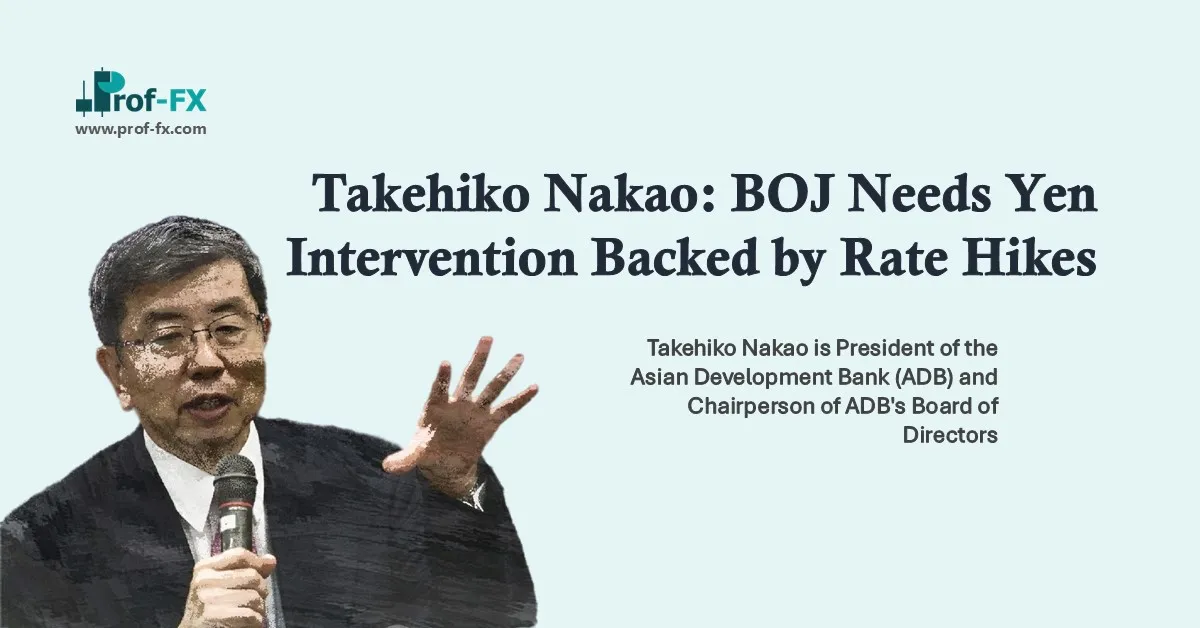
TOKYO – A former Japanese Ministry of Finance official said that foreign exchange intervention by the Bank of Japan (BOJ) using foreign reserves can deliver an immediate impact on markets, but its effectiveness would be more sustainable if accompanied by gradual interest rate increases.
Quoted by Reuters, the remarks were made by Takehiko Nakao, who served as Japan’s Vice Finance Minister for International Affairs from 2011 to 2013, amid renewed weakness in the yen ahead of the final phase of Japan’s election campaign.
“Intervention using real funds can have a strong short-term effect. However, the impact becomes more durable if the BOJ demonstrates a clear commitment to consistently raising interest rates,” said Nakao, who is currently Chairman of the Center for International Economy and Strategy.
Last December, the BOJ raised its short-term policy rate to 0.75 percent and signalled that it would continue lifting borrowing costs. Despite this, Japan’s real interest rates remain in negative territory, as inflation has exceeded the BOJ’s 2 percent target for nearly the past four years.
According to Nakao, the yen’s weakness is primarily driven by the BOJ’s still overly accommodative monetary policy. The slow pace of rate hikes has kept the interest rate gap with the United States wide, continuing to weigh on the yen’s exchange rate.
“By responding to inflation through interest rate increases, the government also has an opportunity to curb excessive spikes in long-term government bond yields,” he added.
Nakao warned that the yen could come under renewed pressure if the BOJ does not accelerate monetary tightening. He also pointed to the nomination of Kevin Warsh as the next Federal Reserve Chair as an external factor that warrants close attention.
“Warsh is likely to adhere to the tradition dating back to former US Treasury Secretary Robert Rubin, that a strong and stable dollar is in the interest of the United States,” he said.


